Regenerative braking: what your EV really gets back, and why it still needs real brakes
Regenerative braking doesn’t charge your car. It hands back part of the energy you already spent, and it skims a fee on the way.
Every EV ad leans on it. “Recovers energy every time you brake.” “Recharges going downhill.” Watch enough commercials and you’d think the car feeds itself every time you lift your foot. The real story is better and a lot less magical. Regen exists, it works and it saves energy, but it runs into hard physical limits, it has days when it basically switches itself off, and it comes with side effects almost nobody mentions: brakes that rust before they wear out, brake lights that don’t always warn the driver behind you, and a recall that cost Toyota a very bad week back in 2010.
A motor running in reverse
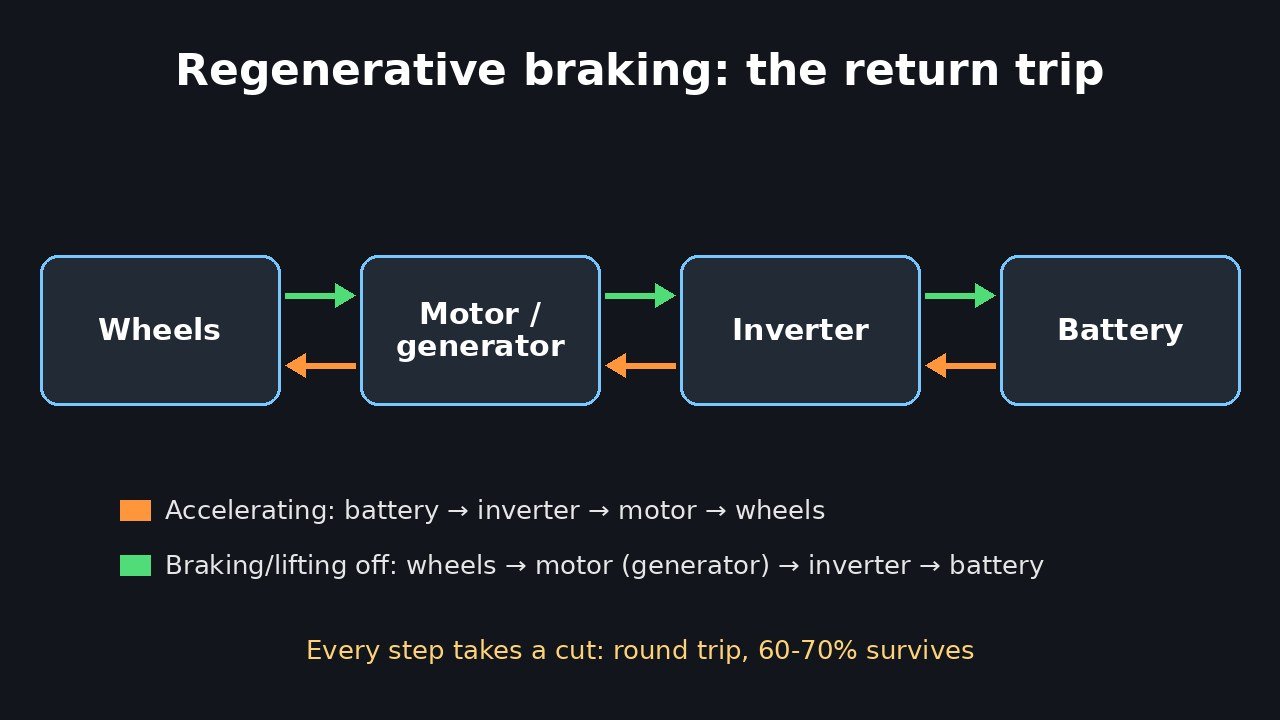
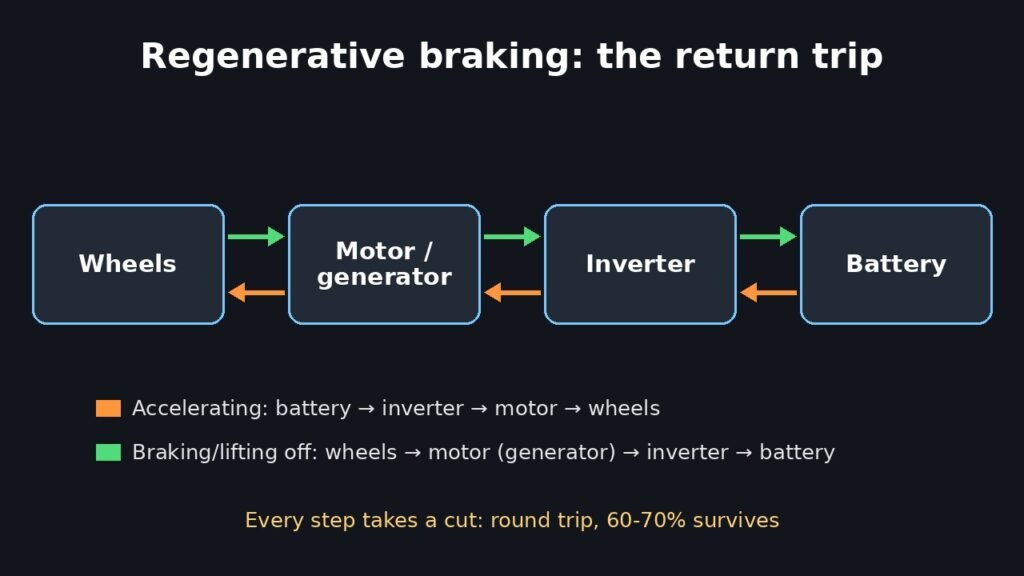
The principle is simple. An electric motor and a generator are essentially the same machine. Feed it electricity and it spins. Spin it from the outside and it produces electricity. When you accelerate an EV, the battery pushes current through the inverter into the motor and the wheels turn. When you lift off or touch the brake pedal, the roles flip: the wheels now drive the motor, the motor generates current, and the inverter converts it back so it can go into the battery.
Generating isn’t free for the car, and that’s the whole trick. Producing electricity creates a counter-torque that resists rotation. That counter-torque is what slows you down. The car stops precisely because it’s making energy. In a gas car, every bit of braking energy ends up as heat in the rotors and pads and drifts off into the air. In an EV, some of it goes back into the pack.
Note the word: some. The return trip runs through the motor, through the inverter, through the battery’s chemistry and then, when you get back on the throttle, through the inverter and the motor all over again. Every step costs something. If you read our piece on the inverter, you already know that power electronics work both ways and charge a toll in both directions.
Nothing new: a 1904 electric already had a “regen” setting
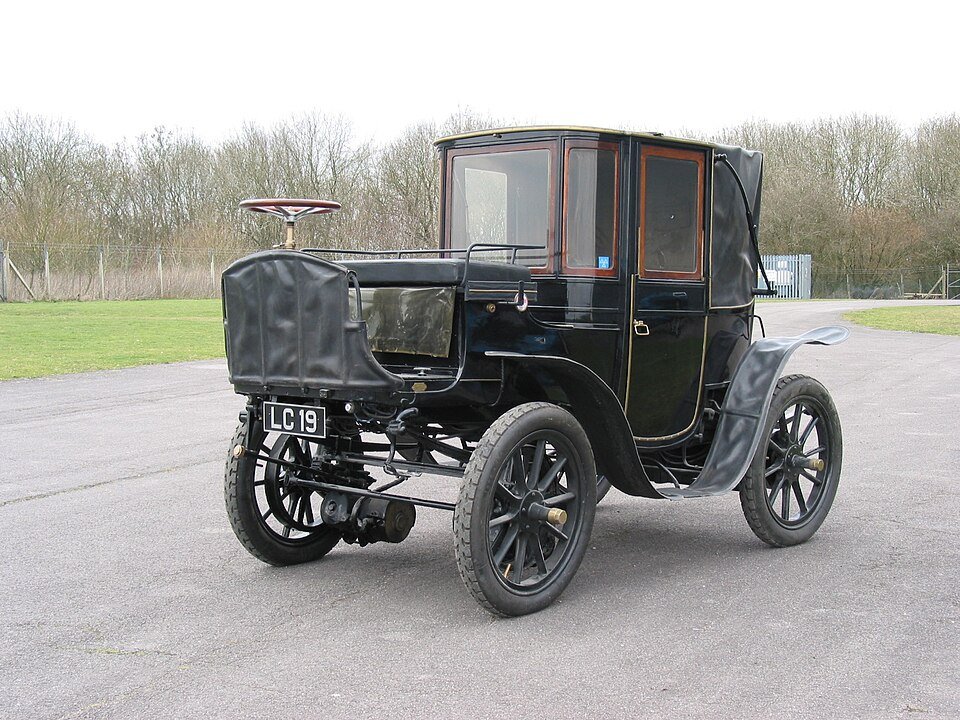
It gets marketed as cutting-edge tech, but regen is more than a century old. In 1890s Paris, Louis Antoine Kriéger started building electric cars with a motor in each front wheel. London’s Science Museum keeps a Kriéger Electric Brougham built in 1904: two Postel-Vinay motors, one per front wheel, fed by twenty cells good for roughly 50 miles of range. Its drum controller offered seven forward speeds plus coasting, reverse, emergency braking and regenerative braking positions.
Postel-Vinay, by the way, also supplied the motors for La Jamais Contente, the electric car Camille Jenatzy drove in 1899 to become the first automobile past 100 km/h. The forgotten era of the EV had already figured out what gets sold to you today as innovation.
The problem back then wasn’t the idea, it was control. In many early electrics, the same lever handled power and regen, with a separate manual switch flipping between functions. Grab the wrong notch and you were in trouble. It took modern electronics for the car to decide on its own how much braking comes from the motor and how much from the friction brakes. GM’s EV1, the car General Motors built and then sent to the crusher, was already blending regenerative and friction braking automatically in the late nineties.
The math nobody shows you
Here’s the number that wrecks half the marketing. The energy a moving car carries is far smaller than people think. A 2,200 kg EV (about 4,850 lb) at 100 km/h (about 62 mph) holds around 849 kilojoules of kinetic energy. Convert that to the unit on your power bill: 0.236 kWh. Less than a quarter of a kilowatt-hour.
And you don’t get all of it back. Industry consensus puts regen’s round-trip efficiency somewhere between 60 and 70 percent: that’s what survives turning motion into electricity, storing it, pulling it back out and turning it into motion again. Run the numbers yourself: a full stop from 62 mph gets you back about 0.15 kWh on a good day. Pocket change.
So where does the reputation come from? Two places. First, repetition: in stop-and-go traffic you brake hundreds of times, and all those nickels and dimes add up. Second, hills. The energy a car stores climbing doesn’t depend on speed, it depends on mass and height. That same 4,850 lb car coming down 1,000 meters (about 3,300 feet) of elevation has roughly 6 kWh of raw potential energy to play with, about twenty-five times what you get from that highway stop. That’s why regen shines on a mountain pass and barely registers on a flat interstate. And don’t trust the range estimate too much on a descent: the number going up doesn’t mean you recovered exactly that much energy, the computer is just recalculating off your recent consumption.
One pedal versus coasting
The industry is split down the middle here, and it’s worth knowing before you buy.
On one side, one-pedal driving. Nissan made it mainstream with the e-Pedal on the second-generation Leaf, announced in 2017. Lift off and the car slows at up to 0.2 g, comparable to pressing the brake, and once it stops the hydraulic brakes hold it in place, even on a hill. Nissan claimed at the time the pedal covered 90 percent of a driver’s needs. In traffic it’s easy, you learn it in a day, and going back feels weird.
On the other side, Porsche, which refused to put it on the Taycan or the electric Macan. Its argument is pure physics. Martin Reichenecker, senior manager of chassis testing at Porsche Engineering, says the most efficient move is to let the car roll free, because that keeps the kinetic energy in the vehicle. One-pedal driving recovers first and then turns that energy back into propulsion, and according to Porsche that means paying the losses twice.
It checks out. Lift off at 75 mph and let the car regen hard, and you’re turning motion into electricity with losses only to spend electricity with losses ten seconds later getting your speed back. Coast instead and you convert nothing. The best energy is the energy that never leaves the car.
Who’s right? In a traffic jam, Nissan. The moment the road opens up, Porsche, and it isn’t close. One pedal wins in a traffic jam, where you’re going to brake anyway. Coasting wins on an open highway, where most of that lift-off drag is wasted. What separates a good EV is letting you choose, or making the call well for you: the Taycan itself has an automatic mode that uses cameras and sensors to decide whether to coast or recover.
The front axle does the heavy lifting, even if the big motor is out back
Porsche published a technical detail that says everything about how complex this gets. When you brake, weight shifts forward, which is why every car does most of its braking up front. On the dual-motor Taycan, the front motor provides two thirds of the regenerative braking power and the rear motor one third, even though the rear motor is bigger and could theoretically recover more. Harvesting energy can’t fight braking physics or stability.
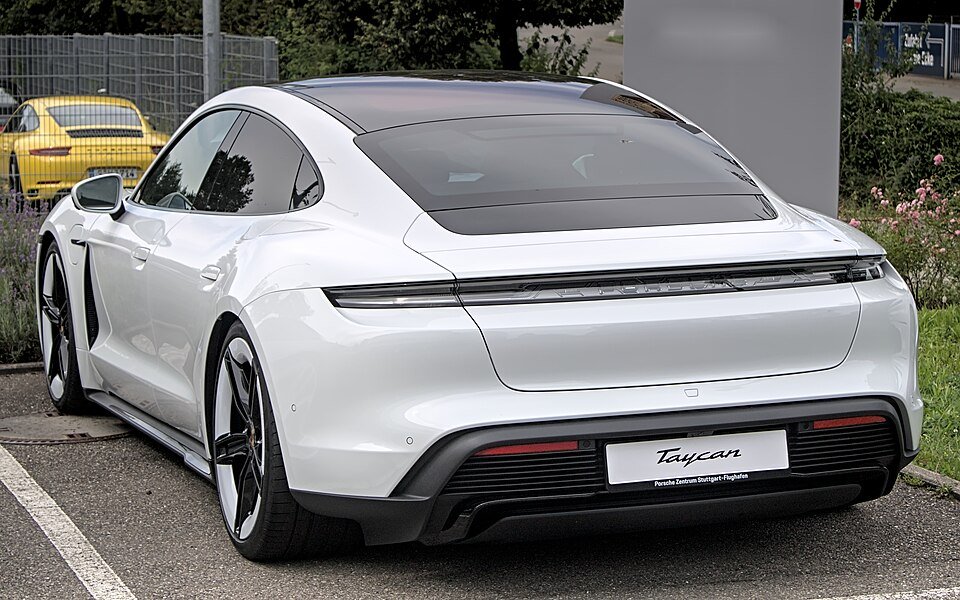
The Taycan’s numbers are among the highest on the market. The original car could regenerate up to 290 kW, and Porsche figured two seconds of deceleration at that rate was worth about 0.43 miles of range. With the update unveiled in 2024, peak recuperation went up to 400 kW, more than 30 percent higher.
Now look at the other side. Porsche engineer Ingo Albers explained that a full stop from top speed in a fully loaded Taycan demands more than two megawatts of braking capacity. Two thousand kilowatts against the 290 the motors could recover. That’s why a two-and-a-half-ton EV still rides on massive brakes: regen handles almost all of the daily work, but in the stop that saves your life, the rotors are in charge.
The days regen calls in sick
This is what surprises most new EV owners. There are situations where regen works less, or not at all.
First: a full battery. Charge to 100 percent and head downhill, and the battery has nowhere to put the energy. It’s the same thing we covered in our charging curve piece: the fuller a battery gets, the less power it accepts. Regenerating is charging, so with a full pack the car holds back less and the work falls back on the pads and rotors. If you live at the top of a hill, charging to 100 percent and starting the day on a descent is throwing energy away.
Second: cold. Lithium cells don’t like taking charge when they’re cold, and forcing it can damage them. We explained that in our thermal management and BMS piece. The system protects the battery by limiting regen until the pack warms up. On winter mornings, one-pedal driving gets lazy, and it isn’t a defect.
Regen depends on the battery, and the battery has moods. A car that brakes differently depending on charge and temperature needs a system that knows how to blend.
Blending has to be invisible
When you press the brake pedal in an EV or a hybrid, you aren’t pushing directly on the pads. You’re requesting a deceleration, and an electronic brain decides how much comes from the motor and how much from the hydraulic brakes. That mix, “brake blending” in engineering-speak, has to be seamless. The pedal must feel the same whether you’re stopping on the motor, on the rotors or on both. In the Taycan, the stability control and an electromechanical brake booster keep the pedal’s pressure point constant.
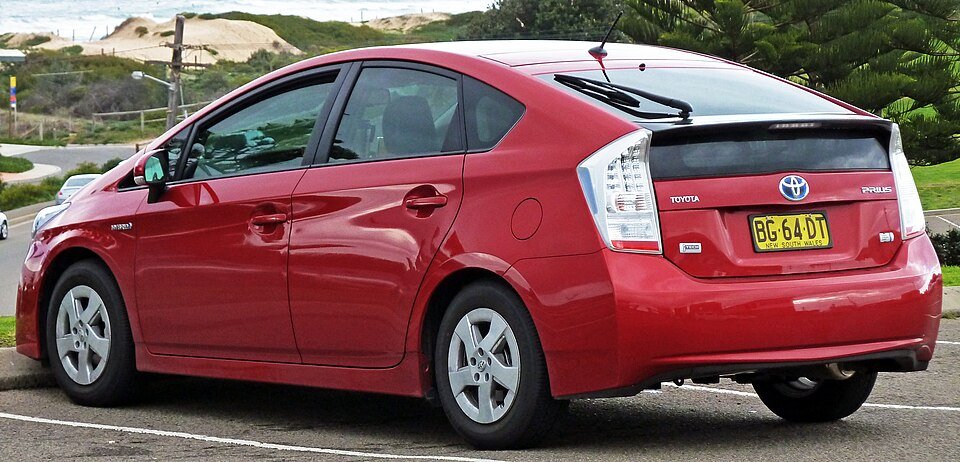
When blending goes wrong, you notice. In February 2010, Toyota recalled about 437,000 hybrids worldwide, the Prius chief among them, for an anti-lock brake software update. In the US that meant roughly 133,000 2010 Prius and 14,500 Lexus HS 250h. Owners reported inconsistent brake feel when braking lightly and steadily on bumpy or slick pavement, exactly when the car was handing off from regenerative to hydraulic braking and the ABS kicked in. Plenty of drivers experienced it as a momentary brake failure, and it landed right in the middle of Toyota’s unintended acceleration crisis. The fix was a software reflash of about 40 minutes per car. It was a warning to the whole industry: regen isn’t just a motor generating power, it’s software that has to coordinate two completely different brakes in milliseconds.
Do the brake lights come on?
Serious question, because with one-pedal driving you can slow down hard without touching the brake. If the tail lights stay dark, the driver behind you has no clue.
In Europe, the UN regulation that applies, Regulation 13-H, sets three steps for regen triggered by lifting off the accelerator. Below 0.7 meters per second squared, the brake lights must not come on. Between 0.7 and 1.3, the manufacturer may switch them on. Above 1.3, they’re mandatory. The 0.7 figure isn’t random: the automakers’ 2008 proposal treated it as representative of “natural” deceleration, the kind you get from engine braking in a gas car. Nissan’s e-Pedal, for example, lights the brake lamps once deceleration starts and keeps them on after the car stops.
Brakes that rust before they wear out
This is regen’s big paradox. You use the friction brakes so little that the problem stops being wear and becomes rust.

Rotors that rarely get hot don’t clean themselves. Moisture, road salt and disuse let them corrode (anyone who has wintered a car in the Rust Belt knows the look), especially at the rear, where an EV’s brakes barely work outside hard stops or very low speeds. Repair-shop trade magazines are already documenting seized rear calipers and badly corroded rotors on vehicles with regen.
Volkswagen made a call that got laughed at when it came out: rear drum brakes on the ID.3 and ID.4. Yes, drums, the kind you’d expect on a decades-old economy car. VW’s reasoning holds up. Disc pads tend to drag a little even when you’re not braking, which costs range; drums don’t. VW also says drums respond better after long stretches without use. Continental, which engineered the system, adds that the enclosed design protects the braking surfaces from water and salt, and that in its endurance testing on the ID.3 the linings lasted more than 300,000 kilometers, about 186,000 miles. According to the same supplier, an EV with brake-by-wire can cover up to 80 percent of everyday deceleration with regen, and up to 95 percent if every stop starts on the motor.
The NEB take: an EV’s brakes need some use to stay healthy, and a brake check is no longer about how much pad is left, it’s about whether the calipers and rotors are still alive. A brake that works a little is a win. A brake that never works is a maintenance risk the salesperson won’t bring up.
Europe is now regulating brake dust, EVs included
Across the Atlantic, regulators already factor regen into the law. The EU’s Euro 7 standard starts applying on November 29, 2026 to newly type-approved cars and vans, and from November 29, 2027 to every new car sold. For the first time, an emissions rule looks beyond the tailpipe and caps the particles coming off brakes and tires.
The brake particle limit is 3 milligrams per kilometer for battery-electric cars and 7 for most gas, hybrid and fuel cell vehicles. EVs get the tougher limit precisely because regulators assume regen does most of the work. European law already counts on your regenerative brakes. The same Euro 7 package also sets minimum durability requirements for EV and hybrid batteries.
Where regen is a monster
To see regen at full strength, look at two extremes.
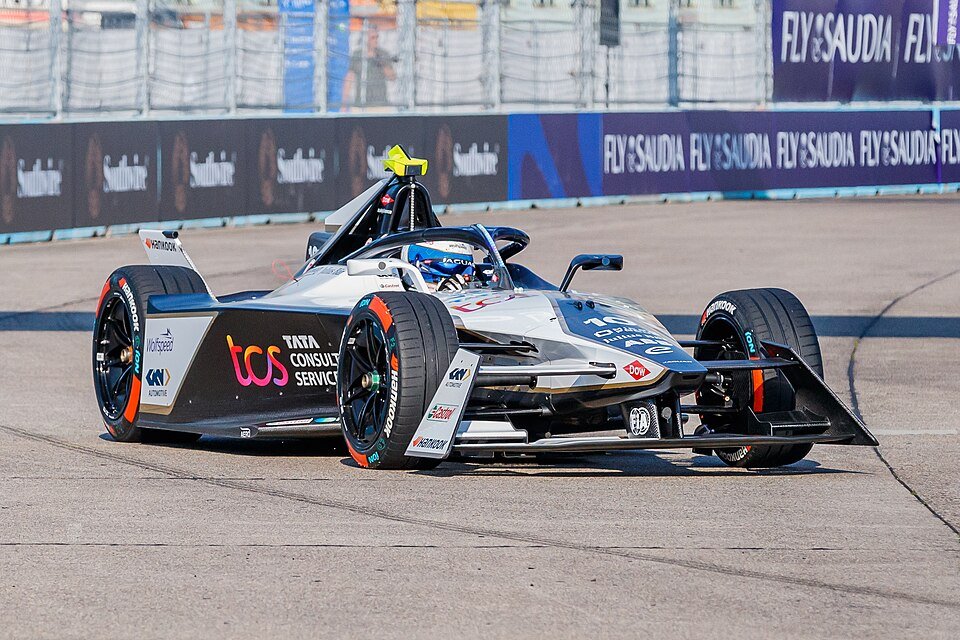
The first is Formula E. The Gen3 car, which debuted in the 2023 season, added a 250 kW front motor used only for regeneration, which together with the 350 kW rear unit gives 600 kW of recovery capacity. It’s so strong the car dropped rear hydraulic brakes altogether, the first open-wheel race car to do so, keeping friction brakes only up front. The series projected that about 40 percent of the energy used in a race would come from regen.
The second is a Swiss quarry. Near Biel, a converted Komatsu HD 605-7 called the eDumper hauls rock for a cement plant. The 45-ton truck, converted to electric by Kuhn Schweiz, carries a 700 kWh battery, the biggest ever fitted to a vehicle when it was unveiled. It climbs a 13 percent grade empty, gets loaded with 65 tons of rock, and comes back down weighing 110 tons. Descending at more than twice the weight it climbed with, it regenerates more energy than it used going up. Its maker says it produces about 200 kWh of surplus a day. Formula E champion Lucas di Grassi drove it: he reached the top at 80 percent charge and was at 88 percent by the bottom.

That truck is the best physics lesson you’ll get. It works because it goes down heavier than it goes up. Put the quarry at the bottom and the plant at the top, and it would have to plug in like everything else. Regen doesn’t create energy. It just rescues part of what gravity or your right foot already put into play.
Madrid tried charging cars off subway brakes
Spain ran a version of this back in March 2014, and hardly anyone outside Madrid noticed. Metro de Madrid opened what it called a “metrolinera” at street level next to a Citroën dealership at Sáinz de Baranda. A subway train brakes dozens of times an hour, and whatever energy another train isn’t drawing at that moment usually gets burned off in resistors. The Train2Car project grabbed it from the overhead line instead, parked it in a Siemens storage unit and fed it out through a CHAdeMO fast charger. Charging was free during the trial, through June 2014, and the whole thing cost around €2.1 million in public research money. Metro bragged that its 115 traction substations could host many more. We found no source showing the network ever grew past the pilot. The physics was never the problem: lots of mass and lots of stops is exactly where regen pays, and a subway train has both in spades.
Where NEB stands
Regenerative braking is one of the smartest ideas in the electric car, and that’s exactly why it got turned into a slogan. It won’t turn your car into a power plant. A hard stop gets you pocket change. It pays off in traffic and on long descents, it gets lazy with a full or cold battery, and in exchange it leaves you with brakes more likely to die of rust than of wear.
Few brands will say it out loud: the most efficient stop is the one you don’t make. Not even the best regen system in the world gives back what it loses along the way. Reading the road, lifting early and letting the car roll saves more than any maximum-recovery mode. Porsche knows it and puts it in writing. The brands selling one-pedal driving as if regenerating were making free energy know it too. It just doesn’t look as good in the commercial.
So, one pedal or let it roll?
Unplug and enjoy.
Images: NEB diagram · Science Museum Group (CC BY 3.0) · Alexander-93 (CC BY-SA 4.0) · OSX (public domain) · ShriniwasGajare (CC BY-SA 4.0) · Steffen Prößdorf (CC BY-SA 4.0) · Michael KR (CC BY-SA 4.0)
1 thought on “Regenerative braking: what your EV really gets back, and why it still needs real brakes”