La Jamais Contente: The First Car Over 100 km/h Ran on Batteries
The man who won the 1903 Gordon Bennett Cup in a Mercedes also raced the Vanderbilt Cup on Long Island. And before any of that, he was the first human being to go faster than 62 mph in a car. He did it in an electric.
That’s the part that never makes it into the “EVs are the future” speeches. The first automobile to pass 100 km/h, which is 62 mph, wasn’t a petrol-burner or a steam wagon. It was a battery car called La Jamais Contente, “The Never Satisfied,” and it did it on April 29, 1899, outside Paris. Its driver was Camille Jenatzy, a Belgian with a red beard. Its speed was 105.88 km/h, or 65.8 mph.
Let’s go through how a farm road northwest of Paris ended up in the history books, and why the people who tell this story usually skip the best bits.
Thirty-four seconds
That’s the whole record. A timed kilometer, flying start, and a clock that read 34 seconds when the car crossed the line. Divide 3,600 seconds by 34 and you get 105.88 km/h. Almost 30 meters, or about 96 feet, every second.
A flying kilometer means the car is already at speed when it enters the measured stretch. Nobody times the launch. The clock starts when the car is moving flat out and stops 1,000 meters later. It’s the purest speed test there is: no tricks with traction, no excuses about the start. You either go through that line fast or you don’t.
The number everyone repeats is the 100 km/h barrier. The interesting number is the one before it. The very first land speed record on the books, set on December 18, 1898, took 57 seconds over the same distance, which works out to 63 km/h, about 39 mph. Four months and eleven days later, Jenatzy did it in 34. That’s 23 seconds off, and a speed 68 percent higher than the first record, on the same ground.
A count and a rubber heir
The record didn’t start with Jenatzy. It started with a French nobleman. On December 18, 1898, Count Gaston de Chasseloup-Laubat took a Jeantaud electric car out to Achères, a farm park northwest of Paris, in a trial organized by the magazine La France Automobile, and posted the first land speed record in history. It was electric. That’s worth saying twice. The Jeantaud came from Charles Jeantaud, a French carriage maker who had been building electric vehicles since 1881, which means Jeantaud had been in the electric business for 17 years by the time his car took that first record.
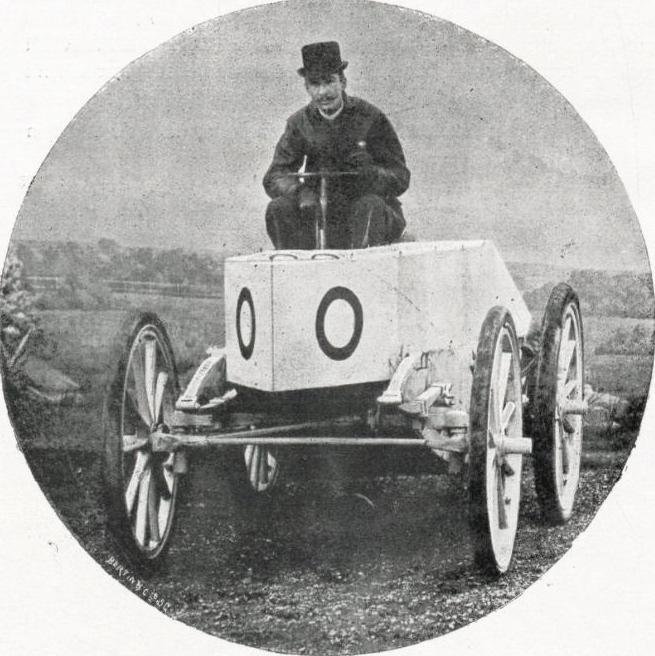
Jenatzy answered. On January 27, 1899, he lifted the mark to 80.35 km/h (about 50 mph) in a dog-cart. On March 4, the count came back with more than 92 km/h, around 57 mph. For a few months the record went back and forth between two men on the same stretch of road, and each of them kept stealing it from the other.
It was a strange pairing. One was a French aristocrat. The other was the son of a Belgian rubber manufacturer, Constantin Jenatzy, who had started his business in Schaerbeek, now part of Brussels, in 1865. Camille trained as an electrical engineer. People called him “le Diable Rouge,” the Red Devil, after the beard.
The taxi guy
Here’s something that gets lost. Jenatzy wasn’t a hobbyist with a fast toy. By 1898 he’d set up a company in Paris to run electric cabs, the Compagnie Générale des Transports Automobiles, Jenatzy system, based in Boulogne-sur-Seine. In September 1898, his electric fiacres began taking fares in the city, in the space where horse-drawn cabs had been. So the man who cracked 100 km/h on batteries already had battery cabs working the streets of Paris. Electric wasn’t an experiment for him. It was a business.
What he built
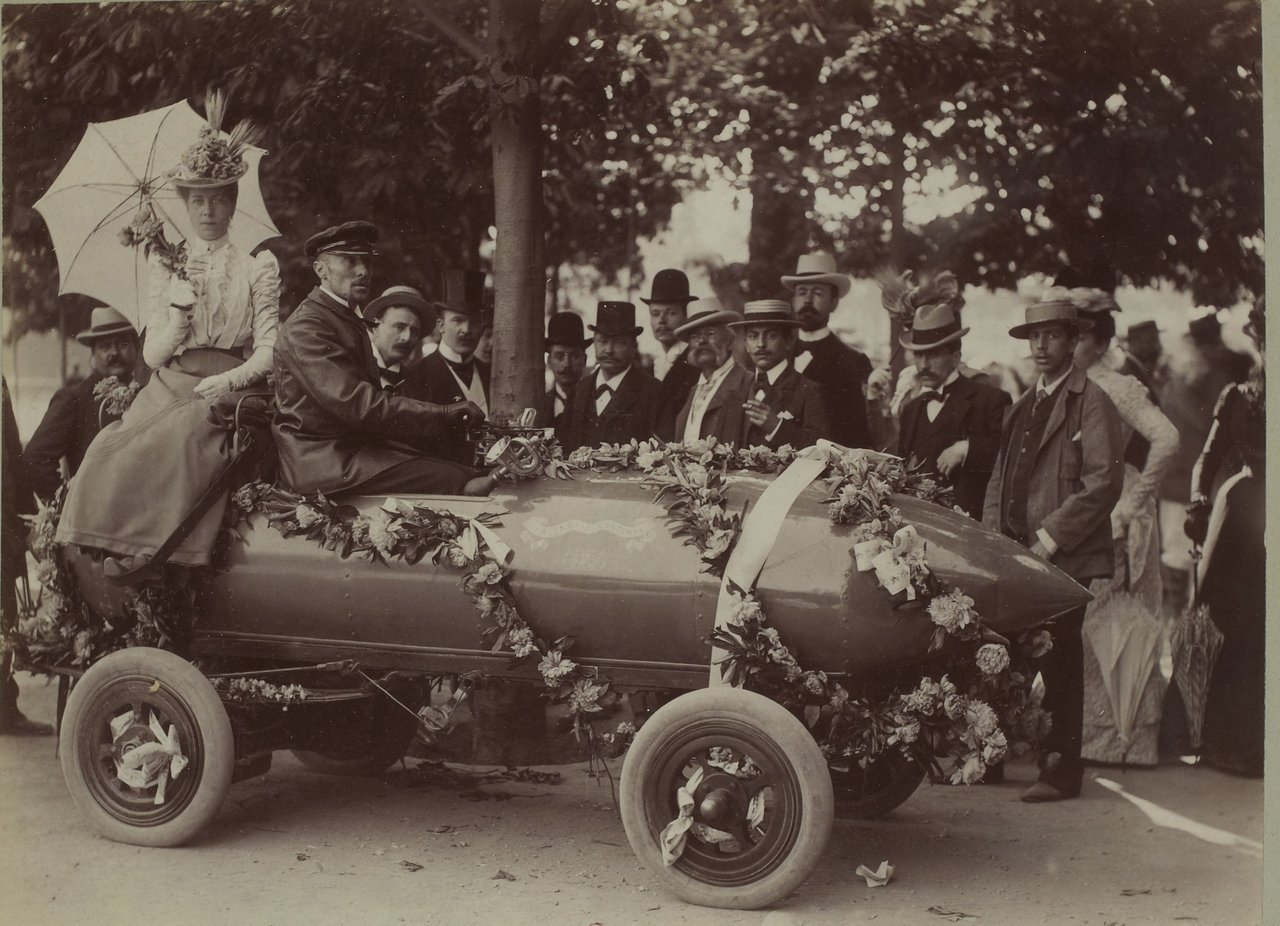
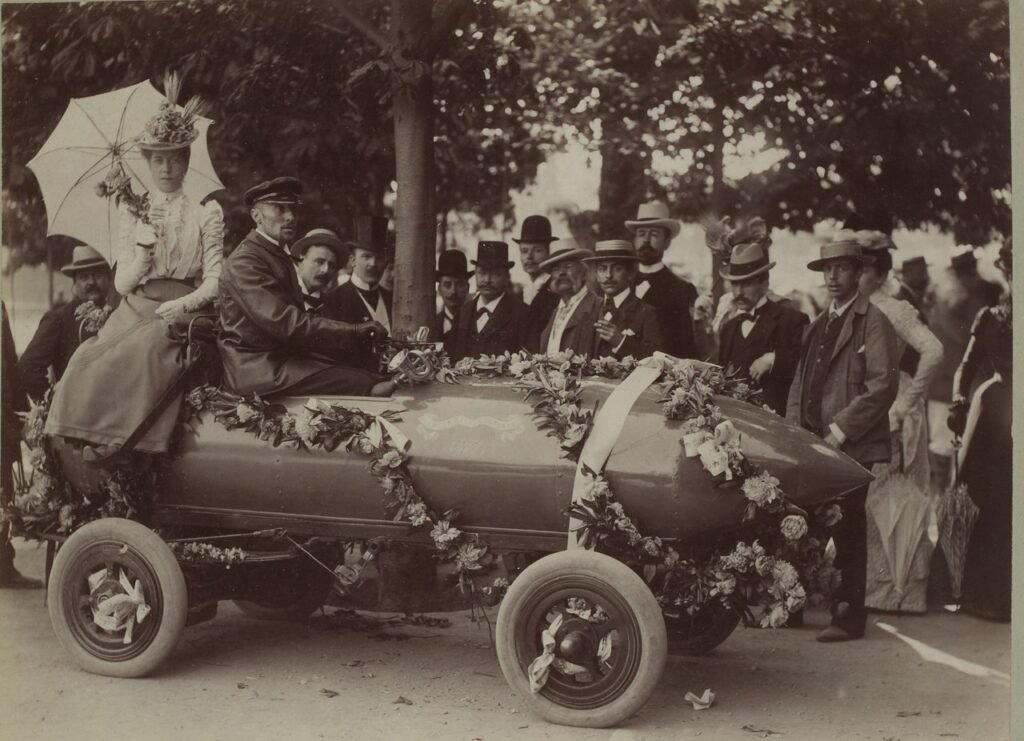
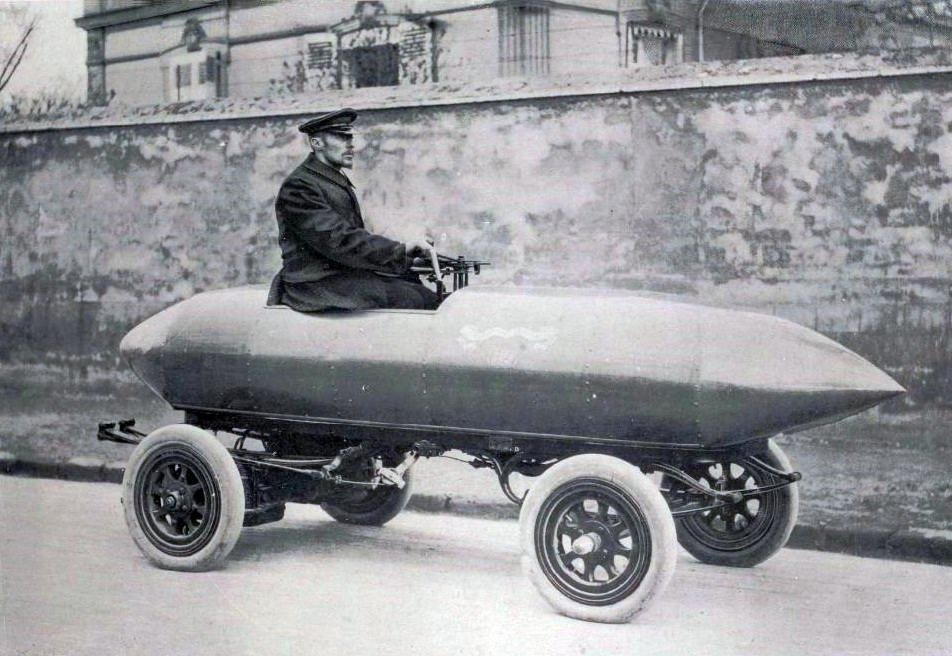
For the record attempt he stopped chasing the number in a conventionally bodied car and built something designed to break it. The body was shaped like a shell, a torpedo, and it was made of partinium, a light alloy of aluminum, tungsten and magnesium. It came from the coachbuilder Rothschild & Fils, with Léon Auscher and Edmond Rheims behind the design. The museum that holds the car now describes the aims plainly: aerodynamics, and bodywork lightened with aluminum. All four wheels were the same size and small, wrapped in Michelin tires.
Two Postel-Vinay motors, 25 kW each, did the work. Fulmen batteries supplied the power, and they made up almost half of the car’s weight. Imagine a modern car where half the mass is fuel. That’s what this was.
The driving position didn’t help. The driver sat high up, out in the open on an exposed frame, which spoiled some of what the shape was supposed to gain. And there was no steering wheel in the sense you’d expect. A lever did the steering. A torpedo with a man perched on top gripping a lever. That’s how the first 100 km/h was done.
One more point on the numbers. The car’s total weight and its power output are not settled. Pull a handful of sources and you’ll get a handful of different figures, separated by hundreds of kilos. I’m not printing any of them, because I can’t stand behind any of them. A car that’s been in the record books for more than a century, and the sources still disagree on what it weighed.
The first try didn’t count
Jenatzy went after the record with the car for the first time on March 31, 1899. The run was not ratified, because of a problem with how the course had been measured. A record only exists once it’s measured by the rules. If the measurement is wrong, you’ve driven fast for nothing. It took nearly four more weeks before he tried again.
Steam, not gasoline
Everybody assumes the combustion engine took the title. It didn’t. On April 13, 1902, on the Promenade des Anglais in Nice, Léon Serpollet reached 120 km/h (75 mph) in a steam car called the Œuf de Pâques, the “Easter Egg,” named for its egg-shaped body. He was the first driver of a non-electric car to hold the land speed record, and he beat Jenatzy by 13 percent. Three years later, that was the margin.
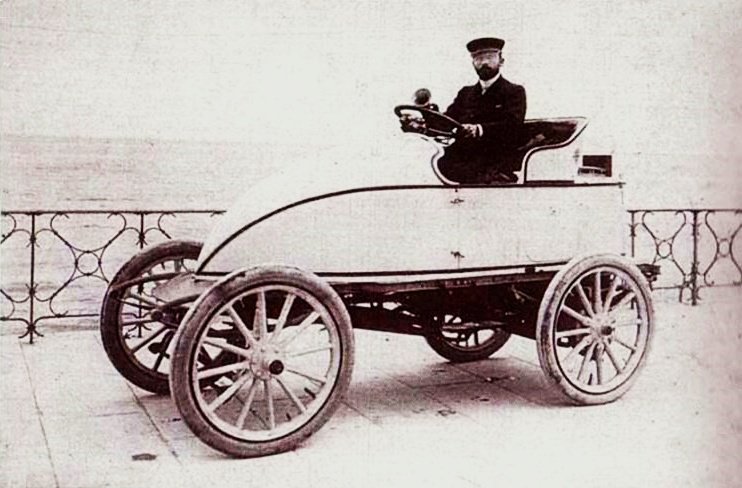
From the first record in December 1898 until April 1902, every official absolute land speed record was electric. The car that finally broke the streak wasn’t running petrol. It had a boiler.
So line up the order of arrival. Electric first. Steam second. Petrol had to wait its turn behind both of them, because the first non-electric record holder was Serpollet, and Serpollet’s car ran on steam. Every time someone tells you the internal combustion engine was born to dominate speed, hand them the dates. The record books say otherwise.
An American connection
Jenatzy raced the cars that came next, and the next chapter of his life has more to do with the United States than you’d guess. On July 2, 1903, he won the Gordon Bennett Cup at Athy, in Ireland, in a Mercedes. The cup carried the name of James Gordon Bennett Jr., an American newspaper publisher. The field was twelve cars, three entries each from Germany, France, Great Britain and the USA, and Jenatzy, a Belgian, drove for the German team. He won in 6 hours and 39 minutes at an average of 79.2 km/h, or 49.2 mph. His Mercedes was reportedly down on horsepower next to some of the others. It didn’t matter. The race is often called the one that saved motorsport, coming after the deaths on the 1903 Paris–Madrid.
Put the two numbers side by side. Over six and a half hours on an Irish circuit, he averaged 49.2 mph. Over one kilometer on a French road four years earlier, he’d gone 65.8. The record was a sprint with a battery on board, and the win was an endurance grind in an engine that burned petrol. He was good at both, and he wasn’t picky about what powered them.
He also drove the Vanderbilt Cup on Long Island, in Mercedes cars, in 1905 and 1906. The first man over 100 km/h on batteries went on to win in petrol and race on American roads.
He died in December 1913 during a hunting accident, in the Belgian Ardennes. The record lasted almost three years. The car has outlived him by more than a century.
From the battery maker to the museum
La Jamais Contente is still with us. In 1933 it entered the museum at Compiègne, in France, through a joint donation from the company Fulmen, which had supplied the batteries, and from Camille Jenatzy’s widow. It sits there today in the Musée national de la Voiture, inside the Château de Compiègne. The museum’s own catalog entry lists the materials: painted aluminum, copper, brass, metal, moleskine, wood and rubber. That’s a workshop inventory, not a spec sheet. Copies exist, including a working one built in 1993, but the real thing is in Compiègne.
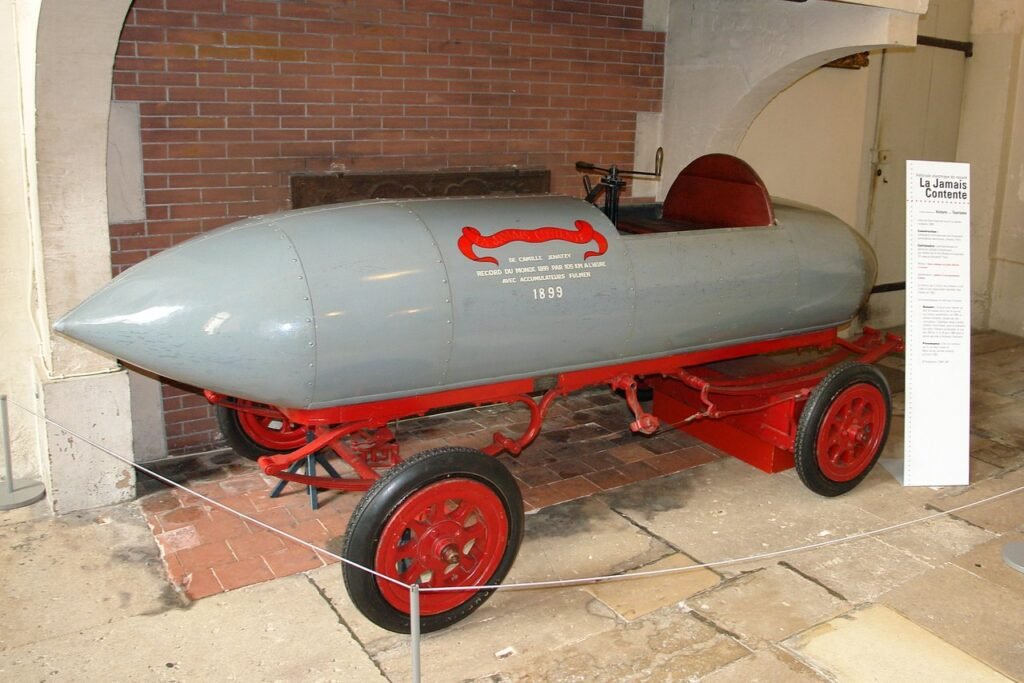
The name
Nobody is sure where “Jamais Contente” comes from. Some say it reflects Jenatzy’s perfectionism. Others say it reflects his wife’s temperament. Neither version is confirmed, so take both with a grain of salt.
What 123 years did
In November 2022, the Rimac Nevera, a production electric car with four motors and 1,914 horsepower, reached 412 km/h, about 256 mph, at the Papenburg test track in Germany, driven by Miro Zrnčević. Rimac announced it as a world speed record for a production electric car. That’s almost four times what La Jamais Contente managed.
The Nevera’s run was measured with a Racelogic VBox, on Michelin Pilot Sport Cup 2R road tires. La Jamais Contente rolled on Michelin tires too. Same maker, 123 years apart, and electric power at both ends.
Don’t take that comparison too far. La Jamais Contente was a one-off built to run on one road. The Nevera is a production car. And the gap in power is enormous: two motors of 25 kW against more than 1,900 horsepower. Still, the story holds. The electric car had speed from the first day. What it didn’t have, and still argues about, is weight and charging. In 1899, batteries were about half the car. Today the debate is still how much they weigh and how long they take to fill. The numbers moved. The question didn’t.
So here’s where we land at NEB. Nobody gets to sell electric as a fad, because an electric car held the land speed record before any petrol or steam car did. And nobody gets to sell it as the fix for everything either, because the problem sitting in that 1899 car is still sitting in today’s. This piece connects two others we’ve published, the editorial on the forgotten era of the electric car and our piece on the Rimac Nevera R. La Jamais Contente is the thread between them.
Still think electric is new?
Unplug and enjoy.
Images: Jules Beau, 1899 (BnF Gallica, public domain) · Le Sport universel illustré, 1899 (public domain) · La Vie au Grand Air, 1899 (public domain) · La Vie au Grand Air, 1902 (public domain) · Afernand74, Wikimedia Commons (CC BY-SA 3.0)