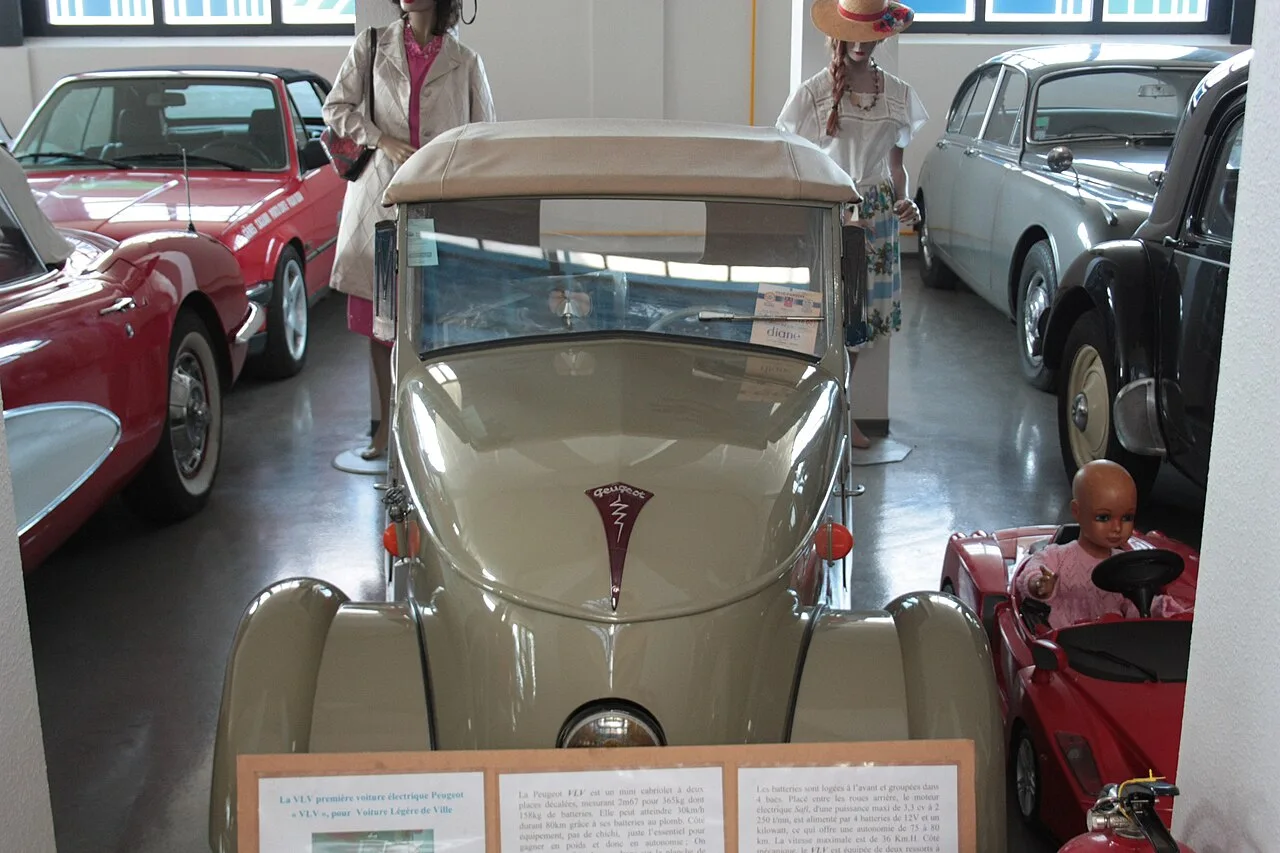
Peugeot VLV: The 1941 Electric Car With No Gearbox and No Differential
Most Americans think the electric car started with Tesla. The well-read ones will say GM’s EV1. Both answers skip most of the story. One of the chapters they skip is a 772-pound French cabriolet that a major car company built in 1941 because its customers couldn’t get gasoline.
Peugeot called it the VLV, short for Véhicule Léger de Ville, “light city vehicle”. Peugeot built 377 of them. No gearbox, no differential, a single headlight, and a windshield wiper you worked by hand. It ran on four lead-acid batteries and it did what it promised. Then somebody banned it.
Almost every article about the VLV treats it as a wartime curiosity. It deserves better, and it deserves a closer look at the numbers, because the numbers don’t agree with each other from one source to the next.
France, 1941: no car, or no fuel
The armistice was signed on June 22, 1940, and the German occupation of France began. Peugeot’s own history of the period describes the problem in plain terms. Some people had had their cars requisitioned. Others kept theirs but couldn’t run them, because fuel was rationed and expensive. A doctor on house calls or a mail carrier still had to get around, and a bicycle only goes so far.
Americans got their own version of the problem a year later. Detroit built its last civilian cars in February 1942, gasoline rationing hit the East Coast that May and the whole country by December, and nobody in Michigan answered with a battery. In occupied France, one big automaker did.
One answer was the gazogène, a wood-gas generator bolted onto an ordinary car. It burned charcoal or wood to make fuel gas for the engine. The other answer was electricity, and a handful of small builders went for it. The auction catalog of one VLV, written by the Paris house Artcurial, lists them: Louis Bréguet, Fenwick, Faure, Duriez, Sorel, Georges Irat, Autelec, Jourdain-Monneret and Mildé-Krieger. All of them were building electric vehicles in early 1941. None of them was a major automaker.
Peugeot was the only big French manufacturer to take an interest. L’Aventure Peugeot, the association that looks after the brand’s heritage, says the announcement caused surprise. It came on May 1, 1941, after the car had passed type approval on March 28.
Peugeot’s home plant at Sochaux was in occupied hands and was turning out utility vehicles for the German army. So the VLV was built at La Garenne, on the outskirts of Paris.
Designed as an electric car, not converted into one
Here is what most wartime electrics were: an existing gasoline car with the engine pulled out and batteries dropped in. Heavy to begin with, heavier after. Peugeot did the opposite and started from a blank sheet.
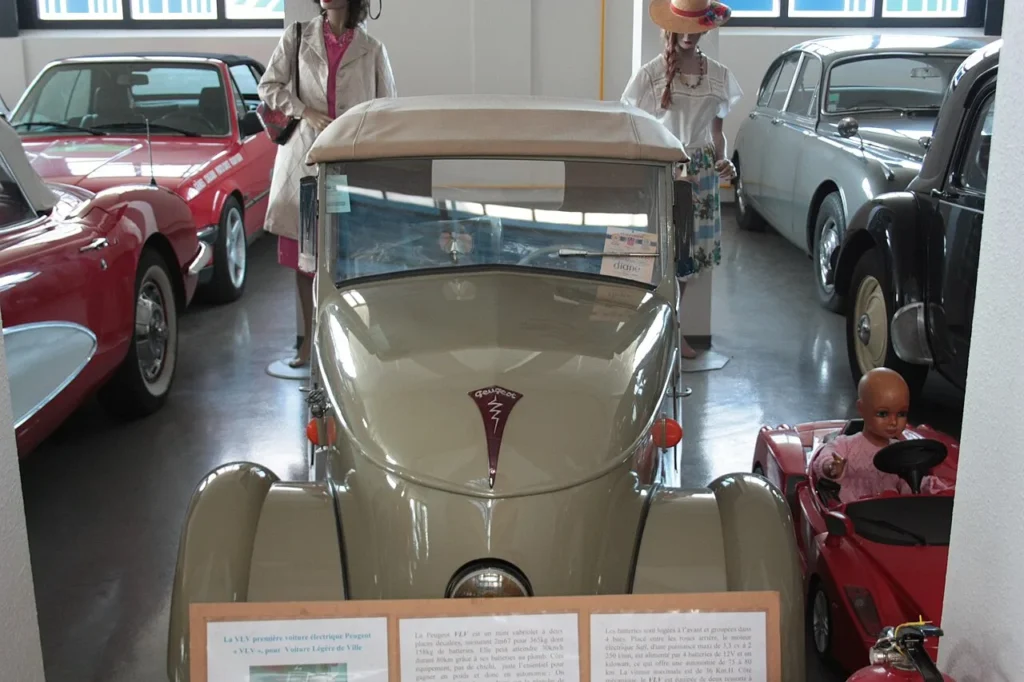
The VLV is 2.67 meters long, about 8 feet 9 inches, and 1.21 meters wide, a hair under 4 feet. It’s a self-supporting aluminum body with two staggered seats, a fabric top, one central headlight, one wiper and no rear bumper. Where a Peugeot would normally wear its lion, the VLV wears a lightning bolt.
L’Aventure Peugeot gives the weight as 350 kg, or about 772 pounds, and 160 kg of that, roughly 353 pounds, is batteries. Do the arithmetic: 46 percent of the car is lead. Everything else, body, motor, wheels, seats, weighs about 419 pounds.
The designers knew exactly what they were fighting. Every extra pound of car needs extra pounds of battery to move it, and the batteries need still more car to carry them. Cutting weight beat adding cells, so Peugeot cut weight.
No gearbox, no differential: how that works
Start with the gearbox. A gasoline engine only works well inside a band of revolutions, which is why it needs gears. An electric motor delivers its push from a standstill. A historian of Spanish alternative-fuel cars, Manuel Lage, makes the same point about the electrics of that era: they needed no gearbox. For a car that tops out at 36 km/h, about 22 mph, there’s nothing to shift between.
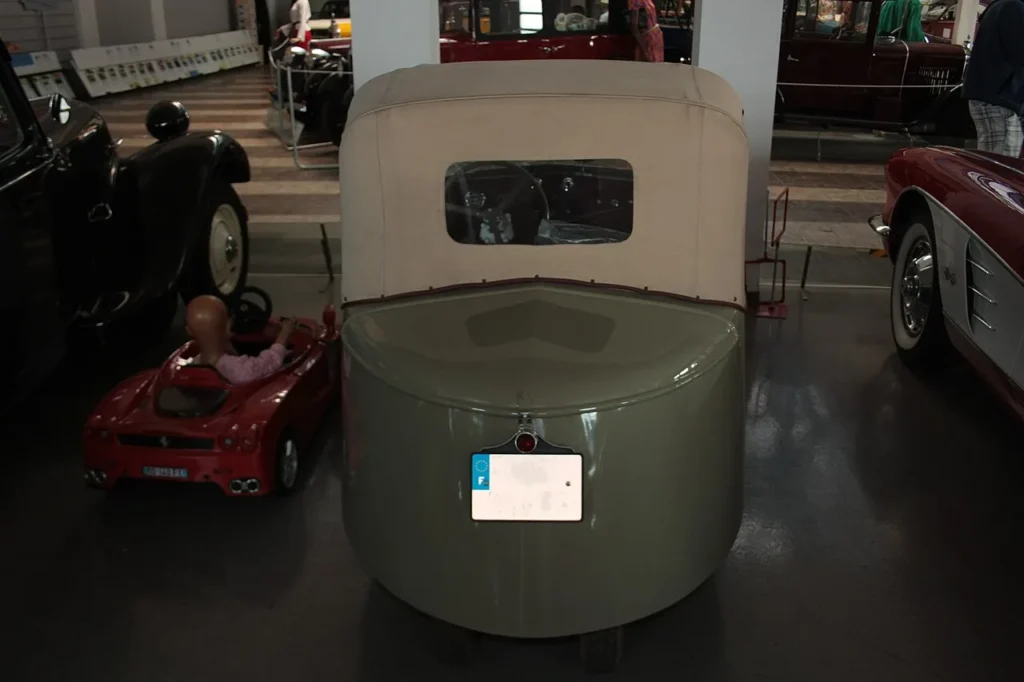
The differential is the more interesting part. In a corner the outer wheel travels farther than the inner one, so a driven axle needs a way to let the two wheels turn at different speeds. That’s the differential. How much extra distance depends on how far apart the wheels are. In a 90-degree turn the outer wheel covers the track width multiplied by 1.57 more than the inner one. With wheels 4 feet apart, that’s about 6 feet of difference. With the VLV’s rear track of 330 mm, about 13 inches, according to Artcurial, it comes to about 20 inches.
Peugeot did the sum its own way. Put the rear wheels almost together, the difference nearly vanishes, and the differential goes in the bin, along with its weight, its cost and the power it eats. The company itself calls the VLV a cyclecar, wide track in front and narrow at the back. The front wheels are independent. A Safi electric motor sits at the rear.
Driving it: all or nothing
The people at Automobile Propre, the French site that drove one, describe three pedals and a reverse selector. The one in the middle is the brake, with drums on all four wheels. The right pedal is the controller-starter, the left one a special contactor.
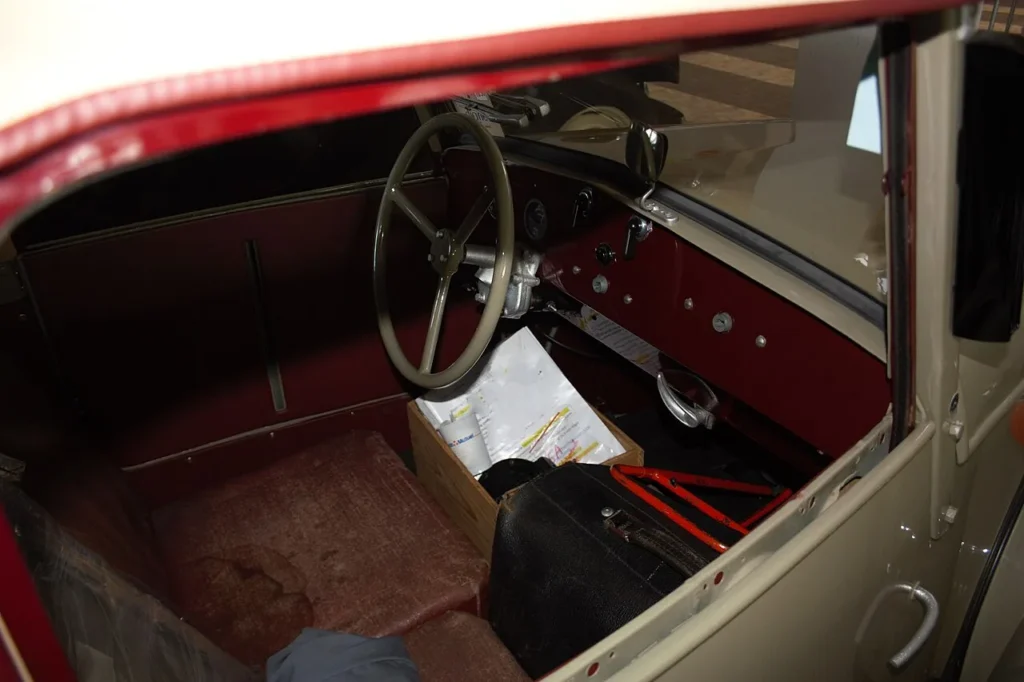
The right pedal does not work like a throttle. You either floor it or you let it go. Hold it halfway and the resistors in the circuit overheat. So to go slower, you alternate the two positions, on and off, like a two-position switch. The left pedal is a boost. It raises top speed by 15 to 20 percent, or helps against wind and hills.
Do the arithmetic again. The same source puts normal top speed at around 30 km/h, about 19 mph. Add 15 to 20 percent and you land between 34.5 and 36 km/h, and 36 is the number Peugeot’s heritage association quotes as the maximum. The figures line up.
What the catalog says
Four 12-volt lead-acid batteries wired together make 48 volts, according to Artcurial, and sit under the front hood. Range is 70 to 80 km in Peugeot’s own press release, and 75 to 80 km according to L’Aventure Peugeot. In American terms, 43 to 50 miles. Nobody ever ran a VLV through the WLTP test cycle. These are 1941 brochure figures.
You charged it from a household outlet with an Alsthom charger, and it took about ten hours.
The rival: Grégoire’s CGE-Tudor
The other serious electric of the Occupation came from the Compagnie Générale d’Électricité, partnered with the battery maker Tudor, and designed by Jean-Albert Grégoire, the front-wheel-drive pioneer. It was an aluminum cabriolet with a central DC motor that could recover energy under braking. It weighed 970 kg, about 2,138 pounds, 460 kg of that batteries, about 1,014 pounds. Top speed 58 km/h, about 36 mph.
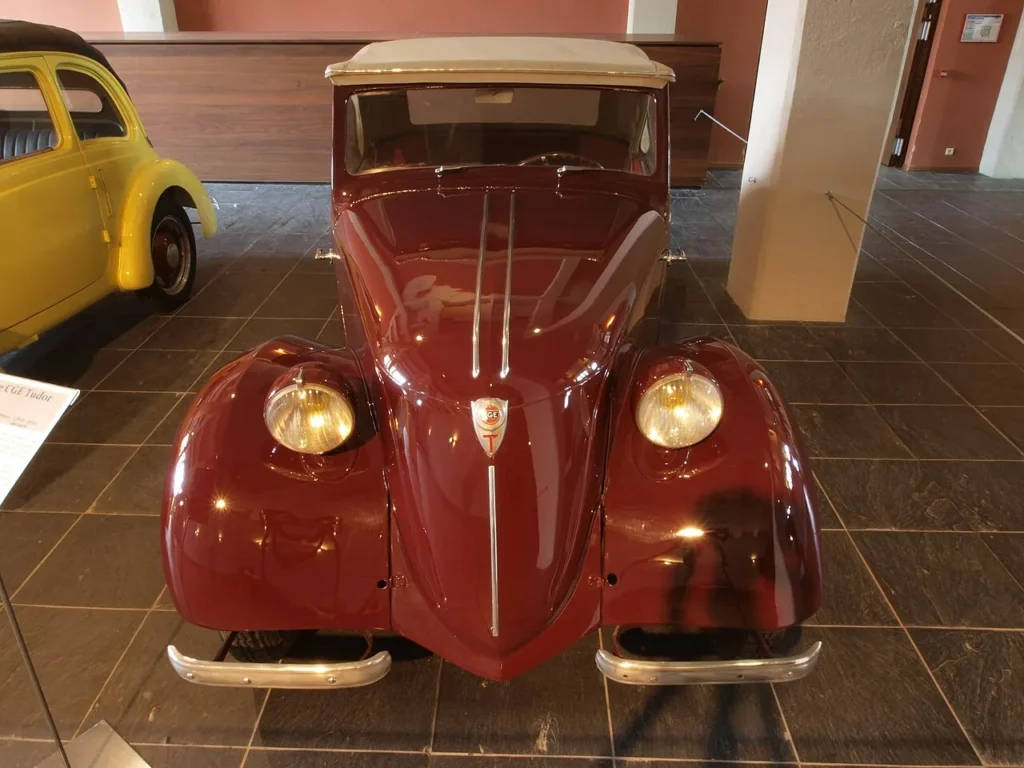
On September 11, 1942, a CGE-Tudor set a world distance record for an electric car on the Paris–Tours run, at an average of 42.32 km/h, about 26 mph, according to the French Ministry of Culture’s catalog entry. About 200 were made, in semi-secrecy. A local history archive that traces the project says the price stayed far too high for a real market to form.
Put the two side by side and you have the two poles of the era. The VLV is small, slow and carries 353 pounds of lead. The CGE-Tudor is almost three times heavier, carries almost three times the batteries, goes faster and goes much farther. In both, almost half the weight is battery: 46 percent in the VLV, 47 percent in the CGE-Tudor.
Who bought it, and how many
Peugeot aimed the VLV mainly at mail carriers and doctors. The Artcurial catalog adds that the medical profession got delivery priority. Peugeot’s press release says 377 cars were built between June 1941 and February 1943.
For perspective, the ordinary Peugeot 202, the company’s mainstream car, totals 104,126 cars between 1938 and 1949 according to L’Aventure Peugeot, touring versions included. The VLV is 0.36 percent of that.
The ban
According to the French railway-history association AHICF, a decree of July 1942, issued at the direction of the German authorities, banned all production of electric vehicles in France. It took effect October 1 in the occupied zone and January 1, 1943 in the free zone. The reason given was that the copper and lead in the batteries were needed for munitions. Other sources add shortages of aluminum and repeated power cuts.
There are four versions of who signed it: the German military command, a French decree dictated from outside, the Vichy government, or the automobile industry’s own organizing committee. For the VLV, the signature hardly matters. Whether it was lead for ammunition or factory floors for the Reich’s trucks, the occupier’s war made the call, and the doctors and mail carriers lost their cars.
Peugeot closes the VLV in February 1943. In 1946 it goes back to ordinary cars with the 202, a 1938 design. The next electric it sells is the J5 van in 1989, forty-eight years later. Private buyers had to wait until July 1995 for the 106 Electric.
What survives
There’s a VLV in the L’Aventure Peugeot museum in Sochaux, another in the Maurice Dufresne museum near Tours, and a third at the Louwman Museum in The Hague. Artcurial has sold two at separate auctions. One, runnable but with no batteries, was estimated at 4,000 to 5,000 euros and is listed as sold for 26,806, more than five times the top of its estimate. The other, restored, with body number 32, which the catalog says puts it among the first assembled in 1941, and four 12-volt, 105 Ah batteries, was estimated at 8,000 to 12,000 euros and is listed as sold for 17,870.
Meanwhile in Spain: a professor and a Fiat
Spain stayed out of the war but not out of the fuel crisis. It restricted liquid fuels between 1940 and 1945, the age of the wood-gas generator, and a Barcelona company called Autarquía built electric vans, trucks and buses. The country had been there before: in December 1900, Emilio de la Cuadra drove an electric omnibus down Barcelona’s Ramblas.
The historian Manuel Lage has done the count for the postwar years: 40 or 50 from Autarquía, 10 or 15 from Wikal, a dozen from ICM and a single electric Pegaso. Fewer than a hundred in all, by his reckoning, and many were conversions of existing vehicles. One French automaker built 377 VLVs on its own.
The best-documented Spanish case is a Seville engineering professor, Guillermo Francisco Domínguez-Adame Romero, who taught hydraulics and heat engines. In 1943 he converted a Fiat 508 to electric power: a 3 hp motor, a 48-volt, 150 Ah battery and pneumatic suspension. It never worked properly, because the Fiat kept its clutch, gearbox, driveshaft and differential, all hardware built for a gasoline engine. In 1946 he started over with a clean-sheet electric car, got it road-approved and drove it every day. He called it DAR SE-19935, his surname initials plus its license plate. It took him three years and a sacrificed Fiat to reach the conclusion Peugeot started from.
The numbers that don’t match
The sources can’t agree. Weight runs from 348 to 365 kg depending on who is counting. The name changes: Peugeot writes Véhicule Léger de Ville, several other sources write Voiture Légère de Ville. Top speed runs from 30 to 36 km/h. Production ended in February 1943 according to Peugeot, in 1945 according to an auction house.
This piece follows Peugeot itself, through its heritage association and its press release, plus the Artcurial technical catalogs. The rest gets cross-checked or left out. Motor power, for example, shows up in figures that contradict each other, so it isn’t here.
The same idea, 79 years later
The Citroën Ami went on sale on May 11, 2020, 79 years after the VLV. Top speed 45 km/h, about 28 mph. Range up to 75 km, about 47 miles, on the WLTP cycle with a 5.5 kWh battery. It measures 2.41 meters, about 7 feet 11 inches, 26 centimeters shorter than the VLV, and wider.
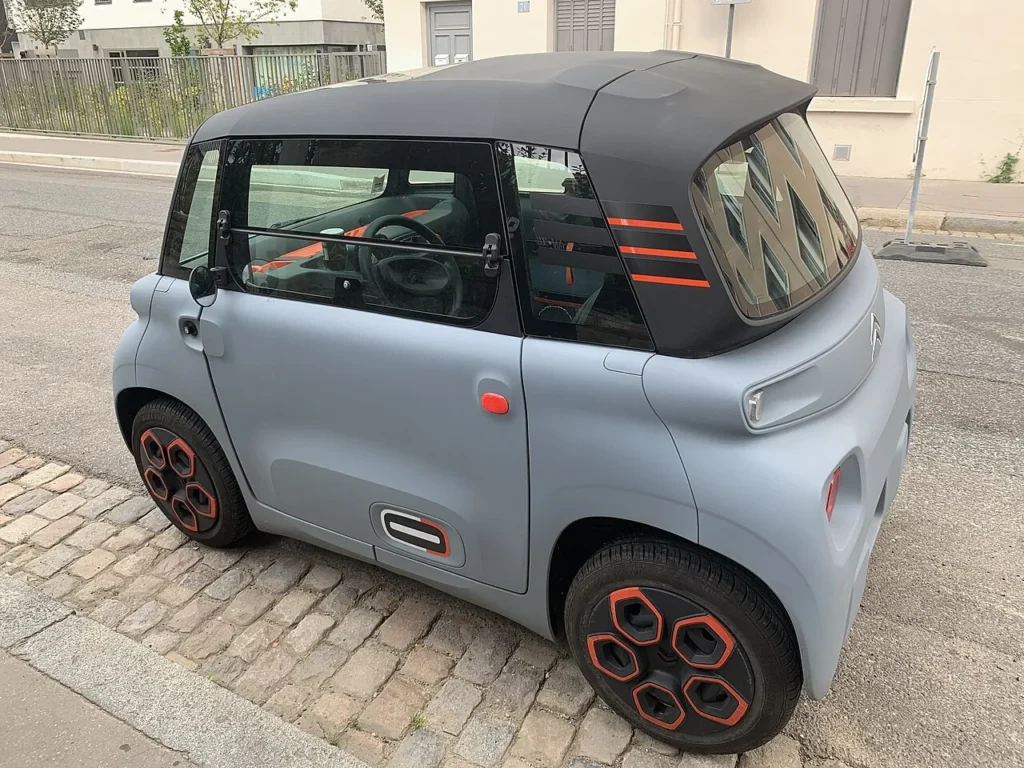
On paper range is a tie: 75 to 80 km in 1941 with 353 pounds of lead, 75 km in 2020 with lithium-ion. The Ami wins on speed by 9 km/h. In a road test by Touring in Belgium it managed 50 to 60 km in real life. Hagerty called the VLV the Twizy of the 1940s. Flip it around: the Twizy, launched in 2012, is the VLV of this century.
The third death of the electric car
The electric car has died three times, and NEB has already told you about two of them. The first was economic: the forgotten era of the early electric. The second was deliberate: GM crushing its own EV1. The third came by decree, with lead and copper as the excuse.
That one makes the blood boil. The VLV worked. It went where it was needed, it carried doctors and mail, and it plugged into the wall at home. Peugeot understood in 1940 that every extra pound demands more battery, and designed the whole car around that fact. Today we sell electric cars with ever bigger batteries inside ever heavier bodies, and a 772-pound car gets called a curiosity.
Peugeot solved it in 1941 with lead, aluminum and a motor that needed no gears. What’s our excuse?
Unplug and enjoy.
Images: MakotoVRC (Wikimedia Commons, CC BY-SA 4.0) · Alf van Beem (Wikimedia Commons, CC0) · Benoît Prieur (Wikimedia Commons, CC0)