GM EV1: the electric car its owners loved and General Motors ordered crushed
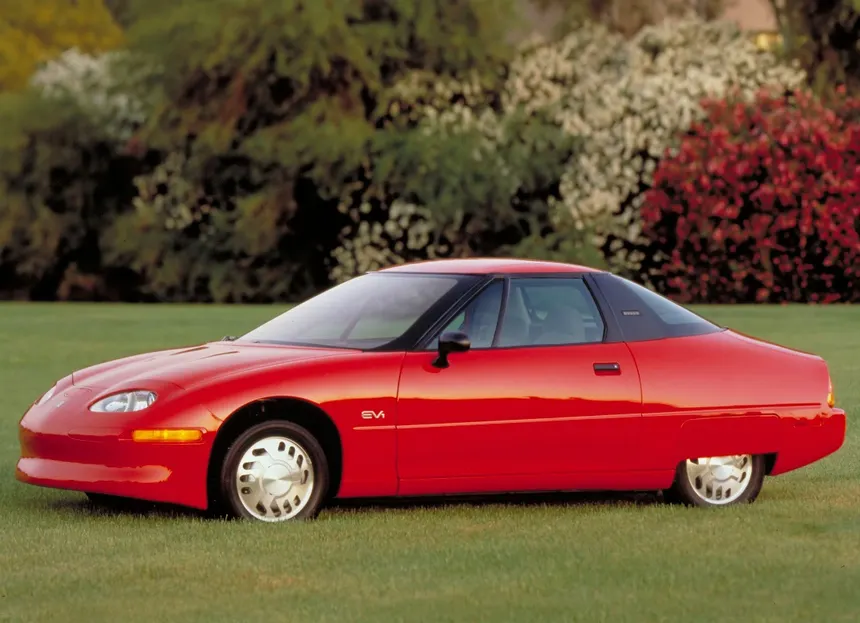
People loved it. They wrote letters. They offered checks. They promised to cover every repair out of their own pockets just to keep it. General Motors said no, took the cars back, and fed them into the crusher — with their drivers watching from the other side of the fence.
This is not the story of a car that failed. It’s the story of a car that worked, that had a waiting list, and that its own maker pulled off the market by force to destroy it. And once you understand how and why, it stops looking like a business misstep and starts looking like something else. Let’s tell it straight, because the comfortable version lies by omission.
The car that wasn’t supposed to exist, and was great because of it
Go back to 1990. Elon Musk was still a student, and if you said “Tesla” people thought of the Serbian inventor. In that world, GM showed an electric concept called the Impact at the Los Angeles Auto Show, and it landed so hard it triggered two things at once.
One: California, through its Air Resources Board (CARB), passed a mandate that same year requiring the seven big automakers to build and sell zero-emission vehicles if they wanted to keep selling in the state. Two: GM decided to turn the concept into a real car. The EV1 launched in 1996 as the first modern-era vehicle designed from the ground up as an electric and mass-produced by a major automaker.
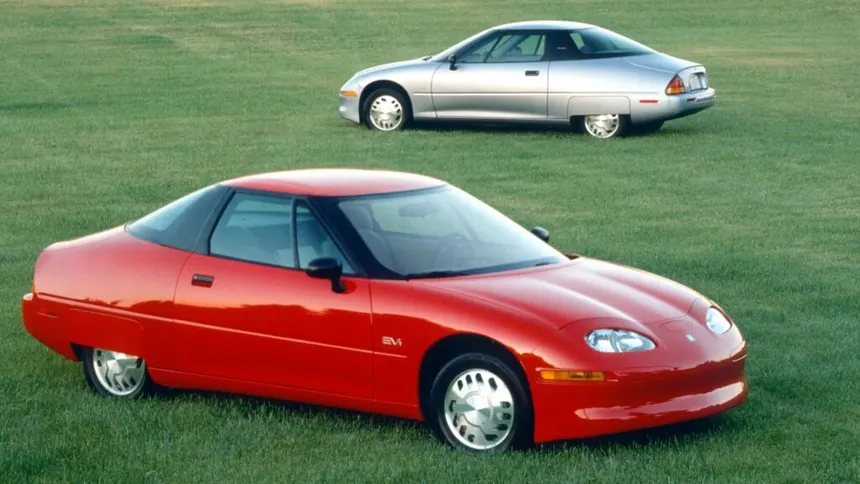
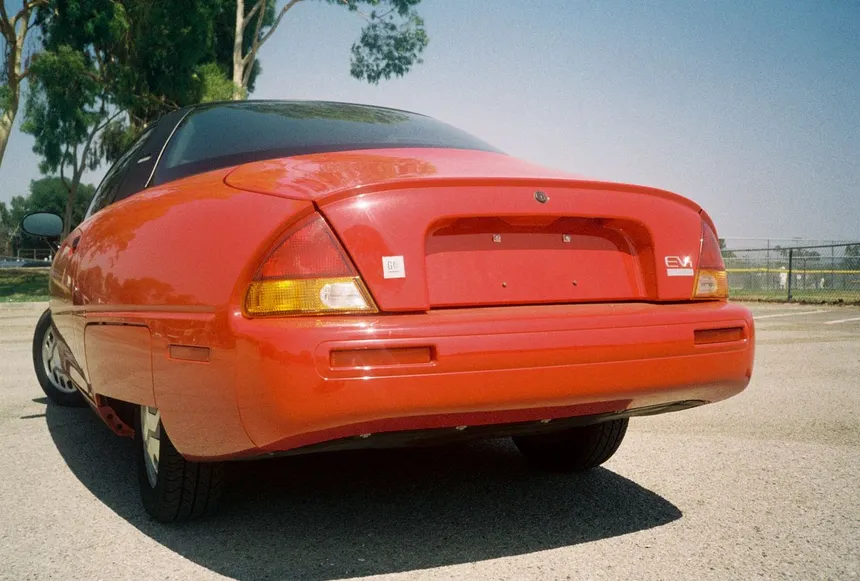
And it wasn’t a compromise machine. It had lively acceleration, an aerodynamic body with partly enclosed rear wheels, and regenerative braking, which in 1996 was street-legal science fiction. The first EV1 ran lead-acid batteries good for 90 to 120 km. The second generation, in 1999, jumped to nickel-metal hydride (NiMH) batteries and raised the rated range to around 105 EPA miles, some 169 km, with higher figures under certain conditions. For the turn of the century, this was the absolute state of the art. Remember the word “NiMH,” because it’s what turns this story into a thriller.
The trap lived in the contract
Here’s the detail that explains everything, and almost nobody underlines it.
The EV1 was never for sale. You could only lease it. The sticker was around 35,000 dollars — over 70,000 today — but the number was irrelevant, because buying it outright was expressly forbidden in the lease. GM offered it in only a few states, serviced only by specific Saturn dealers.
They framed it as a “real-world engineering evaluation.” In practice, the lease-only model handed GM one thing that would prove decisive years later: legal control over the entire fleet. When it decided to close the program, no lessee had a contractual right to keep their car or to demand it be sold to them. That clause wasn’t paperwork: it was what decided the final fate of every EV1.
And here’s a contradiction worth facing head-on. GM built the EV1 with one hand while, with the other, it sat in the automakers’ coalition that took CARB’s mandate to court to kill it. Building the car the law demands while suing to make that law disappear isn’t incoherence: it’s strategy. While the mandate had teeth, the EV1 was GM’s compliance insurance. When CARB eased its requirements and GM concluded the program couldn’t pay for itself, the fleet stopped fitting its strategy. The EV1 served a technological, regulatory and image function; once that function expired, the car was surplus.
“Maniacal and wonderful loyalty”
Now the fact that makes this a tragedy and not a simple commercial flop: people genuinely loved it.
That’s not our read. The EV1 program’s own brand manager, Ken Stewart, described the drivers’ response as a “maniacal and wonderful loyalty.” They didn’t treat it as a curiosity: they’d built their lives around it as a primary car. When GM began reclaiming the fleet, dozens of drivers wrote letters and sent deposit checks begging to extend their leases and promising to hold GM harmless for any repair cost.
Let’s be fair with the numbers, because NEB doesn’t inflate anything. GM built 1,117 EV1s — 660 of the first generation and 457 of the second — and put them in the hands of a driver community far smaller than a commercial launch. Thousands showed interest, but the fleet was limited and the program never opened to a national market. So no, the EV1 was not a bestseller. Nobody disputes that. What’s disputed is what GM did with the people who had one and adored it.
The crime, step by step
The timeline is cold, and that’s why it stings. In 2002 GM notified lessees that all the electric cars would be pulled from the road. In November 2003 it began reclaiming them. Of the 1,117 units built, only about 40 survived, handed to museums and universities — the Smithsonian keeps one — almost always with their drivetrains disabled. The rest went to the crusher, quietly, on flatbed trucks.
One program engineer summed it up with a line that stays with you: watching them destroyed before most people had even driven one was a gut-punch of a moment.
Why? The official and the real versions don’t match, and NEB puts both on the table.
GM’s version: liability and cost. They argued they couldn’t guarantee, for years, the supply of some 2,000 proprietary components or the servicing of aging high-voltage batteries; that range dropped in the cold; that public charging infrastructure was minimal; and that keeping an experimental fleet on the road exposed them to civil liability.
The version the facts support: money and politics. GM had spent over a billion dollars on EV development, saw electric as a margin-free niche next to SUVs, and — the key detail — the automakers’ coalition took CARB’s mandate to court and got it relaxed. Without the regulatory pressure that had forced the car to exist, in 2003 the EV1 went from legal obligation to unnecessary cost. And the destruction removed from the road almost all the physical proof that the technology had worked for years in real drivers’ hands.
The bomb almost nobody tells: the battery ended up with an oil company
Here’s where the word “NiMH” detonates. Pay attention, because this stretch is what separates NEB from the outlet that stops at the surface.
That nickel-metal hydride battery wasn’t GM’s by accident. GM took a controlling stake in Ovonics, including the patents governing the manufacture of large-format NiMH batteries, originally to develop them specifically for the EV1. Some usage tests cited in the Ovonics literature exceeded 150 miles, though the EV1’s official EPA range with NiMH was around 105; either way, GM shut the program down before that battery could be widely commercialized.
And where did the patent go? Brace yourself. By 2001 control of the Ovonics technology had moved into oil company Chevron’s orbit: that year Texaco bought GM’s share in GM Ovonics, and Chevron acquired Texaco months later. Control of one of the best electric-car batteries of the moment ended up in the hands of a company whose business is gasoline.
From there, access to those batteries was gated by an extraordinarily concentrated web of industrial property. The resulting venture, Cobasys, controlled key large-format NiMH patents, and in 2008 Mercedes-Benz sued it for failing to deliver NiMH packs it had, per the suit, agreed to supply.
And here’s a collateral victim that deserves its own article, because it links two stories usually told apart: the Toyota RAV4 EV. Toyota had 825 units of that electric crossover on the road and, per those who documented the case, its employees complained about the difficulty of getting even small orders of large-format NiMH batteries to service that fleet. The same patent tangle that surrounded the EV1 spilled onto Toyota’s electric too. The same industrial bottleneck brushed two different cars.
Researcher Sherry Boschert, who documented the case, put it in writing with every caution: it’s possible that Cobasys, controlled by Chevron, was squelching access to large NiMH batteries through its control of the licenses in order to remove a competitor to gasoline.
NEB won’t sign a conspiracy it can’t prove. The corporate chain GM-Texaco-Chevron-Cobasys is not by itself proof of an orchestrated plan to sink the electric car. What is documented is that control of the best battery of the moment ended up with an extraordinarily concentrated ownership structure tied to oil, and that at least one carmaker, Mercedes, had to go to court to get those cells. Connect the dots yourself: the suspicion has gone twenty years without clearing, and not for lack of facts feeding it.
The verdict
Here’s NEB’s take, whole and handing out no caresses.
For American readers this ground was famously covered by the 2006 documentary “Who Killed the Electric Car?”, which lined up its suspects like a murder board: consumers, batteries, oil companies, carmakers, the government, CARB, and the hydrogen fuel-cell distraction. It’s a fine film and it put the crushing on the cultural map. But two decades later the NiMH-patent trail — GM’s stake in Ovonics, the handoff to Texaco and Chevron, the blocked orders — has firmed up from suspicion into a documented chain the film could only gesture at. The picture is clearer now, and it’s uglier.
The comfortable story — the one half the car press repeats — says the EV1 “failed” because it was expensive, short on range and unwanted. It’s false by what it leaves out. The EV1 didn’t fail: it was canceled. There’s a chasm between a product the market rejects and a product the maker pulls by force, buys back and destroys over its users’ pleas. The first is economics. The second is a decision someone signed with a name attached.
Let’s be fair with the caveats, because NEB doesn’t flatter the electric cause either. Real range was short. Availability was laughable. With 1999 battery tech, a mass-market, profitable EV1 was nearly impossible, and there’s a legitimate argument the car arrived a decade or two early. All of that justifies stopping production.
GM’s arguments — civil liability, spare parts, long-term service and protection of proprietary technology — explain why it preferred to reclaim the fleet. What they don’t fully explain is why not a single unit could be sold under extreme conditions: no warranty, no service obligation, a signed liability waiver, and only to drivers already trained in the program itself. That’s the gap no balance sheet quite closes. And it leaves a fair question hanging: why destroy every last unit of a technology that worked, instead of letting a few enthusiasts keep it alive on their own dime? A crushed car gives no testimony. A car in a garage does.
The EV1 is the link between 1899’s La Jamais Contente and the 2008 Tesla Roadster. Proof that killing the electric car wasn’t a one-time accident a century ago. It’s something this industry knows how to do, has done more than once, and only stopped doing when an outsider — first Tesla, then the Chinese — took away its power to decide. The crushers of 2003 weren’t a market failure. Reclaiming the fleet and destroying it was a decision, not an accident. GM had the only fleet of purpose-built electric cars in America, a customer base that begged to keep driving them, and the patents to the battery that would have made them genuinely usable. It looked at all three and chose the crusher. And decisions, unlike accidents, are made, signed, and open to judgment.
Unplug and enjoy.
3 thoughts on “GM EV1”