Toyota RAV4 EV: the hybrid giant built two good electric cars and let both die
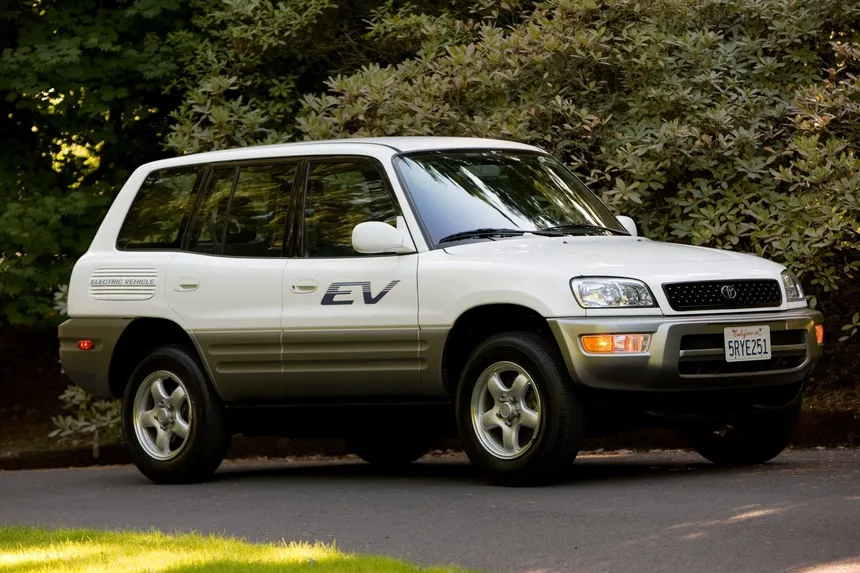
For 25 years Toyota told the world the battery electric car wasn’t ready. And it was right often enough to look like the smartest company in the room. The trouble is that while it preached patience, Toyota built two of the best electric cars of their day and let both die. The second one it had Tesla build. And to complete the joke, it sold Tesla the old Fremont plant, where Tesla would later build the Model S — the car that would prove an electric could be a high-performance global product.
This is the story of the RAV4 EV. Two generations, nearly a decade apart, one company tripping over the same stone twice — not from incapacity, but by choice.
The skeptic who was right, and lost anyway
To understand the RAV4 EV you have to understand Toyota. No carmaker has staked more credibility on the idea that the future wasn’t the pure electric car. Toyota bet on the hybrid with the Prius, launched in 1997 as the world’s first mass-produced gasoline-electric hybrid, and later on hydrogen with the Mirai. Its message, repeated for two decades, never changed: the battery isn’t there, the range isn’t there, the infrastructure isn’t there, go slow.
The strange part is that, technically, Toyota wasn’t wrong about a lot of those warnings. The problem is different. While it sold caution to the public, Toyota had already proven in its own workshop that it could build EVs in its sleep. Its electric-car R&D goes back to 1969; by 1983 it had a prototype, the EV-10, built on a Corolla. The company insisting the electric car wasn’t ripe had been cooking it for decades. That’s the knot in everything that follows.
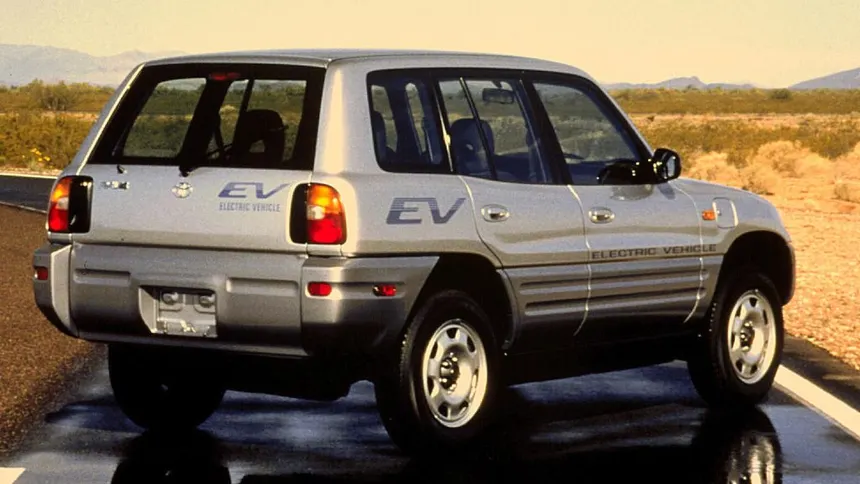
First generation (1997): the electric car that actually survived
When Toyota launched the RAV4 EV in 1997, it didn’t ship a compromise. It shipped one of the most advanced electric cars in the world at that moment. It ran a nickel-metal hydride battery — the famous EV-95, 24 twelve-volt modules totaling about 27.4 kWh — a single 67-hp motor, and a rated range of about 95 EPA miles (some 153 km), though real-world range leaned heavily on weather, speed and heater use. Top speed capped near 78 mph. It seated five, had genuine cargo room, four-wheel ABS, and a decent stereo. For the late 1990s, this was major-league engineering.
At first it was fleet-lease only, three-year terms, no private sales. That changed in 2001, when Toyota opened leasing to small businesses — the “fleet of one” — and took the decisive step in 2002 by offering it for retail sale in California. A total of 1,484 units were leased or sold in California, and 328 were sold directly to consumers in 2002 and 2003.
Here’s the detail that makes this car the perfect counterpoint to the GM EV1. When the program ended, Toyota — at the lessees’ own request — sold many of the cars instead of reclaiming and destroying them. The result is something you can still touch: as of mid-2012, nearly 500 first-generation RAV4 EVs were still running around California, more than a decade later, in many cases still on their original batteries or compatible replacements. While General Motors fed its EV1s into the crusher over their owners’ pleas, Toyota let its electrics live. One precision, though: letting part of the fleet pass into private hands is not the same as betting on the car commercially. Toyota never turned the RAV4 EV into a continuing model; it simply didn’t bother burying it.
It didn’t do that out of love for the EV. It did it, among other reasons, because it wasn’t afraid of the car. And that difference in attitude — GM terrified of a car that threatened its business, Toyota indifferent to a car it saw as a box to tick — is why one ended up shredded and the other became a cult object still on the road.
Place it among its peers. The 1997 RAV4 EV wasn’t born alone: it was part of the litter California’s mandate produced all at once, alongside the GM EV1, the Honda EV Plus, the Nissan Altra, and the Chevrolet S-10 Electric and Ford Ranger EV pickups. Of that whole platoon — most running the same NiMH battery and the same regulatory expiration date — the RAV4 EV aged best and, above all, kept the most units alive. Not because it out-engineered the EV1; it didn’t, not on aerodynamics or efficiency. But its practical SUV body and its status as a car you could buy, not just lease, gave it a second life the others were denied. Format mattered as much as mechanicals.
The battery trap, again
Anyone who read our EV1 piece knows where this goes. The RAV4 EV’s NiMH battery was, in essence, the same technology family as the EV1’s: Ovonics’ EV-95. And control of those patents ended up, through corporate buyouts, inside an oil company’s orbit.
In 2001, Texaco bought GM’s stake in GM Ovonic Battery; after Chevron later acquired Texaco, the technology sat within a petroleum company’s perimeter. That same year a patent dispute touched Panasonic, Toyota’s battery supplier, settled for a sum sources put around 30 million dollars. From then on, the supply of large-format NiMH batteries was gated by litigation, licensing and industrial capacity. For a small, aging fleet like the RAV4 EV’s, sourcing replacement packs was neither easy nor cheap. The difference from the EV1 is that the Toyotas were already in their owners’ hands, and that saved them.
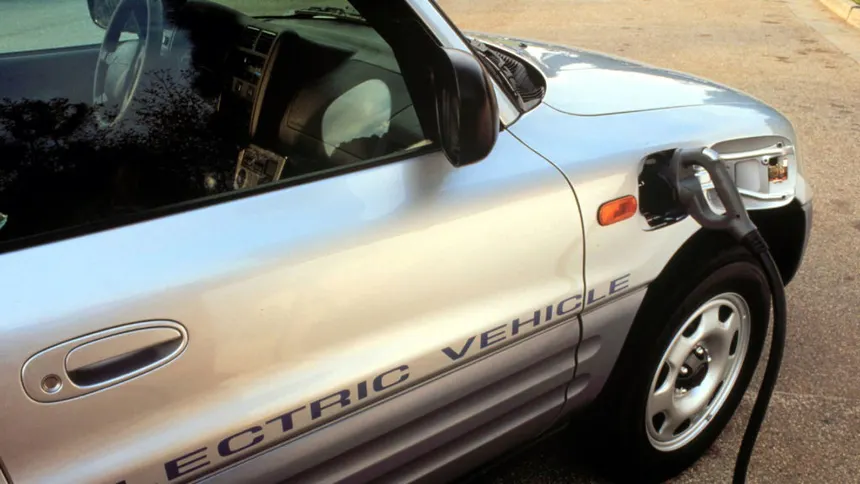
Second generation (2012): Toyota marries Tesla
Here the story takes a turn that reads like a novel today. In May 2010, Toyota announced it was buying a 50-million-dollar stake in a still-small Tesla, known mainly for the Roadster and with no industrial scale of its own. The deal also included selling Tesla a shuttered Toyota factory in Fremont, California, for about 42 million dollars.
Stop on that, because it’s the heart of everything. That Fremont plant is where Tesla would go on to build the Model S — the car that redefined the electric vehicle and ended up detonating Toyota’s own thesis that the battery wasn’t ready. Nobody could have known that in 2010, of course. But seen from today, Toyota put up the cash and sold Tesla cheap the house where its future rival would build the weapon that left it behind.
And the factory itself carries a second layer of irony an American reader will appreciate. Fremont wasn’t just any Toyota plant. It was NUMMI — New United Motor Manufacturing — the legendary joint venture Toyota ran with General Motors from 1984, the place where Detroit went to learn the Toyota Production System. When the GM bankruptcy killed NUMMI in 2010, Toyota handed the keys to Tesla. So the single building where GM and Toyota once tried to save the American car together became the launchpad for the company that would upend both of them. Two of the three biggest names in the old order, feeding the startup that rewrote the rules, in the same set of walls.
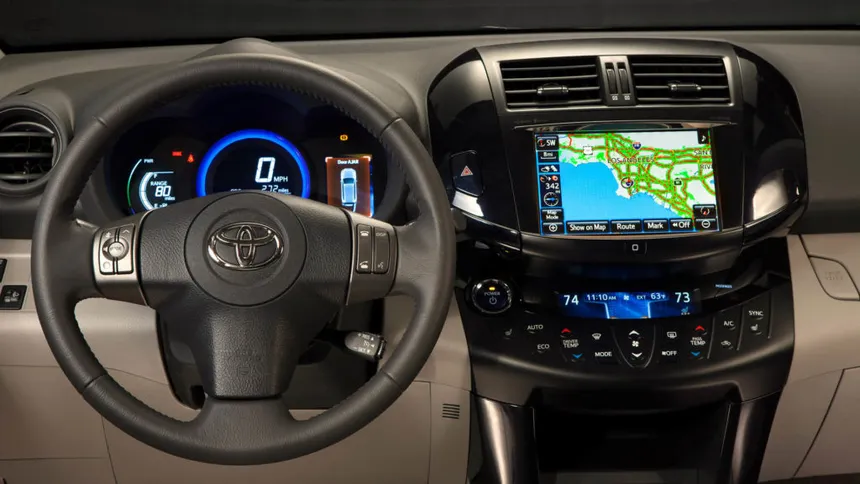
The joint offspring arrived in 2012: the second-generation RAV4 EV, billed as a Toyota-Tesla co-development. Toyota paid Tesla around 100 million dollars for the complete powertrain — battery, motor, gearbox and power electronics. Tesla fitted a lithium-ion pack with 41.8 kWh of usable capacity under the floor and a powertrain related to the 2012 Model S’s, adapted and limited for the RAV4, making around 115 to 129 kW depending on the spec — roughly 154 hp. Toyota quoted about 100 miles of real-world range and up to 113 EPA miles (some 182 km) in Extended mode, with a Standard mode that capped the charge and lowered the figure. The starting price was near 49,800 dollars, planned production roughly 2,600 units, built in Woodstock, Ontario. It sold 2,489 through April 2015.
And they developed it in record time. In an industry where a car takes five years to reach market, Toyota and Tesla shipped it in under half that. It wasn’t a honeymoon: Japanese meticulousness and Silicon Valley speed clashed, with a recall or two along the way. When Akio Toyoda, Toyota’s president, drove a Tesla Roadster in 2010, he said he’d felt “the wind of the future.” That line is the bitter key to the whole thing.
Why they let it die: they never believed in it
Because the 2012 RAV4 EV was never a car Toyota really wanted to sell. It worked in practice as a compliance car: limited production, availability restricted to California, and a volume fixed from the start, to satisfy the zero-emission mandate and lift the fleet’s efficiency average. It was sold only in select California markets, marketed softly to a handful of EV enthusiasts, never pushed nationally. Toyota framed it openly as a specific number of cars for a specific number of years. Translation: quota met, program closed. It’s the same compliance-car playbook that produced a dozen half-hearted American EVs of the 2010s — cars built to be tolerated, not sold — and the RAV4 EV was the most capable of them, wasted on a company that didn’t want it.
Production ended in September 2014, on schedule, and with it the supply of Tesla powertrains. Nobody reclaimed or destroyed the fleet: the cars sold stayed with their owners. It wasn’t crushed; it was simply discontinued. Toyota began unwinding its Tesla stake in 2014 and sold the rest in 2016, with the full split made public in 2017. And it went back to treating the pure EV as a peripheral line — it kept plug-in hybrids, fuel cells and its own electric programs running — right after having had direct access to Tesla’s technology and culture for half a decade.
The verdict
Here’s NEB’s read, and it’s not kind to Toyota.
For twenty years Toyota made the sharpest case for why the battery EV wasn’t ready. Part of that case was reasonable: range, cost and charging were real problems. But being right about the problems is not the same as being right about the future. Toyota gripped the drawbacks so tightly it never saw — or refused to see — that those drawbacks were precisely the work that needed doing, not the excuse for not doing it.
And the detail that condemns it isn’t that it forecast wrong. It’s that it held the future in its hands twice and let go. It built an excellent electric car in 1997 and let it die. It built another in 2012 with Tesla’s technology, sold Tesla the Fremont plant cheap and put up the cash to take off, then relegated the pure EV to hydrogen while that same factory spat out the Model S cars eating the market. The company’s own president felt “the wind of the future” in 2010, and his company spent the next decade turning its back to that wind.
The cruelest irony is written by the cars themselves. Those nearly 500 first-generation RAV4 EVs still running around California in 2012, more than a decade old and many still on their original battery, were physical proof that the technology Toyota called immature worked just fine for a lot of people’s real lives. Toyota didn’t lose the electric race for lack of talent or money. It lost because it decided that wasn’t its business, and handed a rival the keys to the house where the proof would be built. Being the smartest kid in class counts for nothing if you refuse to do the homework. And Toyota spent twenty years bragging about its grades while turning in a blank exam. The bill for that came due exactly where Toyota least wanted to look: in a Fremont factory it used to own, stamped on the back of every Model S that rolled out of a plant Toyota used to own and drove past a half-empty Mirai dealership.
Unplug and enjoy.