Citroën Ami: the car America isn’t allowed to want
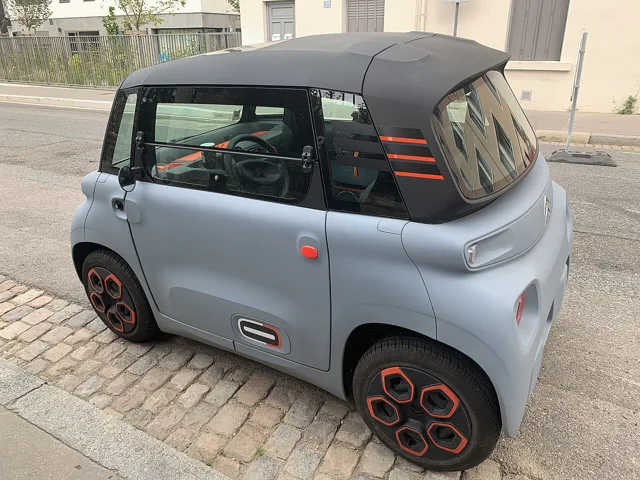
The most sensible electric vehicle on Earth costs about the same as a used golf cart, weighs less than the battery of a Hummer EV, and you cannot buy one in the United States. Not because Americans wouldn’t want it — plenty would — but because the way this country writes its rules and sizes its roads has quietly made the Citroën Ami close to impossible to sell here. That’s worth sitting with. The nation that will happily sell you four plugged-in tons has no comfortable slot for 485 kilos of common sense.
The Ami is a two-seat electric box, 2.41 meters long, with a top speed of 28 mph and a range around 47 miles. In Europe it’s a quiet phenomenon. In America it’s a thought experiment about everything the car market here refuses to allow.
What it is, and why Europe fell for it
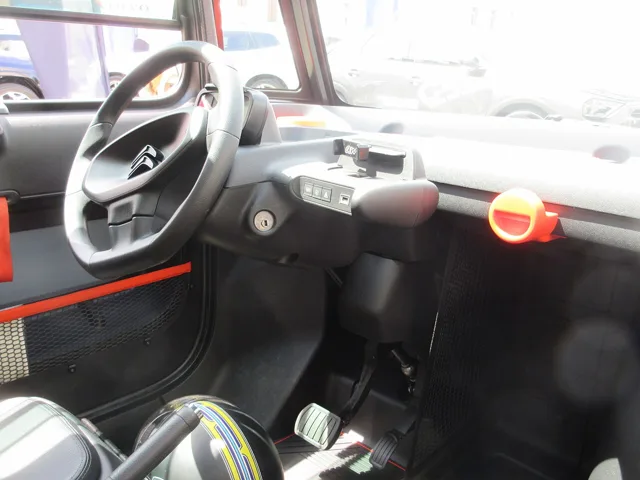
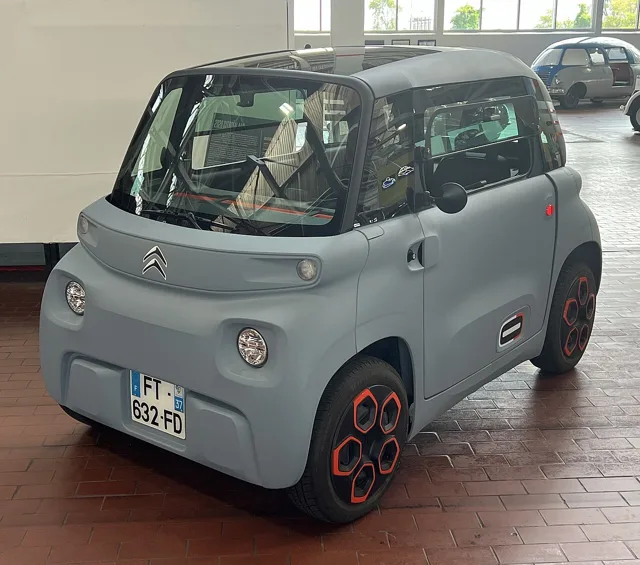
Citroën unveiled the Ami in February 2020 and put it on sale that June. Legally it isn’t a car at all — it’s an L6e light quadricycle, which in much of Europe means you can drive it at 14 to 16 years old with a moped permit, sometimes with no car license whatsoever. A 6 kW motor (about 8 hp), a 5.5 kWh battery under the floor, 45 km/h flat out, a three-hour charge from a normal wall socket. It weighs 485 kilograms. For scale an American can feel: the battery pack alone in a GMC Hummer EV weighs nearly three times what an entire Ami weighs.
The genius is in the frugality. To cut cost to the bone, Citroën built it almost symmetrically — the two doors are physically the same part mounted in opposite directions, which is why the driver’s door hinges at the front and the passenger’s at the back. Front and rear bumpers are identical. It’s assembled in Kenitra, Morocco, to keep the price near €6,000–8,000. Every decision screams the same thing: strip out everything you don’t need. Europe, choking on congestion charges and low-emission zones and parking that costs more than fuel, took one look and understood. It sells by the tens of thousands, and Citroën has spun off siblings — the Opel Rocks-e and the Fiat Topolino — from the same little platform.
Why America can’t have it
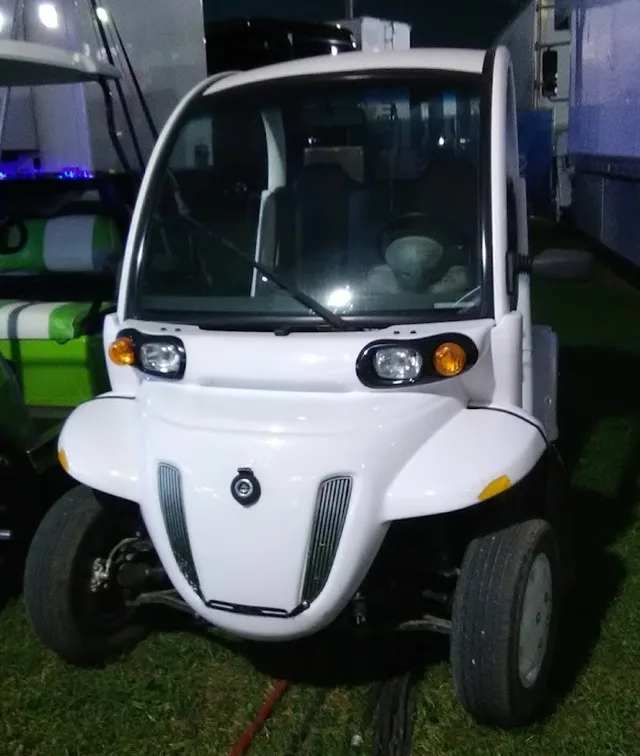
Here’s the part that should bother a U.S. reader. America does have a category for tiny electrics — the Neighborhood Electric Vehicle, or Low-Speed Vehicle. It was carved into federal law back in 1998, when the National Highway Traffic Safety Administration created a new class under Federal Motor Vehicle Safety Standard 500: a four-wheeled vehicle capped at 25 mph, allowed on public roads posted at 35 mph or below, required to carry little more than seat belts, headlights, mirrors and a windshield. It was written for retirement communities, master-planned towns and university campuses — for the Florida golf-cart-as-transport culture — not for a European microcar.
And that single number is the trap. The Ami’s 28 mph top speed pokes just over the 25 mph ceiling, which lands it in a regulatory no-man’s-land: too fast for the Low-Speed Vehicle rules, too slow and far too light to pass as a federal passenger car with airbags, crumple zones and the full battery of crash tests. There’s no American category that fits a vehicle built to a European quadricycle standard. On top of that, Citroën pulled out of the U.S. market decades ago and sells nothing here, and the 25-year import rule — the same law that keeps enthusiasts from importing a new Nissan Skyline — would keep any Euro-spec Ami off American roads until the 2040s. So the single most rational city vehicle of the era is, for practical purposes, absent.
It’s worth noting the irony. The same country that can’t find a slot for the Ami once ran a thriving NEV experiment of its own: in the early 2000s DaimlerChrysler owned a brand called GEM, Global Electric Motorcars, that sold tens of thousands of little low-speed electric runabouts. The appetite was there. The rules just boxed it into gated communities and never let it grow up into real transportation.
It isn’t only the law — it’s the shape of the country
Kill the regulation tomorrow and the Ami would still struggle here, because the obstacle is also physical. American cities were poured around the car, the interstate and the two-SUV driveway. Lane widths, block sizes, the sheer distance between where people live and where they buy groceries — all of it assumes a full-size vehicle doing 45 mph on a stroad. A machine engineered to thread a medieval alley and sip electrons on a two-mile hop solves a problem that American zoning spent seventy years making sure nobody would have to solve with a small car. Where a European sees the perfect second vehicle, a teenager’s first set of wheels, a delivery runabout, an American land-use map sees nothing it was built to accommodate.
There’s a telling parallel here, and it’s the Japanese Kei car — those tiny, tax-advantaged city cars that are wildly popular in Japan and, like the Ami, essentially unsellable new in the U.S. for the same crash-standard reasons. America keeps proving it has no legal or cultural home for the small car, no matter who builds it or how well it works abroad.
What Americans actually bought instead: the e-bike
And yet the demand the Ami answers didn’t vanish in America — it found another outlet. Over the past few years the United States has lived through an electric-bike boom, millions of units sold, because people genuinely do want cheap, light, electric ways to cover the short trips that make up most of daily life. The e-bike is what the American market reached for when the small electric car was off the table. The Ami and a good e-bike are chasing the same customer: the person who doesn’t need two tons of steel to fetch a bag of groceries two miles away.
The difference is the roof. An e-bike leaves you soaked in the rain, baking in July, exposed in traffic, and useless for a kid or a passenger. The Ami is the e-bike’s logic with weather protection, a heater, a second seat and a metal shell around you. That America embraced one and legislated the other out of existence tells you the want was never the problem. The container was.
The Hummer and the Ami, side by side
Put the two vehicles this website has now written about next to each other, because the contrast is the whole argument. The GMC Hummer EV: around 4.1 tons, roughly 1,000 hp, a six-figure price, barely 1.5 miles per kWh, sold as green progress and perfectly legal in all fifty states. The Citroën Ami: 485 kilograms, 8 hp, the price of a nice e-bike, dirt-cheap to run, and effectively unbuyable in America. One of these is a rational answer to urban transport. The other is a monument to excess. Guess which one the American system makes easy to own.
That’s not a knock on Americans who want something bigger for the highway life many genuinely live. It’s a knock on a system that has made the wasteful option the default and the frugal option the forbidden one. Europe taxes weight and rewards small; America, through the light-truck loopholes baked into its fuel-economy rules, the NEV speed caps and a market addicted to size, does close to the opposite. The federal footprint formula even rewards automakers for building bigger vehicles. The Ami is the clearest proof of what those incentives produce: a continent where a 14-year-old can run errands in a clean little box, and a continent where the entry-level EV is a thing you can’t legally register.
Sold like a phone, not like a car
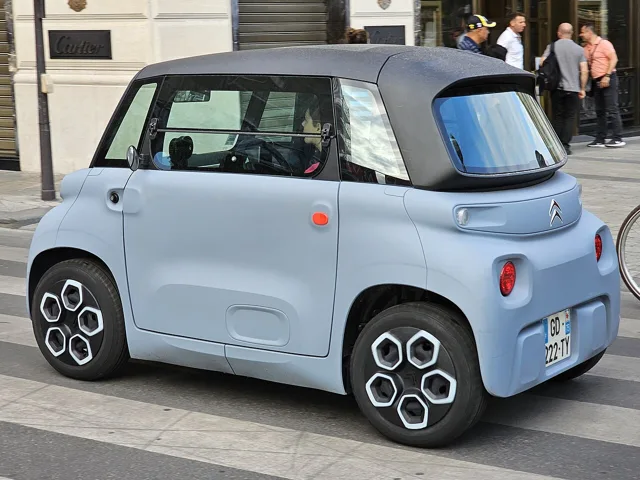
Here’s another piece Americans would find strange. The Ami isn’t sold through the ritual of the dealership — the test drive, the finance desk, the trade-in haggle. In France you can order one online, take it on a monthly subscription, or in some cases walk into a consumer-electronics store and buy it the way you’d buy a laptop. Citroën priced and packaged it to be bought on impulse, as an appliance, not negotiated over for an afternoon. Whole car-sharing fleets of them run in European cities, rentable by the minute like a scooter but with a roof over your head. It has become a last-mile delivery tool in congested centers where a van is a liability and a cargo bike leaves the driver soaked.
That matters because it shows the Ami isn’t solving an invented problem. It’s being used, right now, by couriers and commuters and parents and teenagers, for the short urban hop that is the single most common trip anyone makes. The American car industry designs for the twice-a-year road trip to the lake. The Ami designs for Monday morning. And Monday morning is almost everything.
The flaws, stated plainly
NEB doesn’t flatter even the car it roots for. The Ami’s limits are real and brutal. At 28 mph you cannot leave the city; if your life involves a highway, this is not transportation, it’s a paperweight. Real-world range drops below the rated 47 miles once you turn on the heat. The equipment is monastic — windows that flap open by hand like a 2CV, zero driver aids, a ride that transmits every seam in the pavement. And the price, once you convert it from euros, isn’t the toy-store bargain its looks promise: for that money there are plenty of real used cars with four seats and a highway on-ramp.
None of that invalidates it, because every one of those limits is a consequence of what the Ami chose not to be. Buy it thinking it’s a small car and you’ll hate it. Understand it as a large, weatherproof, two-seat answer to the short urban trip, and nothing touches it on price or on sense.
The verdict
Here’s NEB’s read.
The electric car was born, more than a century ago, to be cleaner and more sensible than the alternative. The Ami is one of the very few vehicles on sale that actually honors that original brief — and it’s the one America has arranged, almost by accident, to keep out. That tells you less about the Ami than about the market that has no room for it. A country that can register a 9,000-pound electric truck as a personal vehicle but has no clean path to sell a 1,000-pound electric box has not run out of engineering. It has run out of imagination about what a car is for.
The Ami isn’t too little car. It’s the right amount of car for the trip most people actually take, built by the one company with the nerve to make it. The fact that you can’t have one here isn’t the Ami’s failure. It’s America’s.
Unplug and enjoy.
Images: Benoît Prieur (CC0) · Wikimedia Commons (public domain) · TaurusEmerald (CC BY-SA 4.0) · MercurySable99 (CC BY-SA 4.0) · Damian B Oh (CC BY-SA 4.0)
1 thought on “Citroën Ami: the car America isn’t allowed to want”