EV Battery Thermal Management: Why Two Identical Cars Age Differently
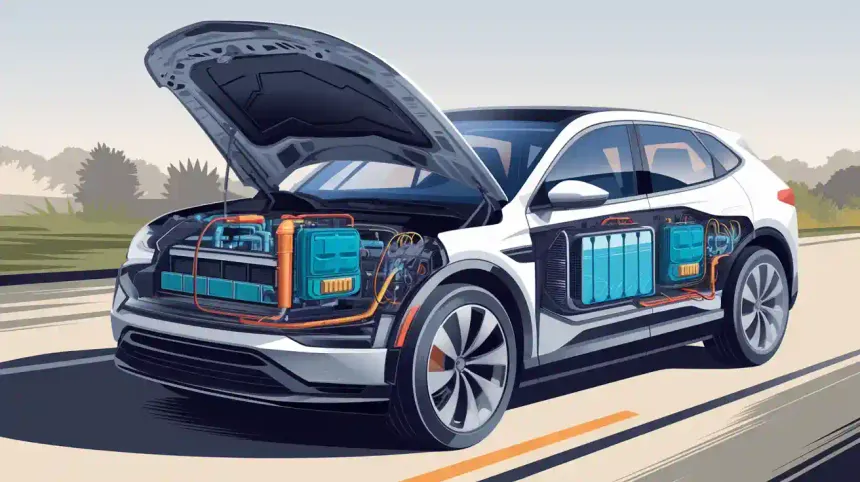
Two EVs with the same battery, bought the same day, can end up one with a healthy pack and the other half-dead in five years. The difference isn’t the chemistry. It’s how they’re cooled.
It’s the most invisible part of an electric car and the one that most decides how long your investment lasts. Nobody shows it to you at the dealership, it’s not in the ad, it has no flashy number on the spec sheet. But while you argue about kilowatt-hours and range, there’s a system working silently under the floor that determines whether your battery still shows up in a decade or gives out before you’ve finished paying for it. It’s called thermal management, and its co-pilot is the BMS. Let’s get our hands down there.
The battery is a diva that only works in its comfort zone
Lithium-ion cells are delicate creatures with a ridiculously narrow comfort zone: they perform best between roughly 15 and 35°C, with the sweet spot around 20-25. Outside that, everything goes wrong.
In the cold, lithium ions move slowly, like a stiff body on a winter morning. Internal resistance rises, the battery delivers less power, accepts less charge, and gives you less range. Heat is worse: sustained high temperatures accelerate degradation, and if things really spike, the specter of thermal runaway appears, the chain reaction that ends in fire. And there’s a silent enemy, the worst of all: leaving the battery full and hot, parked in the sun at 100% in the middle of a Phoenix August. That ages it faster than almost anything else, which is why battery-health guides everywhere tell you to park an EV somewhere between 30 and 70% in the heat, not brimmed to the top.
The thermal management system’s job is, in theory, simple: keep every cell as close as possible to that ideal temperature, as even as possible across the pack, using as little energy as possible. In practice, it’s one of the car’s biggest engineering challenges, and where the good ones separate from the mediocre.
Air versus liquid: the decision that sets the pack’s whole life
There are two big philosophies for cooling a battery, and the gap between them is enormous.
Air cooling is the simple, cheap one: you let air, sometimes pushed by fans, carry heat away from the cells. It weighs less, has no fluids or pumps, no possible leaks, and it’s easy to maintain. The problem is that air is a lousy heat carrier. When you really push the pack (fast charging, a mountain grade in summer, hard use), the air can’t keep up, it leaves hot and cold zones inside the same pack, and those temperature differences make some cells age faster than others. An uneven pack is a pack that dies in pieces, and once a few cells fall behind, the whole battery performs like its weakest link.
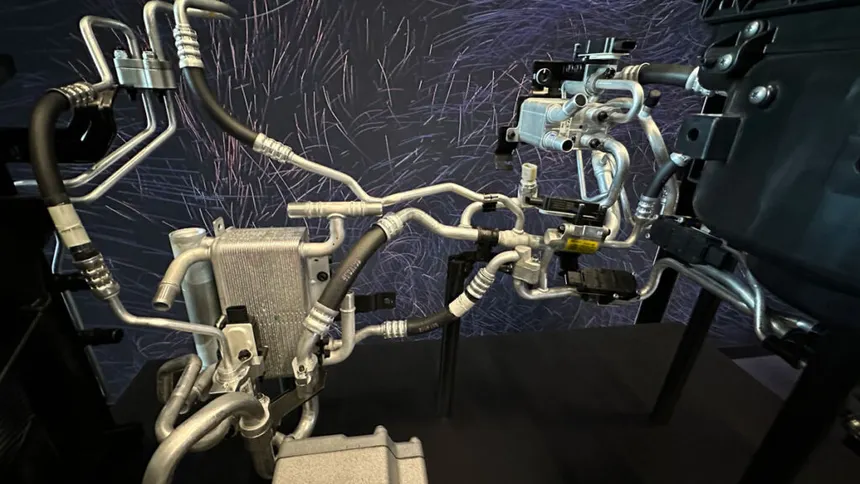
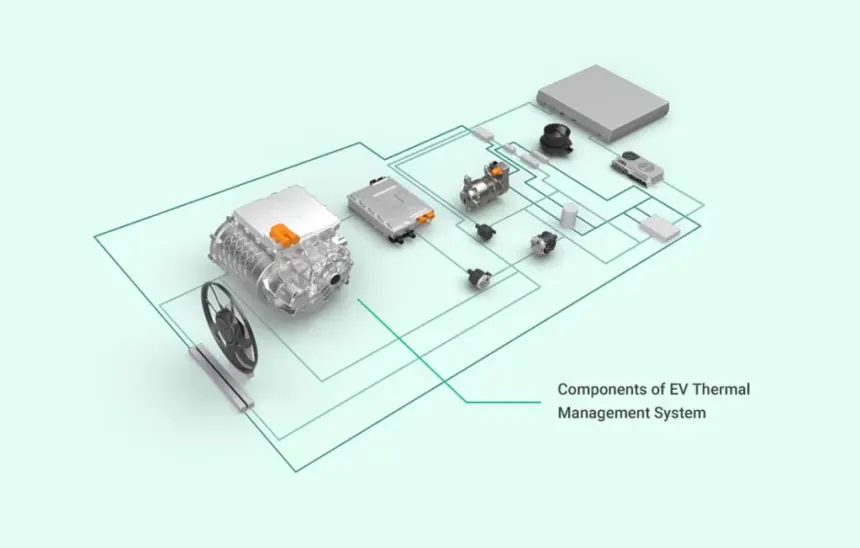
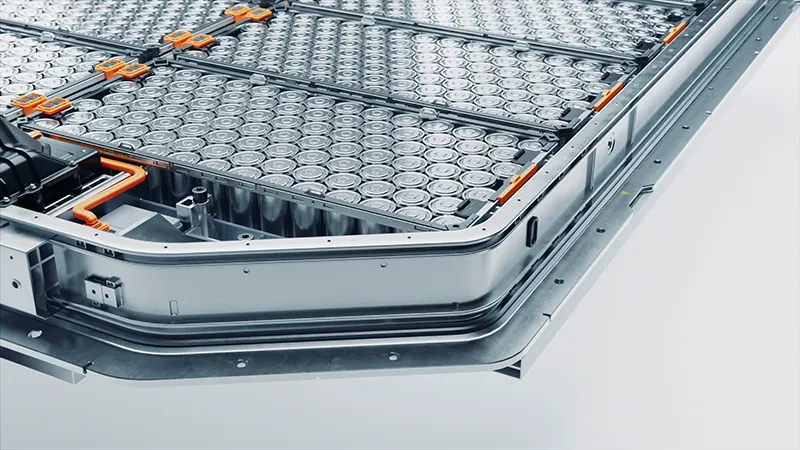
Liquid cooling is the serious one: a coolant loop, usually a water-glycol mix, runs through metal plates or channels bonded to the cells, absorbs the heat, and carries it to a radiator or a chiller shared with the car’s air conditioning. It’s heavier, pricier, and more complex (pumps, hoses, valves), but it dissipates heat far better and, above all, keeps every cell at an even temperature. That’s why practically every self-respecting modern EV uses it. The most advanced systems go beyond cooling: they recover waste heat from the motor and electronics to warm the battery in winter without spending extra energy, and use a heat pump, shared with the climate control, to move heat from where there’s too much to where there’s too little. Electronic valves decide moment to moment who gets cooling or heating: the battery, the motors, the cabin, or all three. It’s a puzzle of radiators and refrigerators working in concert. And the frontier keeps advancing: phase-change materials that absorb heat without spending energy, and immersion cooling, which bathes the cells directly in a non-conductive fluid for maximum thermal control, the bet makers and suppliers are chasing for the next generation.
The case that terrified an entire industry: the Nissan Leaf
Here’s the real story that proves it all, the one that turned fear of degradation into a collective trauma. Because the Nissan Leaf, the best-selling EV in the world for years, committed a sin the industry still hasn’t fully recovered from: it’s just about the only mainstream EV ever sold without liquid cooling on the battery.
Nissan chose passive air cooling, leaving the pack’s temperature at the mercy of the elements. The result was a bloodbath, especially in hot climates, which in America means a huge chunk of the market. An independent test in Arizona in 2012 found a Leaf with barely 60-65% of its original capacity, able to drive only 59 miles, less than two years old. In hot climates like Phoenix or Texas, early 24 kWh Leafs could lose 30 to 50% of capacity within a few years. And the cold numbers finish it off: a Geotab study put the 2015 air-cooled Leaf’s average degradation at 4.2% per year, nearly double the 2.3% of a same-year, liquid-cooled Tesla Model S. Same world, same era, twice the decay.
The Leaf had a second punishment from the same sin, mockingly dubbed Rapidgate. Because the pack heats up and can’t cool well, on consecutive fast charges the BMS is forced to cut power to protect the cells: the first stop might touch 50 kW, but the second or third collapses to 20-30 kW, stretching times until a long trip becomes impractical. The car wasn’t broken. It was protecting itself from a design that left it out in the open.
The competition learned the lesson. When GM designed the Chevrolet Bolt, having watched the Leaf disaster, it gave it generous cooling and a buffer that hides part of the real capacity. Result: Bolts with over 100,000 miles that have barely lost battery. That contrast, two cars of the same generation aging in opposite directions, is the proof that thermal management isn’t a detail. It’s the detail. Every EV on sale in the U.S. today ships with active thermal management, and the Leaf is exactly why. The damage went beyond the cars themselves: the Leaf’s reputation is a big reason so many American buyers still fear EV battery degradation as if it were a universal law, when in fact it was one company’s cooling shortcut. Resale values of early Leafs cratered precisely because the market learned to read the missing cooling as a countdown timer.
The brain nobody sees: what the BMS really does
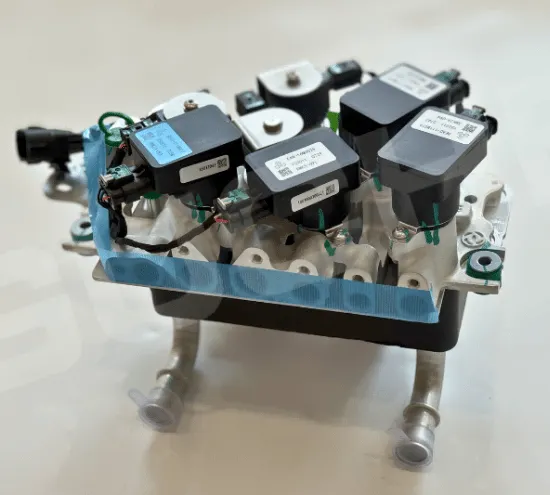
If cooling is the muscle, the BMS is the brain. The letters stand for Battery Management System, and it’s one of the most underrated pieces of engineering in the car.
Picture a pack with thousands of cells. The BMS watches them all at once, in real time. A modern pack generates over 1,000 temperature readings per second, and at the same time the BMS tracks every cell’s voltage and current. With all that data it does several things at once, none of them minor.
First, it protects: it stops any cell from leaving its safe voltage or temperature zone, cutting or limiting current when needed. Second, it calculates: it estimates the state of charge (the famous battery percentage) and the pack’s state of health, neither of which is measured directly but deduced from electrical behavior. Third, and here’s the jewel almost nobody knows, it balances: the BMS does cell balancing, evening out charge across all cells so none falls behind or gets overcharged. Without balancing, the weakest cell drags down the whole pack, because a battery performs only as well as its worst cell. It’s the silent work that keeps the whole thing healthy year after year.
And it decides: the BMS rules over the pack’s cooling and heating, orders the battery preconditioned before a fast charge, cuts charging power when it senses heat. Every smart decision your car makes about its own battery comes from there. And it’s no dumb brain: modern BMS units bring in machine learning, cloud monitoring, and over-the-air updates, so your car can improve how it manages its battery over time, without you ever visiting the shop. Same hardware, better software, ages better.
The trick they don’t tell you: the hidden buffer
Here’s one of the best-kept secrets, and one reason the brochure capacity is almost never the one you use. Serious manufacturers don’t let you use the real 100% of the battery. They reserve a hidden cushion, a buffer, at the top and bottom, that the BMS won’t let you touch.
Why? Because the extreme charge zones, near 0 and near 100%, are the ones that punish the cell most. By hiding a slice of capacity and never letting you reach the real extremes, the maker sacrifices a few miles of paper range in exchange for a battery that lasts far longer. The Chevrolet Bolt was a textbook example: its apparent capacity was somewhat lower than the real one, and that reserve is part of why it aged so well. When you see a car “only” has 74 usable kWh out of a 79 gross pack, they’re not cheating you: they’re extending your battery’s life with a cushion that works for you without you knowing. It’s also why federal battery warranties, eight years and 100,000 miles, are a bet the maker can afford: the buffer and the cooling are what let them promise it with a straight face.
So what should you look for?
Something the spec sheet hides and you have to dig for yourself: how the battery of the car you want is cooled.
If you live in a hot climate, this isn’t a techie detail: it’s the difference between a car that holds up and one that visibly deteriorates, and between a decent resale value and a sunken one. Look up whether the model and year you’re eyeing uses liquid or air cooling. If it’s used, ask for a battery health report before you sign anything, because two cars identical on paper can be in completely different states depending on how they were treated and cooled.
Here’s the closing shot, and I won’t soften it: we’ve spent years obsessed with kilowatt-hours and rated range, staring at the big number while ignoring the part that decides whether that number will still be true in eight years. Thermal management and the BMS are the silent guardian of your investment, and the maker doesn’t tell you about them because they don’t sell as well as a round figure. Next time you compare two EVs, don’t just ask how many miles it does today. Ask how it’ll age, and how it keeps its battery cool. Because chemistry gives you the battery, but cooling decides how long you keep it.
Unplug and enjoy.
1 thought on “EV BATTERY THERMAL MANAGEMENT”