The EV Inverter: The Part That Decides Your Range and That Nobody Talks About
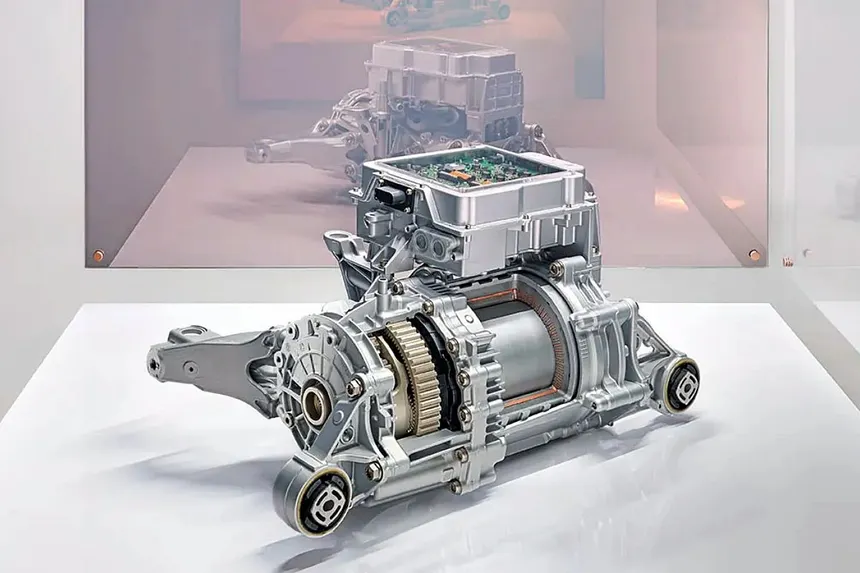
Your electric car isn’t moved by the motor. It’s moved by a box the size of a briefcase that almost nobody can name.
It’s called the inverter, and it’s the most important component no salesman has ever mentioned to you. While everyone argues about motors and battery kilowatt-hours, the part that actually decides how much range you pull from each charge works in silence, invisible, never once appearing in an ad. And here’s what you should know: two cars with the same battery and the same motor can perform differently based on nothing but what’s inside this box. For an American buyer chasing the promise of a cheap EV, it’s also ground zero of a fight between performance and cost that’s playing out in real time. Let’s open it up.
What it does, and why you go nowhere without it
Start with the basics, because almost nobody has this straight. Your car’s battery stores direct current —plain old DC, the kind that comes out of a flashlight battery. But the traction motor runs on three-phase alternating current. Between those two incompatible worlds sits a translator, and that translator is the inverter: it takes the DC from the battery and turns it into the AC the motor needs, thousands of times a second.
But it’s not a dumb converter. It’s the brain that decides, at every instant, exactly how much current and in what shape to send the motor to deliver the torque you’re asking for with your right foot. When you accelerate, when you brake and regenerate, when you hold speed on the interstate, the inverter modulates all of it. It is, literally, the central nervous system of the electric car. Without it, the battery and the motor are two strangers who don’t speak.
And here’s what matters to your wallet: the inverter is one of the largest sources of energy loss in the whole high-voltage system outside the motor itself. Every percentage point lost in the inverter as heat is a point of range that never reaches your wheels, and a point of battery you paid for and won’t use. That’s why it’s quietly become the most contested component on the spec sheet, the place where engineers fight hardest for efficiency —even though you never see it, and no marketing team will ever put it on a banner.
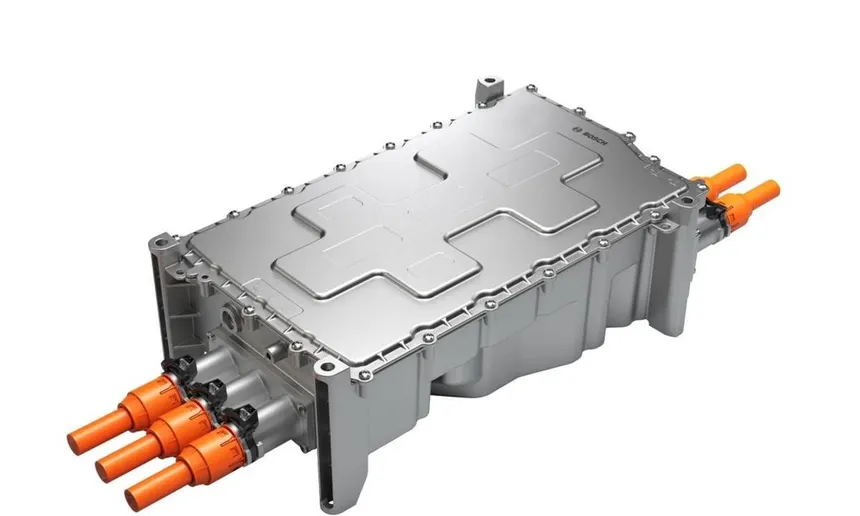
The heart of the inverter: the switch that flips thousands of times a second
All the inverter’s work falls on power transistors —switches that open and close at absurd speeds to chop the DC and shape it into AC. And the material those switches are made of changes everything. There are two players here, and the fight between them defines the generation of car you’re buying.
The veteran is the silicon IGBT, the insulated-gate bipolar transistor. For two decades it’s been the undisputed king: cheap, rugged, low conduction loss at high current, which is why it dominates the 400-volt EVs that make up most of the market. Its weakness is speed: by how it works, it can’t switch much faster than around 15,000 cycles per second without wasting energy, and a chunk of the current passing through it ends up as heat in the module.
The challenger eating the market is silicon carbide, SiC. It’s what engineers call a wide-bandgap semiconductor, and without diving into physics, the practical consequence is brutal: it switches far faster, handles more voltage, runs at higher temperatures, and loses considerably less energy in the process. A SiC module takes a fraction of the space of a silicon one for the same job, and cuts losses nearly in half.
How much does that show? Inverter efficiency climbs from a typical 96-97% on silicon to 98-99% on silicon carbide. Sounds like nothing, two points, a rounding error. It isn’t. Those two points are free range, and the best part is that the biggest gain isn’t at full throttle but at partial loads —the gentle city speeds and highway cruising where you actually spend your driving life. In round numbers, swapping silicon for silicon carbide delivers a 3 to 5% efficiency gain over a real drive cycle. That’s miles that appear without touching the battery or the motor.
The move almost nobody remembers: Tesla lit the fuse
Here’s the story you don’t get told, and it explains why half the industry is chasing silicon carbide today.
It was 2018, and Tesla did something nobody had dared to: it put a full silicon carbide module in the main inverter of the Model 3, working with Europe’s STMicroelectronics. It was the first premium automaker to bring SiC to a safety-critical component like the traction inverter. The teardown revealed an inverter built from 24 power modules on a pin-fin heatsink, tiny and packing enormous power density. As the first automaker to trust SiC in a safety-critical part, Tesla played it conservative: each switching position paralleled eight 650-volt STMicroelectronics dies —48 in total— because it didn’t have the luxury of millions of miles of road data to lean on. That was the starting gun for the whole industry.
The effect was an explosion. The automotive silicon carbide market went from under $100 million in 2017 to around $1 billion in 2021, with forecasts topping $6 billion before the decade’s out. Tesla had, without meaning to, invented an entire market. The Renault-Nissan-Mitsubishi alliance signed with STMicroelectronics too, Bosch stood up a plant in Dresden, and the semiconductor giants piled into the race. Building SiC wafers at automotive quality is brutally hard, which is why ST is expanding in Catania, onsemi in the Czech Republic, and Wolfspeed on U.S. soil —a scramble for capacity that America has a real stake in. The Kia EV6 GT, for one, uses onsemi SiC modules to handle its 800 volts, and onsemi is an American company, one of the names about to get caught in the whipsaw that came next.
And the twist that tanked the chipmakers
But the story has a second act almost nobody connects to the first, and it’s pure NEB.
At its March 2023 Investor Day, Tesla dropped a bomb. Colin Campbell, its powertrain engineering chief, announced that its next powertrain would use 75% less silicon carbide, without compromising performance or efficiency. His words were plain: silicon carbide is an amazing semiconductor, but it’s expensive and really hard to scale, so using less of it is a big win. The same Tesla that had made SiC fashionable was now walking away from it.
Wall Street’s reaction was instant and brutal. Shares of ON Semiconductor and STMicroelectronics fell around 2%, and Wolfspeed —an American pure-play silicon carbide maker— cratered about 7%. Even MP Materials, the U.S. rare-earth supplier, dropped 11% on a related comment about magnet-free motors. Investors panicked, figuring that if the SiC pioneer was turning its back, maybe the whole industry would follow.
The fine print that calmed the waters? That 75% cut applies only to a future low-cost powertrain for Tesla’s cheap car —the one whose drive unit is targeted to cost about $1,000, aimed squarely at the sub-$25,000 market. It doesn’t touch today’s Model S, X, 3, or Y, which keep their silicon carbide. Analysts point to that cheap inverter having a hybrid architecture: a mix of silicon and silicon carbide transistors working together, SiC for the moments of peak demand and cheap silicon for the rest. Analysts also note this hybrid trick only works on a brand-new platform —a low-cost, lower-power car —not on the existing S, X, 3, Y or Cybertruck, and that the cheap next-gen Tesla wasn’t expected in volume before 2025 or 2026. It’s not that silicon carbide is bad. It’s that it’s expensive, and for a car that has to be cheap, every dollar counts. That’s the whole secret, and it’s why the inverter in your next car will be an accounting decision as much as an engineering one.
The catch the SiC makers don’t shout as loud
Because it’s not as simple as “silicon carbide good, silicon bad,” and this is where the straight talk parts ways with the brochure.
A well-designed silicon IGBT, with good control software and a tuned switching strategy, is still tremendously competitive in a real car. Silicon carbide’s advantage shines brightest at very high switching frequencies —higher than a traction system actually needs; in the 10,000-to-15,000-cycles-per-second range cars use, the gap narrows a lot when silicon is paired with good electronics.
And there’s a silicon carbide problem almost nobody mentions: it switches so fast, with such steep voltage transitions, that at 800 volts and above those abrupt edges can trigger partial discharge in the motor winding’s insulation and throw off more electromagnetic noise. Silicon, slower and gentler in its transitions, punishes the motor less. In other words: the faster, more efficient switch is also the more aggressive one on the rest of the system, and taming it has an engineering cost. The best inverter isn’t automatically the one with the newest semiconductor; it’s the one that best balances efficiency, cost, reliability, and integration for that specific car.
What’s coming: gallium nitride
If silicon carbide is the present, there’s a third material poking its head up: gallium nitride, GaN. It’s another wide-bandgap semiconductor, but with a different profile: it shines at even higher switching frequencies and in lower-voltage, lower-power applications. Today its natural home is more in chargers and auxiliary electronics than in the high-power main traction inverter, where silicon carbide rules more comfortably. The industry talks about a sixth generation of transistors where SiC takes the high-voltage work and GaN takes the high-frequency, low-voltage jobs. It’s not a winner-take-all battle; it’s a division of territory.
So which inverter do you want underneath?
The straight answer is: depends on which driver you are, again.
If you’re buying a premium 800-volt EV that brags about ultra-fast charging and squeezing out every mile, you want silicon carbide, no question, and it probably already has it. If you’re buying a 400-volt runabout built to be affordable, a good silicon inverter with well-tuned electronics will give you a reliable, cheap car without you ever noticing the difference day to day. And if they sell you an entry car with a hybrid inverter, they’re not ripping you off: they’re giving you silicon carbide exactly where it matters and saving it where it doesn’t.
Here’s the closing shot, and I won’t soften it: you’ve spent years hearing about motors and kilowatt-hours like they’re the only things that count, while the part that actually translates battery energy into motion doesn’t even make the spec sheet. Next time you compare two EVs with similar batteries and motors and notice one goes farther on the same numbers, you know where to look. The difference isn’t in what they show you. It’s in the box nobody names.
Unplug and enjoy.