
EVs imitating gas cars: do electric cars dream of V8s?
Blade Runner is set in Los Angeles. November 2019. Rain, neon, and a corporation selling machines that look, talk and bleed like people. Its slogan: more human than human.
Walk into an American car dealership today and you’ll find the same business model. Electric cars with the faces of gas cars, the names of gas cars, fake gearshifts and speakers pumping out engines that aren’t there. More gasoline than gasoline. And the people building them don’t seem to believe in what they’re selling.
In 1968 Philip K. Dick published a novel asking whether machines could have a soul. He called it Do Androids Dream of Electric Sheep? Fourteen years later Ridley Scott turned it into Blade Runner. The question has since moved from the movie theater to the showroom: do electric cars dream of V8s?
From what we’re seeing, they do. They dream of becoming the thing they were built to replace. And they don’t dare dream of anything else.
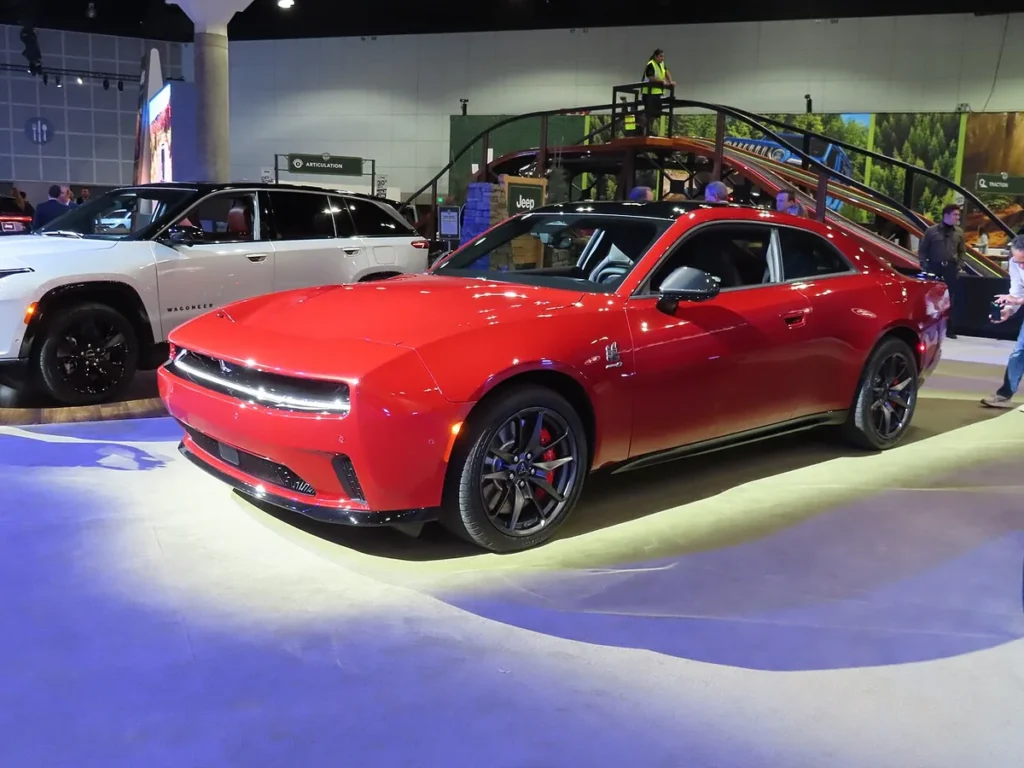
The replicant with a Hellcat in its speakers
Start with the most American case of all.
When Dodge decided the Charger had to go electric, it ran into a problem no engineer can fix: a silent muscle car isn’t a muscle car.
Its fix got a product name: the Fratzonic Chambered Exhaust. An “exhaust” that exhausts nothing, because there’s nothing to exhaust. It’s an amplifier working with a tuning chamber at the back of the car. When Dodge showed it on the 2022 Charger Daytona SRT Concept, it announced it could hit 126 decibels, the same as the supercharged Hellcat V8. They gave a speaker a brand name and sold it like hardware.
Then came the sales. In the first half of 2026, Dodge delivered 534 electric Chargers in the U.S., down 88% from 4,299 in the same stretch of 2025. In the second quarter of 2026 alone, it sold 2,911 gas Chargers.
The numbers don’t tell you why. We’ll tell you what we think: buyers ran the Voight-Kampff test on this car and picked out the replicant.
In the film, the Voight-Kampff is the test blade runners use to catch replicants. It measures emotional response. On the outside, a replicant is a perfect copy. What gives it away is what it feels, or doesn’t.
The pony that isn’t a pony
Ford had a new electric SUV and named it Mustang. The Mustang Mach-E, galloping pony on the nose. A nameplate that since 1964 had meant a two-door sports car.

The backlash was fast. By December 2019 there was a Change.org petition, started by automotive journalist Jimmy Dinsmore, co-author of Mustang by Design, asking Ford to strip the Mustang name and pony badge off the car. Ford didn’t budge.
And in Europe, Ford did something worse. The original Capri, the coupe Ford launched in 1969 as Europe’s pony car, ran three generations until 1986, and almost two million were built. North America knew it too, sold under the Mercury brand. On July 10, 2024, Ford revived the name for a five-door electric SUV coupe. It isn’t even a Ford underneath: it rides on Volkswagen’s MEB platform, the same one under the ID.5. Ford even said the new Capri is what the original would have become if it had never gone out of production.
A Volkswagen wearing the skin of a dead Capri, with its history rewritten.
That’s a textbook replicant. Built in someone else’s factory, carrying implanted memories of a life that was never its own.
The list goes on. Dodge called its electric muscle car a Charger. GMC brought back Hummer, a name that used to mean gas guzzling, and put it on an EV. Porsche put the Cayenne name on its electric SUV.
A face built for an engine that isn’t there
A grille exists to let air in and cool a combustion engine. An EV needs far less cooling, and still half the industry keeps giving it the face of a gas car.
BMW is the textbook case. When it unveiled the iX in November 2020 and the i4 in 2021, the size of the kidney grilles got as much attention as the electric hardware. On the iX, BMW itself explained that the electric drive needed so little cooling air that the grille was completely blanked off and turned into a panel for the camera, the radar and other sensors. A grille that doesn’t let air through. BMW design chief Domagoj Dukec defended it with a line that says everything: the kidney isn’t just an air-cooling system, it’s the strongest differentiator between BMW and its competitors.
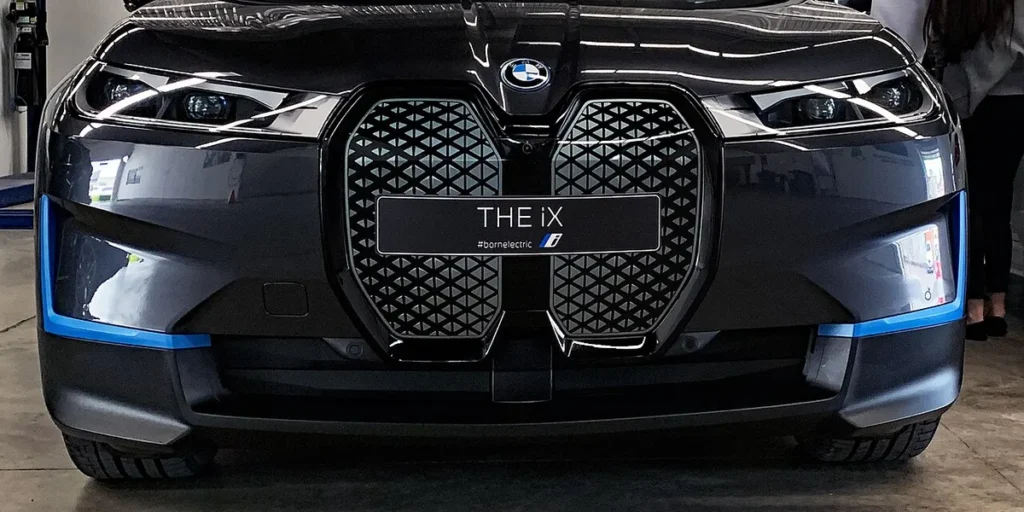
Fine, the sensors have to go somewhere. Nothing forced BMW to put them inside two giant kidneys. That shape isn’t there for cooling. It’s there so you know it’s an old-school BMW.
The GMC Hummer EV‘s front end, where a gas truck would have its grille, was described by Bloomberg as pure showmanship.
Mercedes did the same with the EQC, its first mass-production EV, in 2019: a big grille in front of a motor that didn’t need one. Its lead exterior designer, Robert Lesnik, admitted the design was shaped by the fact that the car was built alongside the gas GLC at the Bremen plant. Underneath, the EQC used a heavily modified version of the GLC’s platform and inherited its axles and interior.
Then Mercedes went further, in reverse. It had created a sub-brand just for EVs, EQ, with names of their own: EQC, EQE, EQS. When the EVs didn’t sell as hoped, it started burying it. The EQC went out of production in 2023. Its successor isn’t called EQ anything. It’s a GLC, like the gas car, “with EQ technology.” The new electric GLC finally rides on a dedicated EV platform, MB.EA, and shares no body panels with the gas model. So Mercedes fixed the bones, then gave it the gas car’s name and a bigger grille. Fix what you can’t see, disguise what you can.
Mercedes ran the same play in Spain. On September 4, 2020, its Vitoria-Gasteiz plant in the Basque Country began series production of the EQV, the brand’s electric minivan. No bones of its own: it shared its body with the combustion V-Class and came off the same assembly line, mixed in with combustion V-Class and Vito vans, alongside the eVito. An EV built from the parts, and on the line, of the vehicle it was meant to replace. Its successor, the VLE, in series production at Vitoria since June 2026, finally gets a dedicated electric platform, VAN.EA. And like the GLC, it has lost the EQ letters.

That’s exactly what the Tyrell Corporation does with its replicants. It gives them a human face so nobody panics.
Stick shifts for cars with no gears
Most EVs don’t have a multi-speed transmission, because they don’t need one (here’s why almost every EV runs a single gear). Automakers are building them fake ones.
Toyota is the company that pushed the #SaveTheManuals hashtag when it brought back a stick-shift Supra. Now look at what it’s doing with EVs. In December 2022, at the Kenshiki Forum, Lexus showed a prototype of the electric UX 300e with a shifter, a “clutch” pedal and a tachometer. All software. Botch the shift and the car stalls. Lexus Electrified chief engineer Takashi Watanabe said the only thing they hadn’t reproduced was the smell of gasoline, and that the system could end up in future Lexus EVs.

An electric car that stalls. Read that again.
Hyundai already went to production. The Ioniq 5 N, an EV with more than 600 horsepower, wasn’t trusted to be enough on its own. Hyundai gave it N e-shift, which simulates an eight-speed dual-clutch automatic by cutting motor torque for an instant so you feel the jolt of a shift that doesn’t exist. Then it added N Active Sound+, ten speakers, eight inside and two outside. It has three sound themes. One of them, Ignition, mimics a gas engine and exhaust, complete with pops and bangs on downshifts. The other two, Evolution and Supersonic, don’t imitate any combustion engine, and there Hyundai is actually searching for a voice of its own. But the gas-engine mode is right there next to the fake gearbox. Hyundai launched the car and both systems at the Goodwood Festival of Speed in July 2023. It was the first EV to simulate an eight-speed dual-clutch.
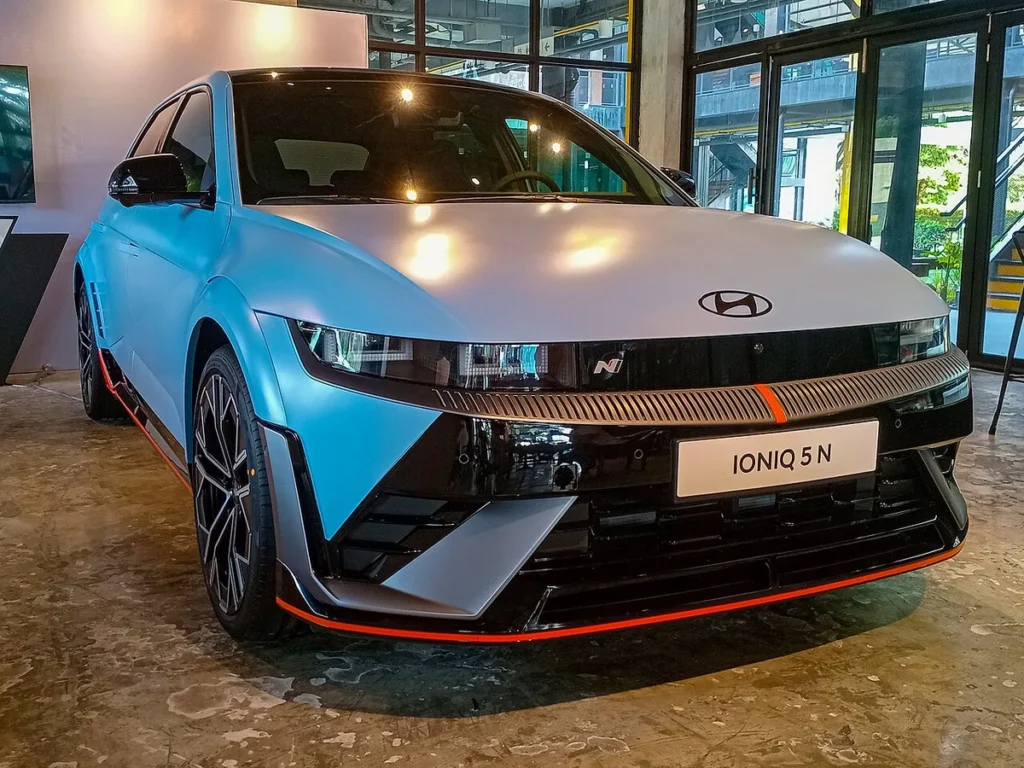
It didn’t stop there. The Ioniq 6 N gets its own version. Since August 2025, European owners of the Ioniq 9, a three-row family SUV, can buy Virtual Gear Shift in Hyundai’s digital store, which Hyundai says recreates the feel of driving a combustion car, with sounds and gearshifts. Hyundai Motor Europe product VP Raf van Nuffel has said they don’t want to limit it to N models.
This isn’t a performance-trim gimmick anymore. It’s product policy.
Implanted memories
In Blade Runner, Rachael is Tyrell’s assistant. She’s a replicant who doesn’t know it. She’s been given the childhood memories of Tyrell’s niece, a past to keep her emotionally stable. She shows Deckard her family photos as proof she’s human. And Deckard tells her those memories aren’t hers.
Porsche, the brand that likes to say its EVs are ahead of everything, does its own version. The Taycan has offered the Electric Sport Sound option since launch, at $500 in the U.S. And for the electric Cayenne, according to Autocar in July 2025, it’s a soundtrack synthesized from a real Porsche V8. An electric Cayenne carrying the recorded voice of the gas Cayenne.
In Europe, Abarth went further. For the 500e, its first EV, Stellantis sound designers spent more than 6,000 hours on the Sound Generator. They recorded Abarth’s gas engine in every driving phase, acceleration, deceleration, braking and fast cornering, and processed it to play through a rear external speaker. What you hear is the turbo engine from the 595 and 695, the very cars the electric lineup was replacing.
That’s Rachael. A car carrying another car’s memories, showing them off as proof of who it is.
The electric sheep
The novel has a detail the movie leaves in the background, and it’s the key to all of this.
In Dick’s future, a war has poisoned the Earth and most animal species are extinct or endangered. Owning a real animal has become an expensive, coveted status symbol. Those who can’t afford one buy electric imitations, so lifelike nobody should notice. Rick Deckard owns an electric sheep. He’s ashamed of it. He takes the job hunting androids to raise the money for a real animal.
That’s the electric car pretending to be a gas car. An electric sheep with a grille, a pony badge and a speaker. It’s the electric crate motor debate seen from the other side: there, the classic loses its engine; here, the EV borrows its voice. And its owner, like Deckard, dreams of the real animal.
Why the obsession with electric sports cars?
Somebody has to ask, so we will.
The electric car makes total sense as a way to get from A to B, in town, every day, with no noise and no fumes. As transportation, it works. What it hasn’t managed, no matter how hard automakers push, is to be what a combustion engine is to a gearhead: a machine you feel, hear and sense through the seat, with its own character and its own flaws. Instead of admitting that, they keep selling electric sports cars in costume.
The numbers don’t explain why, but they do say the business isn’t working. In 2025 Maserati canceled the MC20 Folgore, the electric version of its supercar, and said it plainly: low demand for EVs in the supercar segment. Same brand that had announced a Folgore version of every model in its lineup. You’ve already seen the Charger numbers.
Someone who pays for a sports car isn’t just buying speed. They’re buying a feeling, and that feeling doesn’t come out of 6,000 hours in a recording studio. Either the machine has it or it doesn’t.
Motorsport is a different animal. What you get from a combustion engine can’t be fixed with an amplifier. As long as EVs keep trying it that way, they’ll be replicants entered in a human contest.
The ones that didn’t fake it
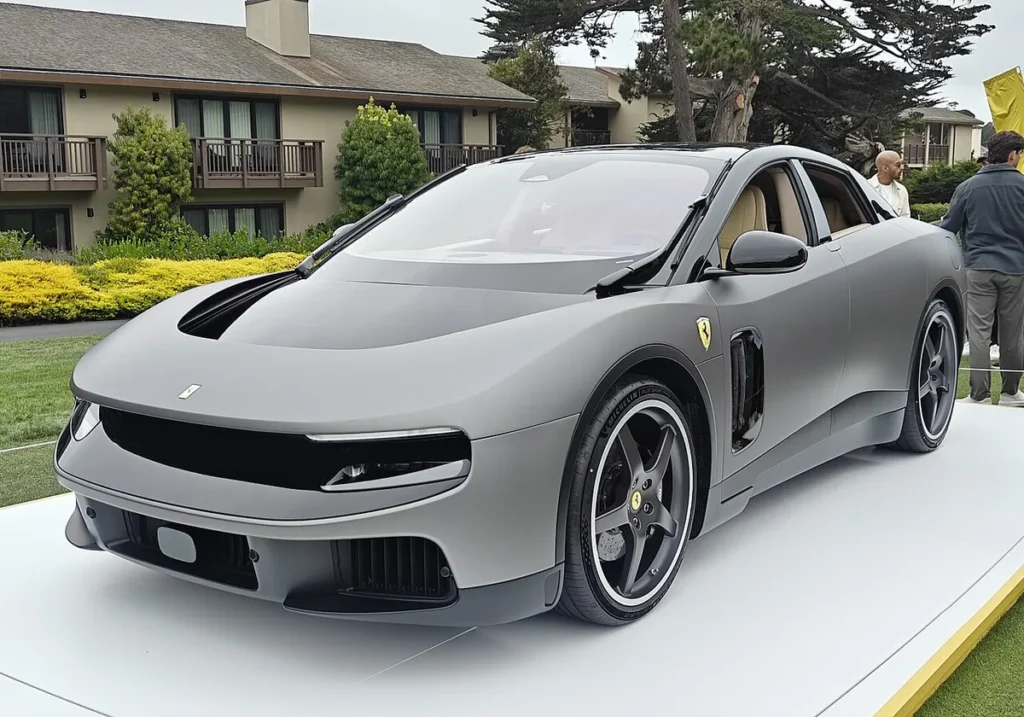
Not everyone went that way. Ferrari, which had already electrified the F80 purely to go faster, had every excuse to load a V12 recording into its first EV. In October 2025 it said the car would have no synthetic sound and wouldn’t imitate a combustion Ferrari. Back then it was called Elettrica. On February 9, 2026, it got its final name, Luce, and it was unveiled in Rome in May 2026. The system works like an electric guitar: an accelerometer on the rear-axle inverter casing picks up the real vibrations of the drivetrain and amplifies them in the cabin. Antonio Palermo, who leads sound and vibration on the project, put it simply: they didn’t want to imitate a combustion engine, but they didn’t want something artificial either.
You can argue that amplifying is just another kind of makeup. What you can’t argue with is the approach: Ferrari wants its EV to sound like what it is, an electric motor, not like the engine that came before.
And here’s a detail that closes the loop. The man writing the sounds for BMW’s electric cars is Hans Zimmer. Since 2019 he’s been creating BMW IconicSounds Electric with Renzo Vitale, BMW’s creative director of sound, starting with the Vision M Next concept. Two years earlier, in 2017, he’d scored Blade Runner 2049 with Benjamin Wallfisch. For that score they used a Yamaha CS-80 synthesizer, the same instrument Vangelis used in 1982 for the original Blade Runner.
Vangelis is the whole argument. That was machine music, synthesizers, and it sounded like a synthesizer, no apologies. It sounded like what it was, and more than forty years later it still gives people goosebumps. A machine that sounds like a machine, proudly, sticks in your memory. A machine pretending to be something else is forgotten the moment the speaker goes quiet.
Tesla, for everything you can throw at it, is in the same camp. Hate Musk, hate the cars, hate both. But Tesla never borrowed gas-car nameplates, because it didn’t have any, and it doesn’t ship its cars with a V8 sound from the factory. The ones who added it were owners, on their own, and companies like Milltek, which went as far as selling a speaker-equipped muffler to make a Model 3 sound like a V8. Others brought the nostalgia. Tesla sold the car as what it was, and people bought it that way.
Tears in rain
Blade Runner‘s most famous scene wasn’t entirely written by its screenwriter. Rutger Hauer, who played replicant leader Roy Batty, cut down the scripted final monologue and added the line everyone knows: all those moments will be lost in time, like tears in rain. Hauer said those words showed Batty wanted to make his mark on existence.
Look at what happens in that scene. Batty spends the whole movie hunting down his maker to get more life, fighting humans on their own turf. And the only thing about him that truly moves you, the moment that made film history, is when he stops imitating anyone. When he talks about what he’s seen, his life, his own death. When he’s finally himself.
That’s the lesson automakers won’t learn. EVs won’t win anybody’s heart dressed up as gas cars. They’ll get there the day they build their own story, the way BMW tried with the i8 and the Pininfarina Battista is still trying to. The day they stop wearing the dead engine’s face, name and voice and dare to have their own design, their own character and an idea of themselves that doesn’t depend on what combustion used to be.
Until then, here’s what we’ve got: grilles that don’t breathe, names that don’t belong to them, borrowed platforms, gears they don’t have, clutches that don’t exist and the sound of gas they no longer burn. Replicants with license plates.
Lose the costume
Automakers need to make up their minds. If they’re selling electric transportation, sell it for what it is, and that’s a lot, and it’s good: quiet, efficient, quick when you need it, perfect for daily life. Don’t ask an EV to pretend to be something it never was. Buyers can tell, and the embarrassment comes through even the speakers.
And if they want to build an electric sports car, then do the work. Find its own thrill, its own face, its own name, its own Vangelis, its own way of making a driver feel something. Not grab the V8, the grille and the nameplate of the model they killed and hang them on its replacement.
Dick asked in 1968 whether androids dream of electric sheep. We’ll leave you with a different question: the day an EV dreams of something of its own, will any of us even notice?
Unplug and enjoy.
Images: Dodge Charger Daytona Scat Pack: HJUdall (CC0) · Ford Mustang Mach-E: Calreyn88 (CC BY-SA 4.0) · BMW iX: Mario Roberto Durán Ortiz (CC BY-SA 4.0) · Mercedes-Benz EQV: Calreyn88 (CC BY-SA 4.0) · Lexus UX 300e: Calreyn88 (CC BY-SA 4.0) · Hyundai Ioniq 5 N: Ethan Llamas (CC BY-SA 4.0) · Ferrari Luce: Banhada (CC BY 4.0), via Wikimedia Commons.