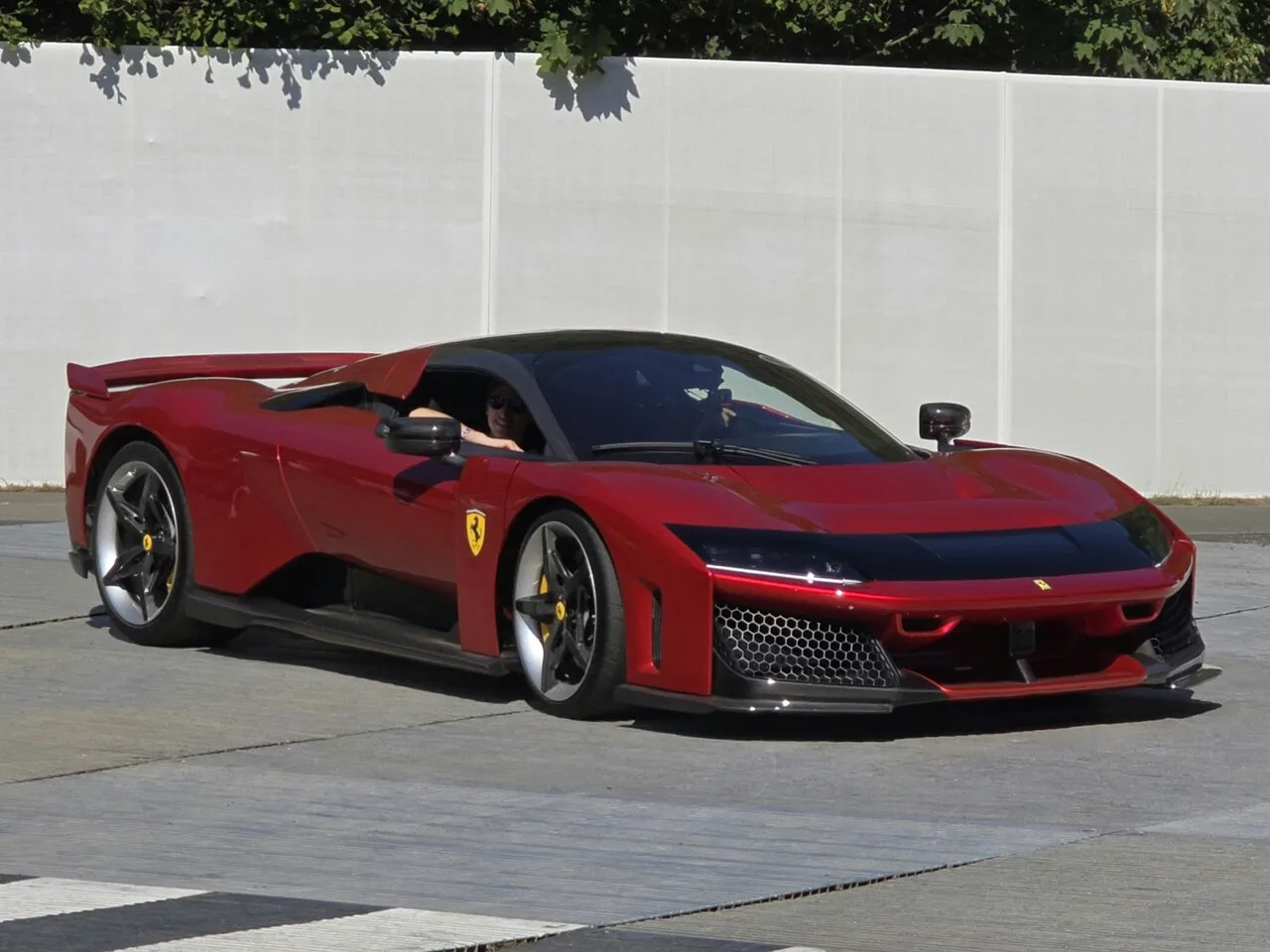
Ferrari F80: the anti-Prius hybrid that refuses to drive on electricity
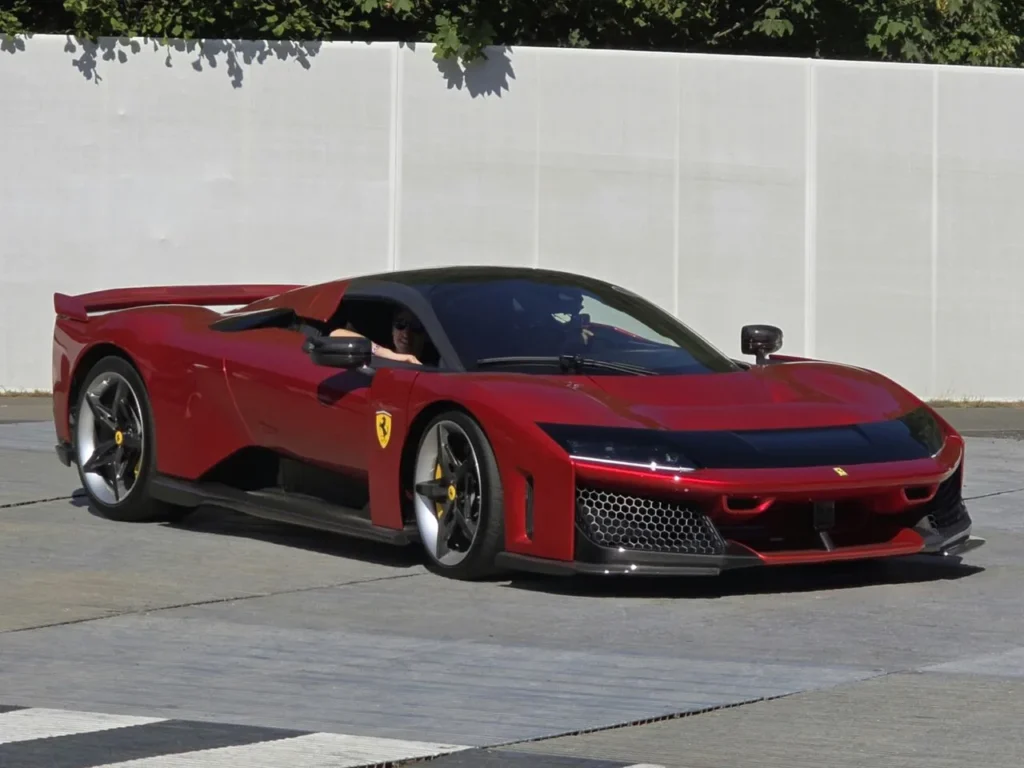
In America, the word “hybrid” has meant one thing for twenty-five years: the Prius. Penance on wheels. The car you buy to use less gas, glide silently out of the driveway, and feel a little better about the planet. That single association has trained an entire country to hear “hybrid” and think “greener, slower, sensible.” So here is the Ferrari F80 to detonate it. It is a hybrid. It cannot be plugged in. It cannot drive a single foot on electricity. And it makes 1,200 horsepower. The most powerful road Ferrari ever built wears the same label as a Prius and means the exact opposite by it. That inversion, not the engine note, is the real story.
Most of the noise around the F80 is aimed at the wrong target, so let’s strip it down part by part.
The numbers, before the arguments
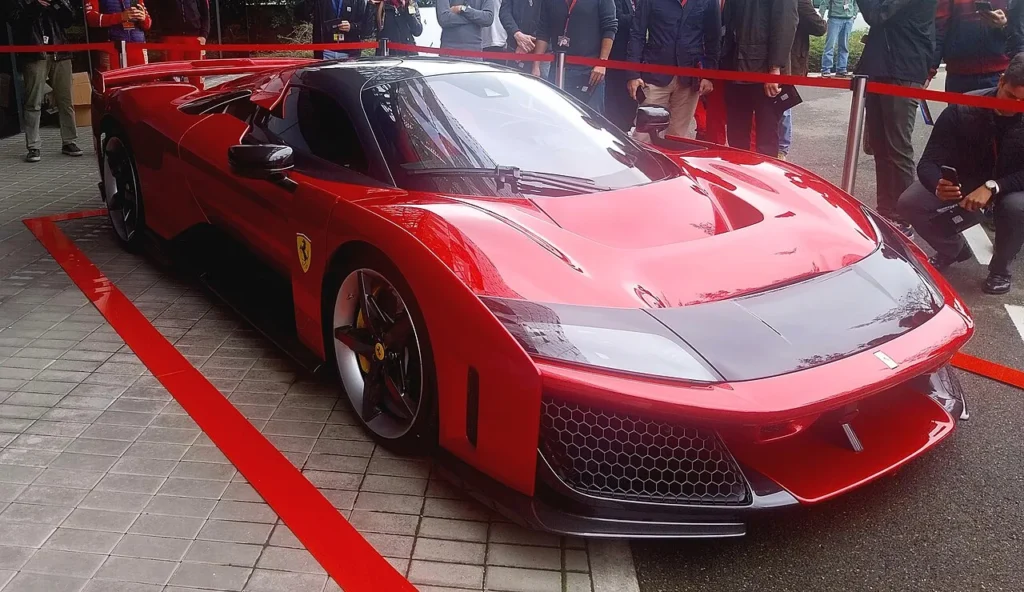
Maranello pulled the cover off on October 17, 2024. The F80 replaces the LaFerrari at the top of the company’s limited-run bloodline, and its output is 1,200 metric horsepower, roughly 1,184 hp in American units. Behind the cabin sits a 3.0-liter twin-turbo V6 with its banks spread to 120 degrees, making 900 metric hp at 8,750 rpm by itself. Electric motors supply the other 300. Zero to 62 mph takes 2.15 seconds, zero to 124 mph takes 5.75, and the car runs out of breath at 217 mph. Dry weight is 1,525 kg, about 3,362 lb. Production is capped at 799, Ferrari quoted €3.6 million including Italian tax (well north of $3.9 million at 2024 exchange rates), and the allocation was gone before the public ever saw the car. Customer cars started reaching owners late in 2025, the first European one handed over in Britain just before Christmas.
As an object it’s from another planet. But that “Ferrari hybrid” headline has half the audience filing it under “Maranello goes green.” It’s the reverse.
A battery that never touches a plug
Here’s the part American readers raised on the Prius will find strangest. In the national imagination, a hybrid saves fuel. The F80 skips that entire script. There is no charge port on the car at all. The pack holds 2.28 kWh, weighs 39.3 kg (about 87 lb), runs at 800 volts, and gets topped up only two ways: by the gas engine and by energy clawed back under braking, the trick we unpacked in our piece on regenerative braking. Nobody will ever sell you a wall charger for it.
Then Ferrari closed the last door. There is no electric-only drive mode. The selector offers Hybrid, Performance and Qualify, and every one of them keeps the V6 running. Physics isn’t the obstacle, since 2.28 kWh could roll the car a few hundred yards. Ferrari simply refused, because silent creeping has no place in this car’s job description. Compare that with the company’s own SF90 Stradale from 2019, which carries a 7.9 kWh battery and an eDrive mode good for about 15 miles without fuel. On the flagship, that option vanished. Every electron aboard the F80 is there to add power and cover the combustion engine’s weak spots. Clean-air zones and fuel economy never entered the brief. This is performance electrification, and that distinction rewrites everything.
Formula 1 hardware in a street car
Follow the current and the logic becomes obvious. Three electric drive motors share the work. A pair lives on the front axle, one per wheel, each rated at 105 kW (141 hp) and spinning to 30,000 rpm. They give the F80 all-wheel drive, and more importantly they meter torque side to side, pulling the nose into a corner with a precision no road Ferrari has ever had. The third motor is tucked between engine and gearbox. It works as an MGU-K, pushing with 60 kW and harvesting up to 70 kW, and it also cranks the V6 to life.
Watch out for a trap on the spec sheet. Add those peaks together and you get something like 270 kW, yet Ferrari quotes 300 metric hp of combined electric help, because the motors can’t all hit their maximum at the same moment and the system has its own ceilings. The battery, for its part, can discharge at up to 242 kW. That’s power, a separate number from the 2.28 kWh of energy it stores, and confusing the two is the most common mistake in coverage of this car.
The turbos get their own electric help. Each one carries a small 48-volt motor between turbine and compressor, a relative of the MGU-H that Formula 1 ran for years. Ferrari says it spins the compressor up before exhaust gas can do the job, killing lag, and harvests energy when the turbine overspeeds. That lets the engineers fit bigger turbos without the usual penalty. So the F80 isn’t a Ferrari with a commuter-car hybrid bolted on. It’s a race prototype with a license plate. For the opposite philosophy, look at the Lotus Evija, which reaches similar numbers by hauling nearly two tons of battery.
Le Mans, three times over
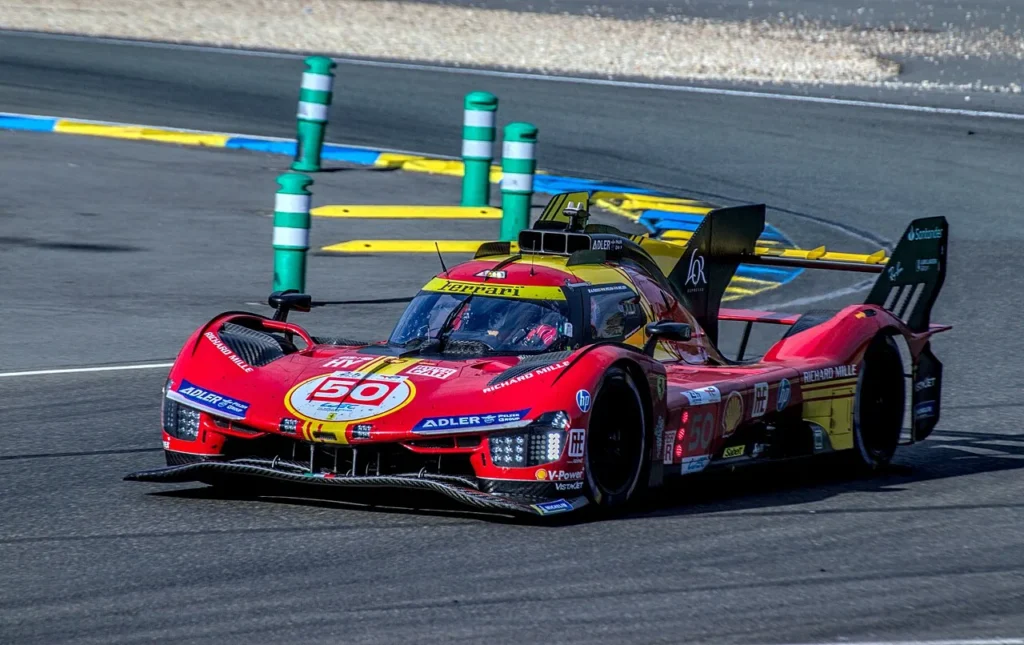
Ferrari markets the F80’s V6 as derived from the 499P, the endurance prototype that won the 24 Hours of Le Mans in 2023, the race’s centenary edition, then again in 2024. Since the F80’s launch it has added a third straight win, in 2025, with the No. 83 car of Robert Kubica, Yifei Ye and Phil Hanson. The road car doesn’t inherit the racer’s calibration; they do different jobs. What it shares is the architecture and a list of parts drawn from the same driveline: crankcase, timing chains, oil pump, bearings, injectors.
There’s a Spanish thread in that pedigree that the American press skipped. The rain-soaked 2024 win belonged to the No. 50 car, and one of its three drivers was Miguel Molina, from Catalonia, alongside Antonio Fuoco and Nicklas Nielsen. Molina became only the third Spaniard to win Le Mans outright, after Marc Gené in 2009 and Fernando Alonso in 2018 and 2019. When Ferrari tells you the F80’s engine “comes from Le Mans,” part of that claim was earned by a Spaniard.
That racing lineage explains the hardware. In an endurance car you don’t hoard energy to cover clean miles. You dump it to pass, claw it back under braking, and dump it again. Which is why the F80’s battery is tiny in capacity and savage in output. It works like an ammunition magazine, not a fuel tank.
The family tree
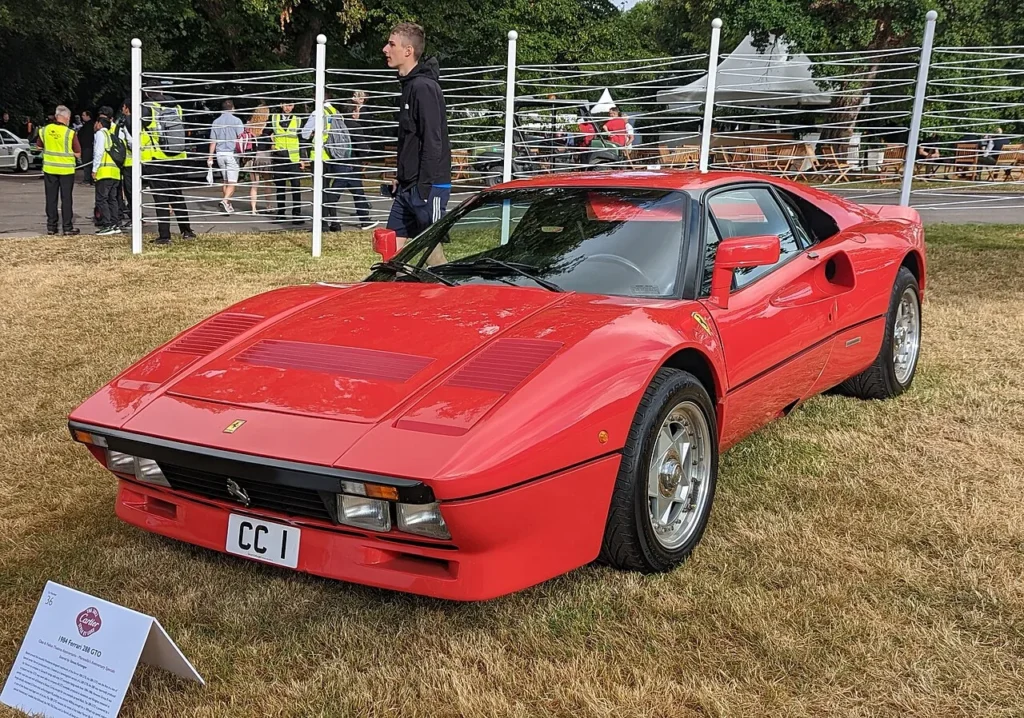
The F80’s ancestors tell you what’s really new. The line didn’t start with twelve cylinders. It began with the 288 GTO of 1984, a twin-turbo V8, followed by the F40 of 1987, another twin-turbo V8. The F50 of 1995 brought a Formula 1-derived naturally aspirated V12, the Enzo of 2002 kept twelve cylinders, and the LaFerrari of 2013 added the HY-KERS hybrid system to a 6.3-liter V12. Our sister site Not Enough Cylinders covers Ferrari’s Big Five, from the 288 GTO to the LaFerrari, for anyone who wants the gasoline side of the story.
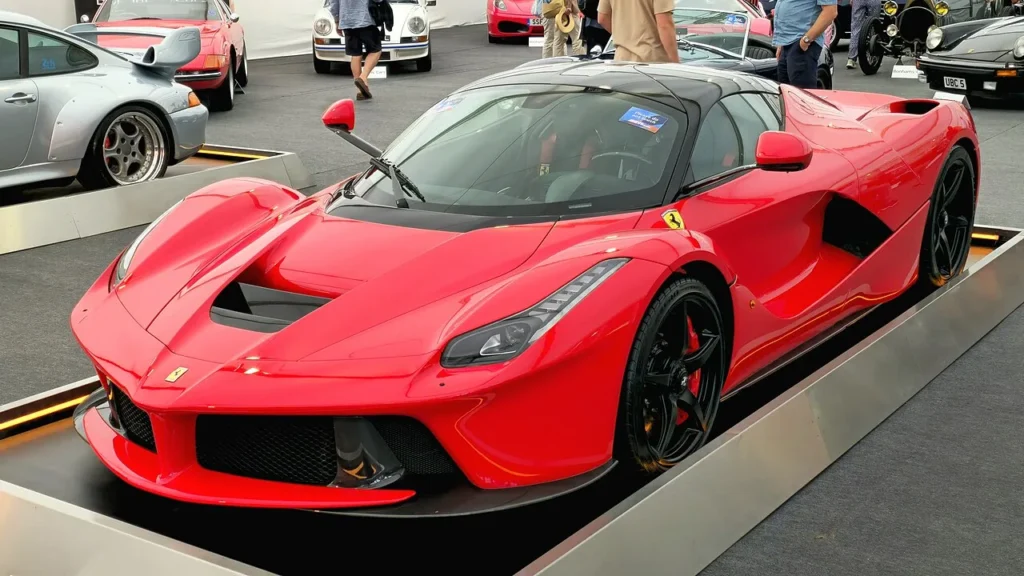
So two popular claims fall apart. The F80 isn’t Ferrari’s first hybrid flagship, because the LaFerrari got there more than a decade earlier. Nor is it the first without a V12, since the GTO and F40 ran V8s. What’s genuinely new is the V6, a first for this family, replacing the LaFerrari’s twelve.
Against its rivals the F80 doesn’t win every number either. The 2022 Mercedes-AMG One, with a real Formula 1 engine, makes 1,063 metric hp, weighs about 1,695 kg and does plug in, with roughly 11 miles of rated electric range. The 2021 Aston Martin Valkyrie gets 1,160 metric hp from a hybrid-assisted naturally aspirated V12. The all-electric Rimac Nevera pushes about 1,900 hp at around 2,150 kg. Where the F80 wins is weight and race provenance.
Why the V6 fight looks different from here
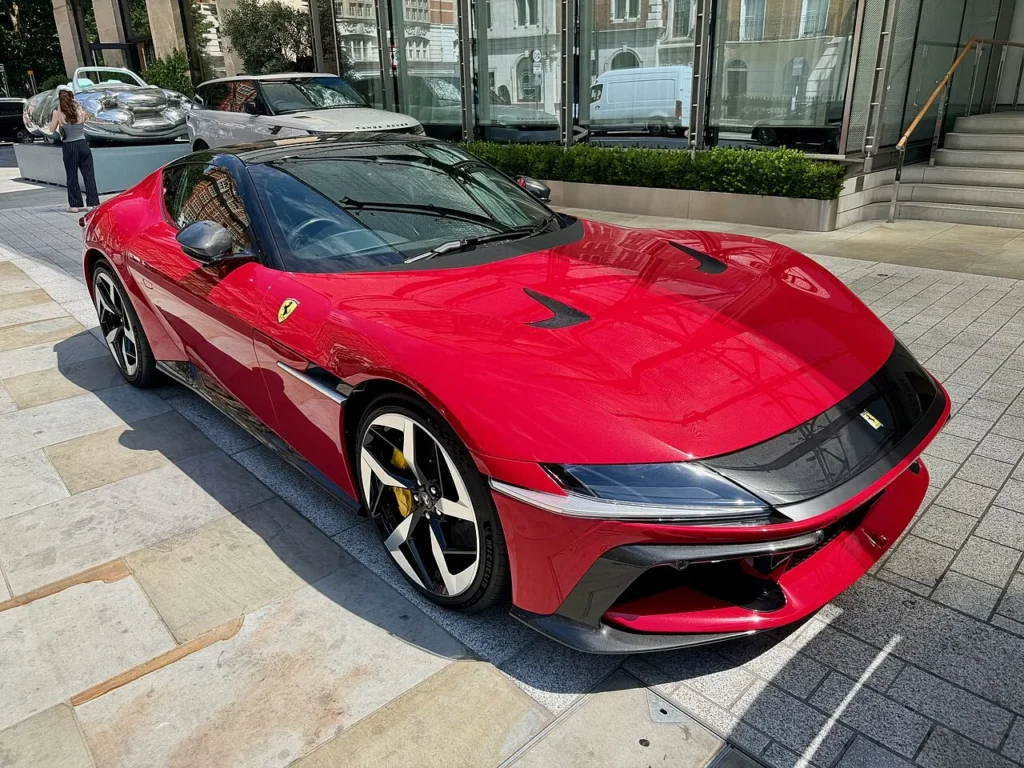
Europe is tearing itself apart over the F80 having a V6 instead of a V12, and it matters less here than you’d think. American performance culture never worshipped cylinder count the way Italy does; it worshipped output and the launch. By that yardstick the F80 is unimpeachable. Its V6 makes 900 metric hp, more than the 830 of the naturally aspirated 6.5-liter V12 in Ferrari’s own 12Cilindri. More power, half the cylinders. Ferrari’s marketing chief Enrico Galliera said the company tested both and picked the stronger one, as it did with the F40’s V8.
Still, the purists are mourning something real, and Americans know it from their own V8s: the sound. A Ferrari flagship that doesn’t scream loses something a dyno can’t measure, and reviewers at the car’s public debut at Imola called the note underwhelming. The purists made one tactical blunder. They argued horsepower, the one ground where the V6 crushes them, instead of staying on sound, where Maranello has no answer.
America has seen this movie
The idea of a battery used purely to go faster has become normal at the top of the American performance tree. The 2024 Chevrolet Corvette E-Ray put an electric motor on the front axle, fed by a small battery charged entirely on the move with no plug, to add grip and instant thrust rather than to sip fuel. Detroit didn’t invent the concept, since the LaFerrari and the SF90 got there first, but it brought the performance hybrid to a price where ordinary enthusiasts can buy one. The F80 is the same gospel at many times the cost.
America also has skin in the endurance game the F80 descends from. The top class Ferrari’s 499P dominates at Le Mans is where Cadillac’s hybrid prototype races too, and the same hybrid-for-lap-time logic runs every winter at Daytona and Sebring in IMSA. The F80 is the road-going version of a philosophy American fans already watch on Sunday.
What’s left is collector theater. Ferrari allocated the 799 cars to its most loyal clients, and the ones that surface at auction will trade above list. For most Americans, the F80 is less a car to drive than an asset to bid on, which puts it about as far from the Prius’s mission as a machine can get.
What deserves criticism
Nobody serious can knock the engineering. Three things deserve pushback anyway. The label, first: “hybrid” with no qualifier lets the F80 borrow the virtuous image of the eco crowd, when it can’t be plugged in and uses electricity only for speed. Then the usage: 799 cars headed mostly for climate-controlled garages, so their real-world mobility footprint is a rounding error. And the price, which makes ownership the point and driving an afterthought.
Call it what it is: the most extreme combustion race car Ferrari has ever sold for the road, with an electric assist borrowed from Formula 1. It has nothing to do with Ferrari’s electric future.
NEB’s verdict
The F80 is the most radical Ferrari in a generation and the most misread. Ferrari isn’t to blame for that; its own launch sold the car as combustion pushed to the limit with racing-grade electric help, and never dressed it up as a planet-saver. The confusion belongs to an audience trained by the Prius to hear “hybrid” and reach for the word “green.” That 2.28 kWh battery, unable by design to move the car an inch on its own, settles the question: in the most expensive, most ferocious Ferrari, electrification exists for lap times and turbo response. With the Lucid Air we saw a “green” label hide who pays for the party; with the F80, the “hybrid” label hides what the battery is for.
The V6-versus-V12 war is an entertaining sideshow. The real news for anyone following batteries without rose-tinted glasses is that “hybrid” has stopped meaning anything by itself. The F80 carries no trace of the hybrid that saves, that hushes, that behaves. Only the one that attacks. Next time you see a battery in a car, ask what it’s for before handing out a medal. In this Ferrari, the answer is speed.
Unplug and enjoy.
Images: Ferrari F80, Calreyn88 (CC BY-SA 4.0) · Ferrari F80 in Maranello, Asgaw (CC BY 4.0) · Ferrari 499P No. 50 at Le Mans 2024, Mickael Le rouzic (CC BY 2.0) · Ferrari 288 GTO, Calreyn88 (CC BY-SA 4.0) · LaFerrari, Calreyn88 (CC BY-SA 4.0) · Ferrari 12Cilindri, Oleg Yunakov (CC BY-SA 4.0), via Wikimedia Commons.