Henney Kilowatt: The 1960 Electric Car Sold to the Meter Reader

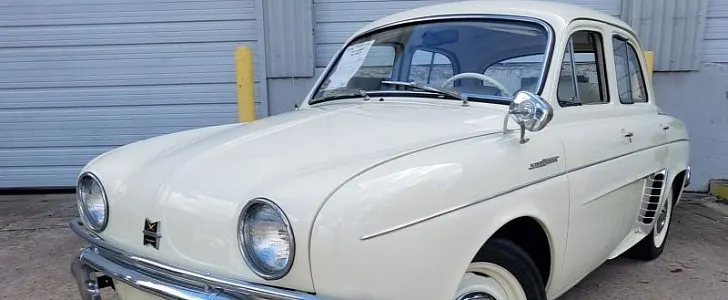
In 1960 you could spend $3,600 on an Oldsmobile 98. Or you could spend it on a French compact with golf-cart batteries under the skin and a charging cord instead of a gas pump. Consumer Guide and Lancaster Insurance both put the Henney Kilowatt’s price in Oldsmobile 98 territory. Hardly anybody went for the second option. The ones who did were mostly power companies, buying a car for the guy who reads the meters.
Forty-seven sold, according to the Eureka company history. Maybe. Nothing about this car adds up the same way twice.
The customer: the guy with the clipboard
The Kilowatt was not a showroom car. It went mostly to electric utilities. The McLean County Museum of History in Illinois names Atlantic City Electric, Louisiana Power & Light and Commonwealth Edison. Green Car Reports says the idea came from the utilities themselves, who wanted a small car for meter readers. A company that sells electricity buys a car that burns electricity. Fair enough.
How many did the utilities take? U.S. News & World Report said on March 20, 1967 that 35 cars went to power companies. Company records reported by the Spanish site Motorpasión say 24 at 36 volts and 8 at 72, 32 in all. Wikipedia says fewer than fifteen went to private buyers. Thirty-two or thirty-five plus fewer than fifteen fits the 46 or 47 sold that Eureka and the McLean County museum report. That part, at least, closes.
The sticker
The price target was $3,600, according to Wikipedia, Hagerty and Green Car Reports; the McLean County museum says $3,500. Lancaster calls it almost double a standard Dauphine, and both Lancaster and Consumer Guide set it next to a well-equipped Oldsmobile 98. Heater? $400 extra, per Lancaster.
Wikipedia adds the production problem: Eureka Williams could not build the 72-volt system fast enough or cheaply enough to hit that target.
Now the market it was fishing in. Time said in 1958, as Wikipedia quotes it, that the car that had come up fastest in the American market in the past year was Renault’s Dauphine. Sales in the United States, from the German magazine Auto-Motor in 2006, were 28,000 in 1957, 57,000 in 1958 and 102,000 in 1959. Lancaster calls it the second most popular import in the country, behind the Beetle. Against that, 47 Kilowatts in two years. More than two thousand gasoline Dauphines for every one of them, and a year against two doesn’t change the order of magnitude. By 1966, Wikipedia says, citing How Things Work, American Dauphine sales had dropped to 12,106.
Built in Illinois by people who sold batteries
The man behind it was C. Russell Feldmann, president of National Union Electric Company. Lancaster says his group also controlled Exide, the battery maker; Eureka Williams, a vacuum cleaner manufacturer based in Bloomington, Illinois; and Henney Motor Company, a coachbuilder of ambulances, hearses and limousines. The McLean County museum says the cars were assembled in Bloomington. Lancaster adds that Feldmann believed an electric car would bring a lot of publicity.
Two facts. We are not saying one explains the other. But a group with a battery company and a body shop had everything except the car, and Renault supplied that.
How many Dauphines? Consumer Guide says a hundred bodies without drivetrains. Motorpasión says parts for about a hundred. Autoblog says two hundred. Victor Wouk, an engineer we’ll get to, remembered in 1999 that Feldmann bought “something like thirty-five” and pulled everything out of them.
What was under the floor
The 1959 car ran on 36 volts, on lead-acid golf-cart batteries according to the Lane Motor Museum. Most sources count eighteen 2-volt elements in series; a few say six 6-volt batteries, which add up to the same eighteen, so that is not a contradiction. The 1960 car doubled to 72 volts with twelve 6-volt batteries.
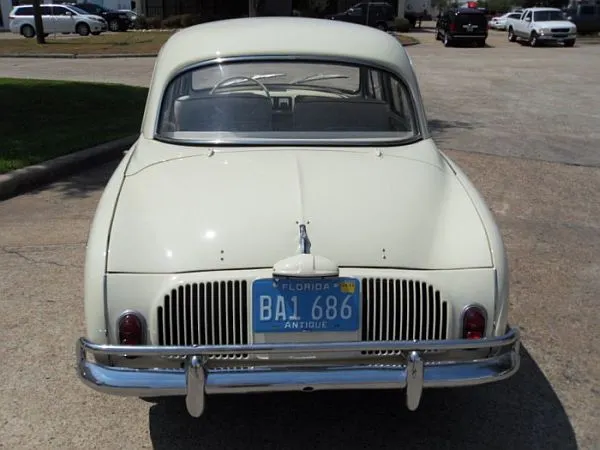
The motor, 7.1 hp according to Lane, sat in the back where the Dauphine keeps its engine. The electrical gear took over the front compartment, which left no trunk, Lancaster says. No conventional gearbox either: you picked forward or reverse with a dash switch between a voltmeter and an ammeter. The charger was on board with a 25-foot cord. The McLean County museum talks about eight to ten hours on household current.
Wikipedia gives the weight as 907 kg in 1959 and 968 kg in 1960: about 2,000 and 2,130 pounds, against 1,430 for the gasoline Dauphine. Barnfinds counts 768 pounds of batteries and Hagerty about 800. The gasoline Dauphine, per Wikipedia, had an 845 cc four-cylinder with 27 hp and a top speed of 70 mph.
Brochure versus lab car
The Henry Ford museum keeps a folding brochure from around 1960, published by Henney Motor Company, titled “The New Electric Powered Automobile”. The museum’s description gives a cruising speed of about 30 mph and a range of about 40 miles between charges. Lane says an advertised top speed of 35 mph and 40 miles per charge. For the 1960 car other sources repeat up to 60 mph and 60 miles. Hagerty and Curbside Classic doubt you could get both at once, and say range dropped when you drove fast.
Four years after the Kilowatt, Detroit built its own. General Motors put a 90 hp electric motor and 450-volt silver-zinc batteries into a rear-engined Corvair in 1964, the Electrovair, according to Carscoops. In 1966 the Electrovair II had 115 hp, 532 volts, a 40 to 80 mile range and an 80 mph top speed. Carscoops says the first one “was never intended for production”.
| Henney Kilowatt (1959–60) | GM Electrovair (1964) | |
|---|---|---|
| Motor | 7.1 hp (Lane) | 90 hp (Carscoops) |
| Voltage | 36 V, then 72 V | 450 V |
| Batteries | Lead-acid | Silver-zinc |
| For sale? | Yes, at $3,600 | “Never intended for production” |
One was cheap lead and you could order it. The other was exotic and you couldn’t.
The engineer and the agency
On January 17, 1999, Victor Wouk gave an oral history to the IEEE History Center. He says Feldmann was retired, wealthy and wanted to do something good for mankind. Somebody told him he needed a modern electronic control and sent him to Wouk. By Wouk’s account that was two or three years after he founded his own company in late 1959, which is after the years the sources give for the Kilowatt, 1959 and 1960.
The controller itself is disputed. Wikipedia says Wouk designed it and that it combined relays and diodes to switch battery and motor configurations; it also rejects the claim that this was the first transistor-based electric car. Hagerty credits a Caltech team led by Wouk. His own interview puts him in the picture later than the production years. That stays open.
What he does say is the part that doesn’t make the brochure. Feldmann asked him whether he was wasting his time trying to get batteries for electric cars, and whether electric cars would ever work. Wouk wrote to Caltech’s president, Lee DuBridge, who held a mini-seminar of chemists, physicists and engineers. The conclusion he recalls is that there were electrochemical couples with much greater energy density than lead. Feldmann’s answer, by Wouk’s account: call me when there are better batteries.
On range he says he thought the car had about 30 miles and that his control might raise it to 35. That is an estimate, not a measurement. The interview doesn’t say which car or which batteries, and the modified control would be an experimental unit costing about $100,000, in his words. Thirty miles doesn’t refute the sixty in the 1960 claim; it could be another car or another use. What does stand is his diagnosis: the real problem was the battery, which “just didn’t store enough energy”. In the text we read, the names Henney and Kilowatt don’t appear.
Wouk kept going. According to Wikipedia, in 1972 he built a hybrid from a Buick Skylark with a Mazda RX-2 rotary engine and had it tested at the EPA in Ann Arbor; in 1974 the EPA granted him $33,000, as cited from The New York Times. In his interview he says it looked very attractive, but the EPA and others didn’t like the idea. “Hybrids stink!” is how he quotes it.
Seventy cars and a warehouse
The McLean County museum says about seventy unsold Kilowatts sat for fifteen years in a warehouse on South Center Street in Bloomington. In the summer of 1975 they went to Tiffany Motor Corp. in Opa-locka, Florida.
The math doesn’t close. One hundred built and 47 sold leaves 53, not 70; add 70 to 47 and you get 117. The sources we read don’t say whether the warehouse held finished cars, half-converted ones or bodies. What happened in Florida, Hagerty, Green Car Reports and Lancaster tell three different ways, so we leave it there.
The built-count is a mess on its own. Eureka’s corporate history, quoted on Wikipedia, says 100 made. Hagerty, Barnfinds and Green Car Reports say 43 complete. Lane says about 120 between 1959 and 1961. Lancaster and Autoblog say about 200 at the start. Survivors: between four and eight per Wikipedia, four per Lancaster. Wikipedia says serial number 0001 and the prototype marked “EXPERIMENTAL” were sold to a collector in the early 2000s.
Not the first
The internet calls the Kilowatt the first mass-produced electric car. It wasn’t. In the early 1900s Detroit Electric and Milburn built thousands of electrics a year, according to Electric Vehicles News. In the middle of World War II, occupied France built the Peugeot VLV, 377 of them between 1941 and 1943, and the CGE-Tudor designed by Jean-Albert Grégoire, about 200. The VLV weighed 772 pounds in total, 353 of them batteries, according to L’Aventure Peugeot; the Kilowatt’s batteries alone weighed about as much as the whole French car. They are not the same kind of car, but it shows how much lead it took eighteen years later to move 2,000 pounds. Curbside Classic calls the Kilowatt a post-war attempt at a production electric, and that holds up.

Our take
They say the world wasn’t ready in 1960. Motorpasión floats it with a “perhaps” and half the internet repeats it. Lazy. The utilities bought for a specific job, and that shows niche demand, not a market. The best explanation came from an engineer: the real problem was the battery.
So here is what it was. A 2,100-pound car that needs eight to ten hours to charge, promises 60 mph on 768 to 800 pounds of lead, and costs what a big American sedan costs. It sells to a guy with a route and a clipboard. Nobody else. The man who put it together bet on the publicity, according to Lancaster, and by Wouk’s account later asked whether he was wasting his time on batteries. When the guy behind the car doubts what’s under the floor, read the numbers.
Sixty-seven years later we still get the same slogan, the car of tomorrow, as the brochure put it according to the McLean County museum. How many more tomorrows do you need?
Unplug and enjoy.