
Bolloré Bluecar: $50 Million in Indianapolis, 180,000 Rides
In June 2020, Indianapolis was sending French electric cars to a scrapyard. Jalopnik noted at the time that the Bolloré Bluecar isn’t sold in the United States. The cars had come with a city subsidy of $6 million, a fight with the state utility regulator and a profit-sharing clause that put the city last in line.
The Bluecar was the car of Autolib’, the electric car-sharing service of Paris. Its business plan assumed eleven rentals per car per day. On February 21, 2025, a French appeals court called that forecast “excessively optimistic.” Real use in Paris ran between 2 and 4.2 rentals per car per day, according to the ruling.
Indianapolis did worse. Run the numbers and you land somewhere around half a rental per car per day.

The part where ratepayers were supposed to pay
Before the cars arrived, the money fight started. Indianapolis Power & Light, IPL, asked the Indiana Utility Regulatory Commission to approve a $12.3 million plan to extend EV charging infrastructure and develop BlueIndy. The whole project was estimated at $16 million. The chargers would be owned by the Bolloré Group.
In February 2015, per Utility Dive, the commission said no. It found it unfair to ask all ratepayers to support a program that let a private company own infrastructure used mainly by a small set of customers. Chair Carol Stephan said there “was insufficient evidence to justify the use of ratepayer funds to install infrastructure owned by a private company.”
Commissioner Angela Weber agreed with the denial and would have gone further. She would also have rejected the line-extension costs, citing no evidence of the project’s profitability or benefit to IPL customers.
Under a settlement that included the city, regulators did approve $3 million for improvements to IPL’s distribution system tied to the plan, contingent on changes to the project’s financing. That $3 million comes back later in this story.
Who paid what

By the end, the Indianapolis Business Journal and InsideEVs put the investment at about $50 million. The breakdown: about $41 million from Bolloré, $6 million from the city and $3 million from IPL. IBJ’s wording for Bolloré is “more than $40 million of its own money.”
At the start, the numbers were smaller. On October 27, 2015, Inside INdiana Business described a $35 million collaboration between the city and the Bolloré Group. It said about two dozen stations were open and that the organizers hoped to reach 200 stations and 500 cars across Marion County.
That same day it reported that Marion County Auditor Julie Voorhies had sued the city. She alleged Indianapolis illegally paid $6 million to help fund BlueIndy, did not publicly bid the construction project and did not obtain the budget appropriations. She said she “had no choice but to file suit” after trying to get the city to fix it. IBJ later wrote that the lawsuit was eventually dismissed. We found no detail on when or why.
Now the clause. In return for its $6 million, the city got a promise from BlueIndy to share profits. The promise had conditions. It applied only after BlueIndy recouped its own investment and after IPL recovered 125% of more than $3 million in ratepayer increases, according to IBJ. The city was not expected to get its $6 million back until the service turned profitable.
The city was behind the vendor and behind the utility. And IBJ’s December 2019 piece says the deal was made at the end of Republican Mayor Greg Ballard’s administration.
What the riders got
BlueIndy launched in September 2015, per IBJ. InsideEVs gives the start as 50 Bluecars, 25 stations and 125 charging spots, five per station. In its first month, Inside INdiana Business reported more than 500 members and 1,500 trips.
Prices, per InsideEVs: pay as you go cost $8 for 20 minutes, then $0.40 for each extra minute. A monthly plan cost $9.99, plus $4 for 20 minutes, then $0.20 a minute.
By September 2017, the fleet had grown to 280 cars and 85 stations. Per Jalopnik, the city blocked off 450 parking spaces for the program.
The car is a four-seat, three-door hatchback with a 30 kWh lithium-metal-polymer battery and a supercapacitor. It was designed with Pininfarina, the same house that a decade later put its name on the $2 million Battista hypercar. Jalopnik gives a U.S. range of about 120 miles. We could not find an EPA rating for it, so we don’t compare that figure with the 73 miles the EPA gave the 2011 Nissan Leaf and its 24 kWh pack. Different tests, different cycles, and one of them is a number reported by a blog.
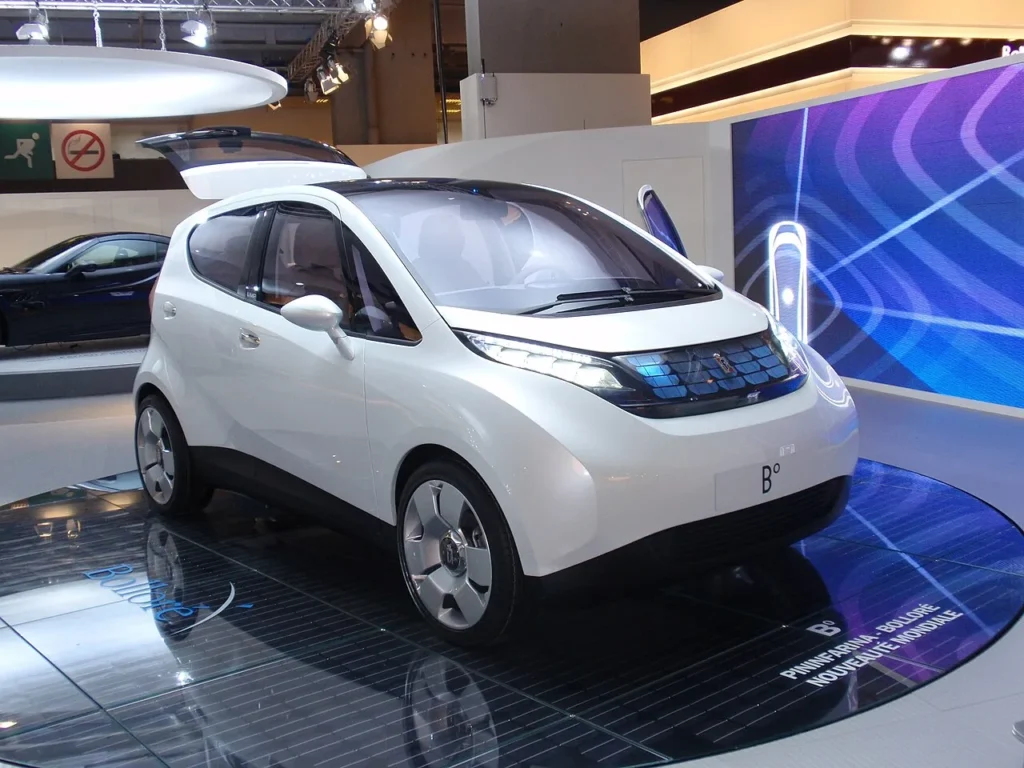
That battery has a quirk. InsideEVs says the LMP packs need roughly 60 degrees Celsius to operate and consume energy even when idle to stay warm. Jean-Luc Monfort, head of Bolloré’s battery arm Blue Solutions, said in a March 2021 Electrive interview that the company has to heat its LMP batteries to between 50 and 80 degrees depending on the application. That is a company statement about its batteries in general, not about the Bluecar’s. Either way, a battery that must be kept hot burns energy while parked, the reverse of the usual EV battery thermal management problem, which is keeping cells cool.
The math nobody printed
The launch projection was profit by 2020, with at least 15,000 members, 200 stations and 500 cars, according to IBJ.
What IBJ found in August 2019: 3,000 active members, about one-fifth of what the company said it needed. 92 stations. 200 cars, which is 80 fewer than two years earlier. Several stations were effectively shut down during construction of the IndyGo Red Line. Advertising on the vehicles earned more than projected. That was the good news.
Rentals were about 46,000 in 2017 and 51,600 in 2018, up 12%. Over the whole run, the company reported 11,000 members and 180,000 rides.
Do the division. 51,600 rentals in 2018 is about 141 a day. The sources don’t give the 2018 fleet, only 280 cars in September 2017 and 200 in August 2019. Divide 141 by 280 and you get 0.5. Divide by 200 and you get 0.7. So somewhere between half a rental and 0.7 of a rental per car per day, in the year with the best numbers reported.
Paris planned eleven. Paris got between 2 and 4.2. Indianapolis, on our estimate, got less than one.
The 2018 fleet was never published, so the decimal can move. What isn’t in dispute is the gap between the 15,000 members in the launch projection and the 3,000 active in the summer of 2019.
How it ended
On Friday, December 20, 2019, BlueIndy told customers it would end its collaboration with the city effective May 21, 2020. It said it could not reach the activity level needed to be “economically viable.” Monthly membership fees stopped on March 21, 2020.
James Delgado, BlueIndy’s managing director, said in August 2019 that the company did not expect to be profitable within 12 months. IBJ also quotes him saying Indianapolis drivers were “slow to adopt alternative transportation options.” Bolloré did not disclose annual revenue.
The city said it would look at whether the stations could still be used. Delgado said that if the city kept the infrastructure it would have 455 charging points, including at universities, the airport and downtown. Taylor Schaffer, the deputy chief of staff, said the city would explore options. IBJ doesn’t say what would happen to the parking spaces.
The cars were a different story. Jalopnik says the program used about 250 Bluecars. Blue City, the company in charge, reportedly moved about half of the better ones to Los Angeles and sent the rest to a scrapyard “for dismantling and shredding.” Jalopnik flags that split as approximate. InsideEVs says some cars lost key components, LMP batteries included, and one media report showed about 50 units at the yard. They weren’t sold, not even as gliders, meaning cars without motors or batteries.
Meanwhile, in Paris
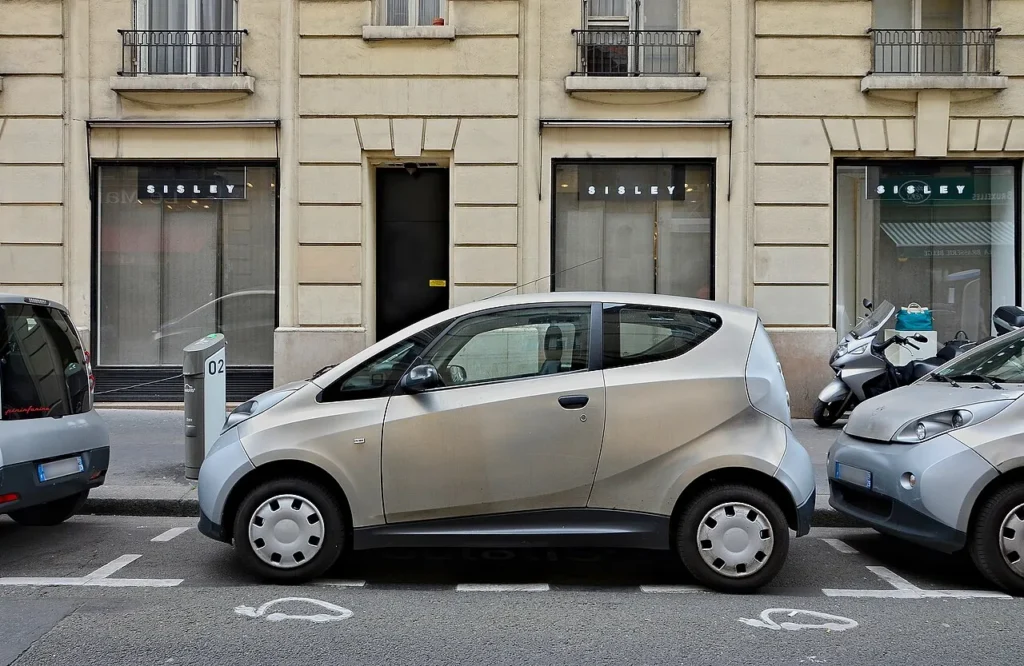
Autolib’ opened on December 5, 2011, with 250 cars and 250 stations, per Wikipedia. By 2016 it had 1,084 stations and 3,980 registered cars. The fee was 120 euros a year plus 6 euros per 30 minutes.
It ended on July 31, 2018. The Paris union of municipalities voted on June 21, 2018 to terminate the contract. Bolloré had asked for up to 40 million euros a year until 2023. On December 12, 2023, the Paris administrative court rejected Bolloré’s compensation claim. On February 21, 2025, the appeals court awarded a little over 66 million euros of roughly 235 million claimed. The Cour des comptes’ regional report says the principal was 66.1 million, 75.5 million with interest, with no further appeal.
The court’s reasoning matters for Indiana. It said the deficit came mostly from an excessively optimistic revenue forecast at launch. It also said Autolib’ should have notified the union that the concession was not viable by November 30, 2013, at the latest. It didn’t do so until May 25, 2018.
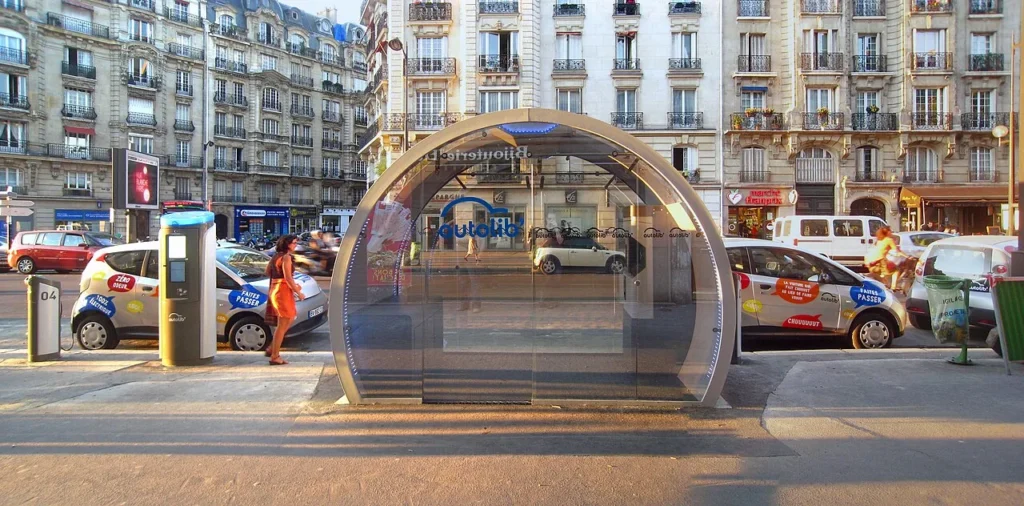
The same car, the same company and the same forecasting habit crossed the Atlantic.
Madrid skipped the stations
Bolloré exported Autolib’ to Lyon, Bordeaux, Turin, Indianapolis, London and Singapore. Spain never made the list, and Madrid ran the experiment the other way around: no stations at all.
On November 11, 2015, car2go launched in Madrid with 350 electric smart fortwos that could be parked anywhere inside a service area of about 20 square miles, soon raised to 500. On December 19, 2016, emov followed, a venture of PSA and the Spanish parking firm Eysa, with 500 Citroën C-Zeros at 0.19 euros a minute. In December 2017 came Zity, from Renault and the Spanish infrastructure group Ferrovial, with 500 Renault Zoes. That is free-floating car sharing: grab the car where the last driver left it, no kiosk, no dedicated charger. The city’s real subsidy was free parking in regulated zones for zero-emission cars.

Paris built 1,084 stations. Indianapolis blocked off 450 parking spaces and ended up with 455 charge points nobody had a plan for. Madrid built nothing. And Zity still pulled out of Madrid on May 21, 2026, after about eight years, more than 800,000 users and ten million rentals. The riders showed up. The per-minute math didn’t.
Stations or no stations, the problem is the same one Indianapolis ran into: a parked car earns nothing, and a shared car spends most of its day parked.
Bolloré’s Bluecar wasn’t even the first French city car built for short hops. Peugeot made 377 of its VLV between 1941 and 1943, when France had no gasoline. And the latest French answer, the two-seat Citroën Ami, is a car America isn’t allowed to want, just like the Bluecar.
The numbers that don’t match
- Fleet size. 280 cars at the peak in September 2017 per InsideEVs; 200 in the summer of 2019 per IBJ; about 250 per Jalopnik.
- Size of the program. A $35 million collaboration in October 2015 per Inside INdiana Business; about $50 million per IBJ, InsideEVs and Jalopnik.
- Bolloré’s share. “More than $40 million” per IBJ; $41 million per InsideEVs and Jalopnik.
- Launch. September 2015 per IBJ; late 2015 per InsideEVs; “introduced in 2014” per Jalopnik.
- End of BlueIndy. 2019 per Wikipedia; May 21, 2020 per IBJ and InsideEVs. This article uses May 21, 2020.
- Cars scrapped. No firm count. “About half” of the fleet per Jalopnik, approximate; about 50 units in one media report cited by InsideEVs.
The forecast was the product
Paris is the story everybody tells: a mayor, a billionaire, a court. Indianapolis is the one that should bother Americans more, because the bill had two more payers: a city budget and, on the first draft, a utility’s customers.
The regulator caught the second one. The city went ahead with the first. And then it signed a profit-sharing clause that paid the city after the vendor had its money back and after the utility had collected 125% of its extra $3 million. The city’s $6 million sat behind two other creditors, in a line that never moved because the profit never came.
BlueIndy’s own launch projection was 15,000 members. In the summer of 2019 it had 3,000 active. The forecast was the product. The city bought it, the same way Paris did, and the cars were the packaging.
Bolloré did put in more than $40 million of its own money, the largest check in the story. But BlueIndy opened in 2015 with the Paris gap already on the table: 7,230 daily rentals in 2013 against 25,922 planned, according to the Cour des comptes audit of the concession.
Better Place depended on a carmaker that wouldn’t follow it. Bolloré made the battery, the car and the service, and ended in the same place. So the car was never the problem. The spreadsheet was.
Who signs a profit-share that pays the city after the vendor and after the utility, on a forecast of 15,000 members?
Unplug and enjoy.
Images: BlueIndy car share in Indianapolis, David Wilson (CC BY 2.0) · Pininfarina Bolloré B0 at the 2008 Paris Motor Show, El monty (CC BY-SA 3.0) · Autolib’ Bolloré Bluecar on rue de Montfaucon, Paris, JLPC (CC BY-SA 3.0) · Autolib’ station on boulevard Diderot, Paris, Poulpy (CC BY-SA 3.0) · BlueIndy car in Indianapolis, kennejima (CC BY 2.0) · emov car in Madrid, Triplecaña (CC BY-SA 4.0). All via Wikimedia Commons.