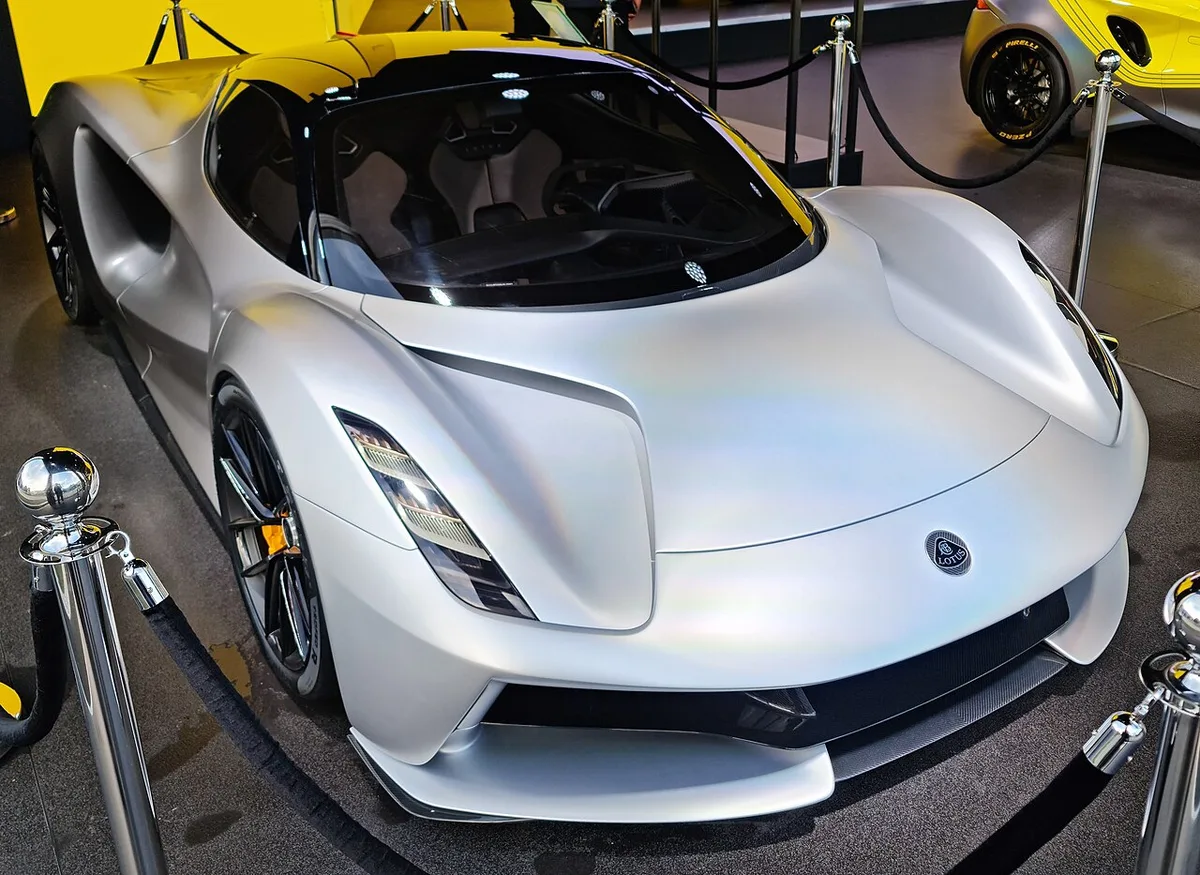
Lotus Evija: the featherweight brand just built a 1,900-kg muscle car (and ran it on batteries)
America and lightness never really got along. The American performance religion was always displacement, horsepower, cubic inches: add more, bolt on more, and the heavier hammer wins. Lotus was the strange little British import that preached the exact opposite gospel: take weight out, and you go faster everywhere without spending a dollar on engine. For decades that made Lotus the thinking enthusiast’s antidote to the muscle car. So here’s what should stop an American cold: the Lotus Evija, the brand’s flagship, makes nearly 2,000 horsepower, weighs 1,887 kilograms (about 4,160 lb), and costs north of two million dollars. The anti-muscle-car company built a muscle car. It only forgot to give it an engine.
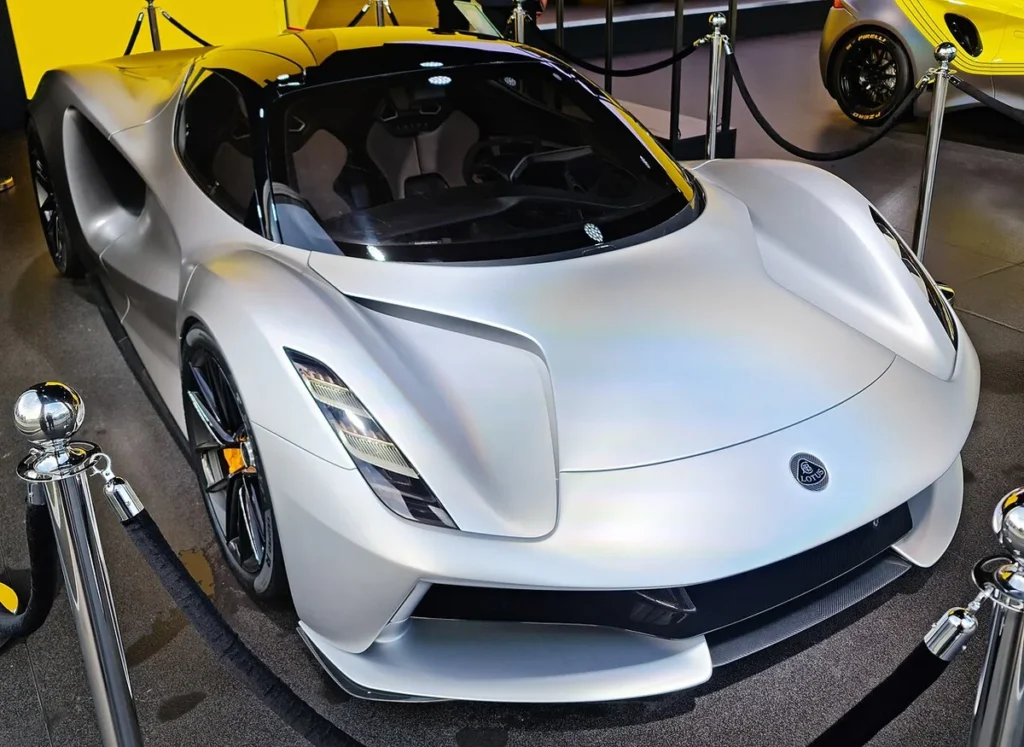
What Lotus says it built
Credit where it’s due: as engineering, the Evija is a monster. Lotus revealed it in July 2019 under the codename Type 130. Each wheel gets its own electric motor rated at 375 kW, four of them for 1,500 kW combined, a hair over 2,000 hp, and Lotus launched it as the most powerful production car in the world. The company quotes 1,704 Nm (about 1,257 lb-ft) of torque, 0-62 mph in under three seconds, 0-186 mph in 9.1 seconds and a top speed capped at 217 mph. The first battery, developed with Williams Advanced Engineering, held 70 kWh; in 2022 Lotus switched to a 93 kWh pack supplied by Unipart’s Hyperbat. The launch range claim was 250 miles on the European WLTP cycle, which is kinder than the EPA test Americans see on window stickers. US pricing sits around $2.3 million before options and taxes; Autocar quotes £2.4 million in Britain. Lotus announced a cap of 130 cars, though by late 2024 its European boss would no longer commit to that number. Every performance figure here is a manufacturer claim; nobody has published independent testing.
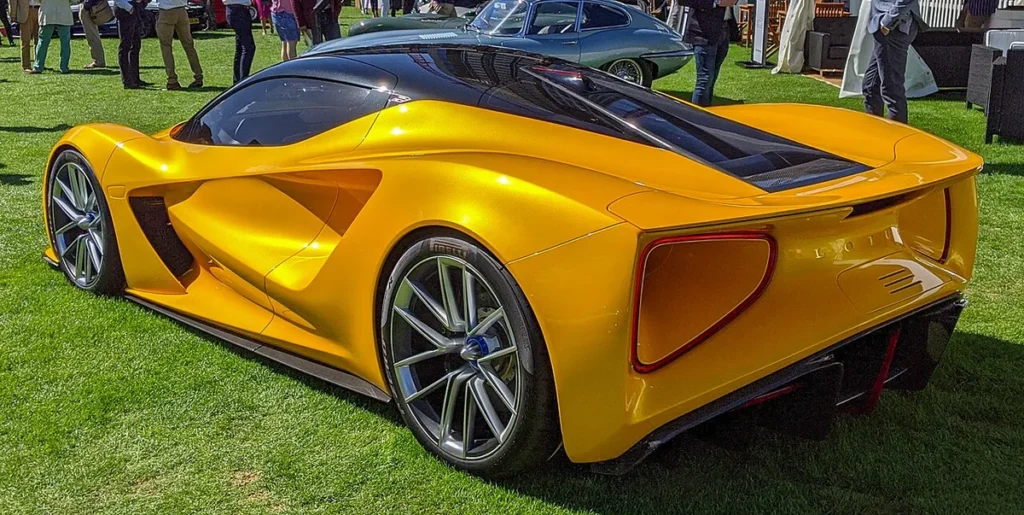
The one-motor-per-wheel layout earns its place. It lets the car meter torque at each corner separately, pushing the outside wheels harder than the inside ones to help the nose turn, a level of control no mechanical differential matches. NEB has covered the electric motor types behind setups like this, the inverter that drives each one and why nearly every EV gets by with a single gear, which is exactly what each Evija motor uses. The bill comes on the scale: four motors, four inverters and 93 kWh of cells are heavy, and that’s where the 1,887 kilos come from.
The creed it walked away from
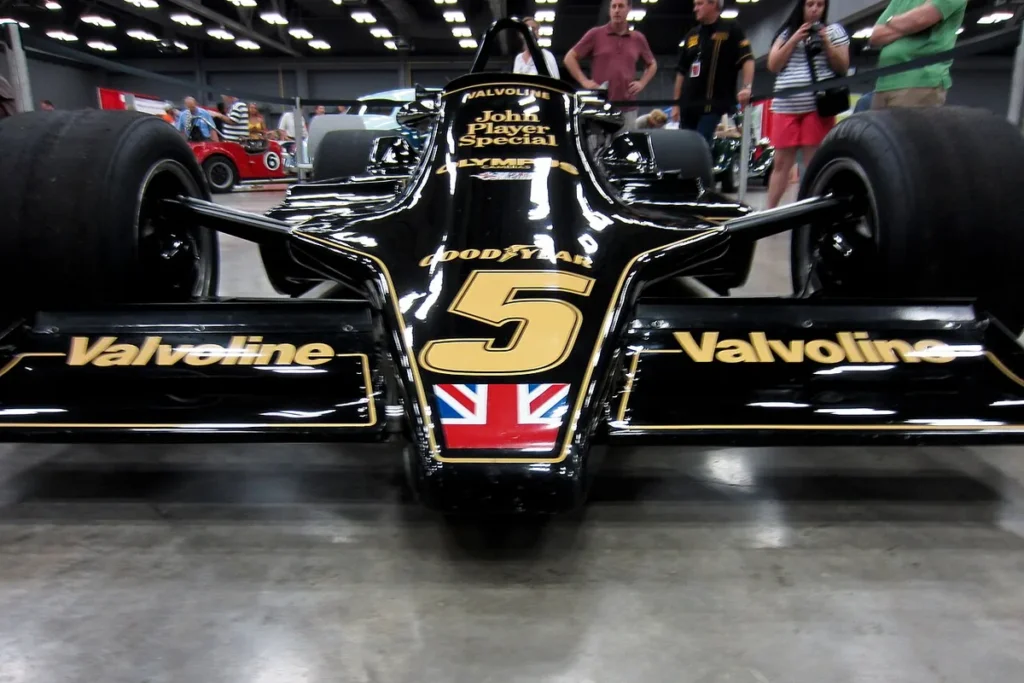
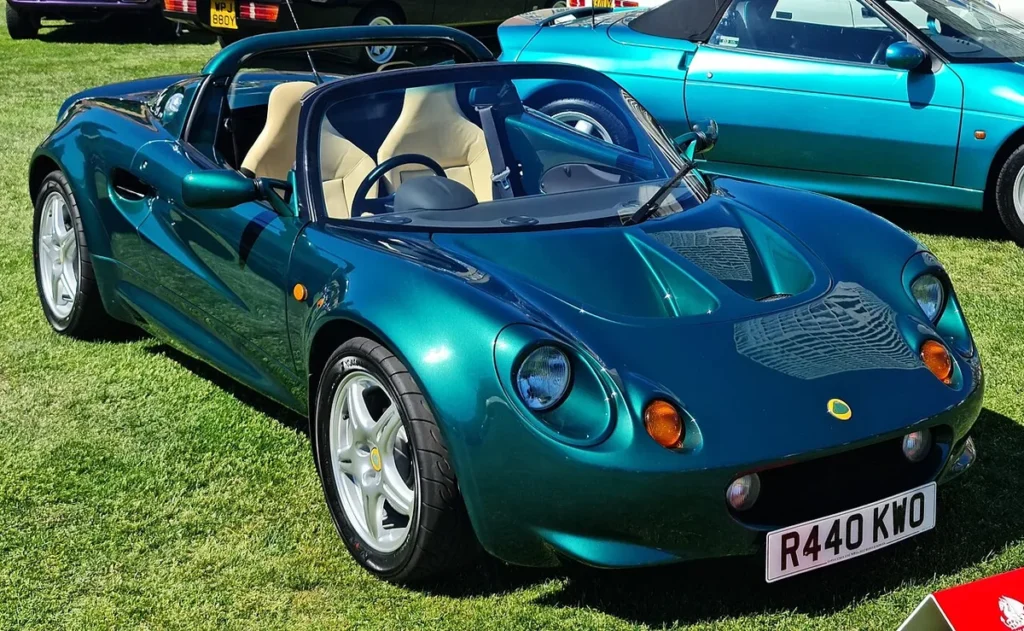
To feel the betrayal you have to know the gospel. Colin Chapman built Lotus on a single stubborn idea: adding power makes you faster on the straights, but subtracting weight makes you faster everywhere. That obsession gave the world the 1996 Elise, a car of about 725 kilograms that drove like it read your mind, and before that a string of Formula 1 cars that humbled better-funded rivals. The Lotus 25 of 1962 was the first F1 car with a monocoque chassis, which Classic Team Lotus itself qualifies as a “(semi) monocoque”, and it pushed the whole grid away from tube frames. Sixteen years later the Lotus 79 took ground effect to the limit and carried Mario Andretti, an Italian-born American, to the 1978 world title. Different eras, same philosophy: win by doing more with less.
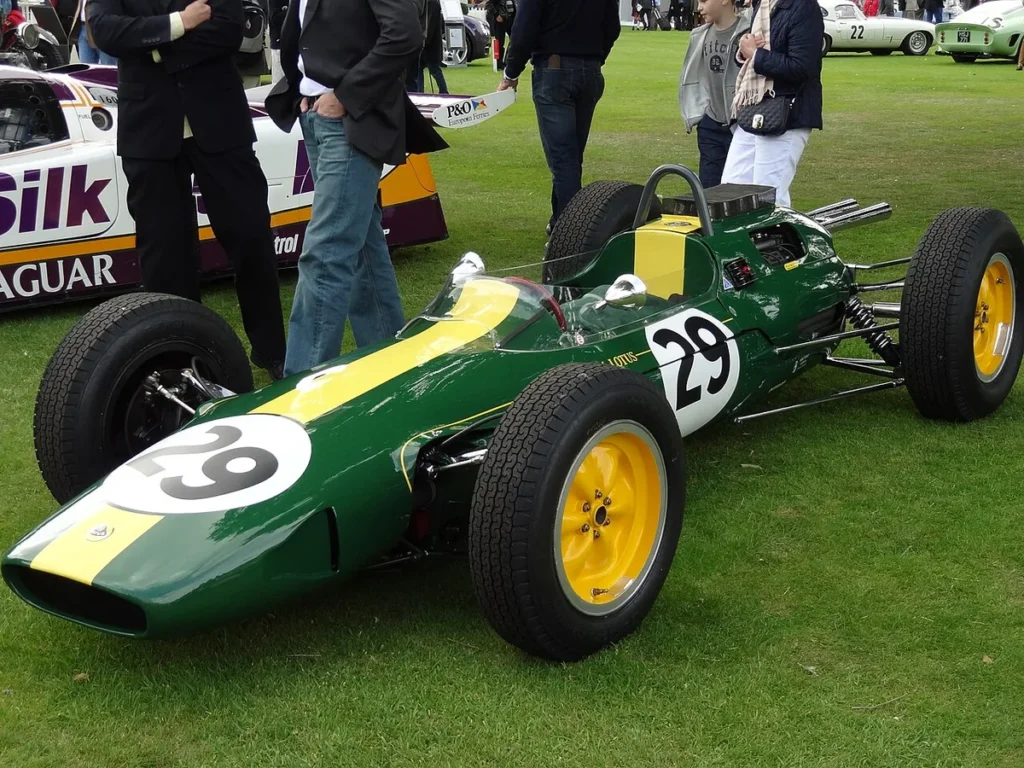
For an American buyer, Lotus was the one exotic badge that didn’t sell excess. You bought a Lotus precisely because it wasn’t a two-ton brute, because it would embarrass far more powerful metal through a corner by weighing half as much. Strip that away and the badge is just a badge.
The American way always won anyway
Here’s the part that stings for anyone who waved the lightness flag. In the long argument between Chapman’s gram-counting and Detroit’s cubic inches, the cubic inches mostly won the sales charts. America bought the big engine, the big body, the straight-line hit. And the electric era hasn’t changed that instinct one bit; it has amplified it. The GMC Hummer EV weighs more than four tons and sells brute force as progress. The Tesla Model S Plaid chases its roughly 1,000 horsepower and quarter-mile bragging rights, not corner-exit finesse. The American approach to electric performance is the same as the gasoline one: pile on power and battery, let the weight sort itself out later.
The Evija is Lotus joining that club. It answers the electric-performance question the American way, with more motors, more kilowatt-hours and more thrust, rather than the Chapman way. And that’s the quiet irony. The brand that spent fifty years telling Americans they were doing it wrong just did it exactly their way, only with a British accent and a Chinese owner. There’s no lightness rebuke left in the showroom. There’s just another heavyweight hitter, plugged into the wall.
What Lotus actually meant over here
Lotus was never a volume player in the States, and that’s the point: it was a cult. The Esprit that turned into a submarine in The Spy Who Loved Me, the wedge on a thousand teenage bedroom walls. The Elise and later the Evora sold in tiny numbers to people who knew exactly why they were buying a stripped, loud, uncompromising little car instead of something softer and faster in a straight line. A Lotus asked you to care about the things mass-market America ignored: steering feel, mid-corner balance, the directness of a car that weighed almost nothing. You put up with the cramped cabin and the agricultural trim because the driving was pure.
That cult is the audience the Evija leaves behind. Nobody who loved an Elise for its featherweight purity sees themselves in a 1,887-kilogram, two-million-dollar flagship that corners on software and sheer power. The Evija is aimed at a global collector who wants the fastest, most exclusive thing with an interesting badge, a buyer who would be just as happy with a Rimac or a Pininfarina. The American Lotus faithful, the ones who made the brand a cult rather than a footnote, aren’t invited to this one.
Where the criticism has to be precise
Lazy criticism trips here, so NEB won’t. Lotus did fight the weight. The carbon monocoque tub weighs, per Lotus, just 129 kilograms. The 2019 target for the whole car was 1,680 kg; it grew to 1,887, but there’s real engineering sweat in that number. The Evija also undercuts its arch-rival: Rimac’s own spec sheet gives 2,300 kg for the Nevera, more than 400 kilos heavier. Claiming Lotus got lazy would be false, and it would hand the car’s defenders an easy win.
The real charge holds up better: Lotus didn’t fail at making the car light, it chose to build the one kind of car that can’t be light. Feeding 2,000 hp takes a huge battery, and a huge battery keeps a car near two tons no matter how much carbon you wrap around it. The whole category is incompatible with Chapman’s creed, and the brand that defined itself by refusing to build that car parked its halo model squarely inside it. Nobody on the engineering team blew it. Somebody upstairs picked the wrong fight.
Who owns it now, and why that matters in America
None of this fell from the sky. Since 2017 Lotus has been controlled by Geely, the Chinese group that bought 51 percent of the brand and, in plain terms, saved it after years of losses and revolving-door owners. No Geely, probably no Evija and no Lotus to argue about, so this isn’t nostalgia griping about foreign money. It’s about direction.
And the direction is heavy. Lotus has bet its future on big cars: the Eletre electric SUV and the Emeya sedan, exactly the kind of machines it wants in American showrooms. Then came the twist. In May 2026 Lotus unveiled its Focus 2030 plan, which walks back the all-electric promise: the combustion Emira stays in production, hybrids move to the center, and a hybrid V8 supercar with more than 1,000 PS, codenamed Type 135, is due in 2028. So Lotus courts America with heavy electric SUVs and a promised hybrid V8, while its two-million-dollar halo car abandons the single trait that made Americans respect the badge in the first place. The timing is almost cruel.
Late to a party someone else was already hosting
Then there’s the calendar, and it deserves accuracy rather than the easy round number. The Evija was shown in July 2019 with first deliveries promised for late 2020, soon pushed to mid-2021. They didn’t come: Covid stopped global testing and hit several suppliers. The first car handed over was, fittingly, handed over on American soil. Jenson Button collected his Brawn GP-inspired Evija at Monterey Car Week in August 2023, a special build rather than a regular customer car. The first series customer got keys in January 2024, according to Autocar, which still headlined it a “four-year delay.” Measured against the promised date it’s a little over three years; four and a half is the time since the reveal, not the slip.
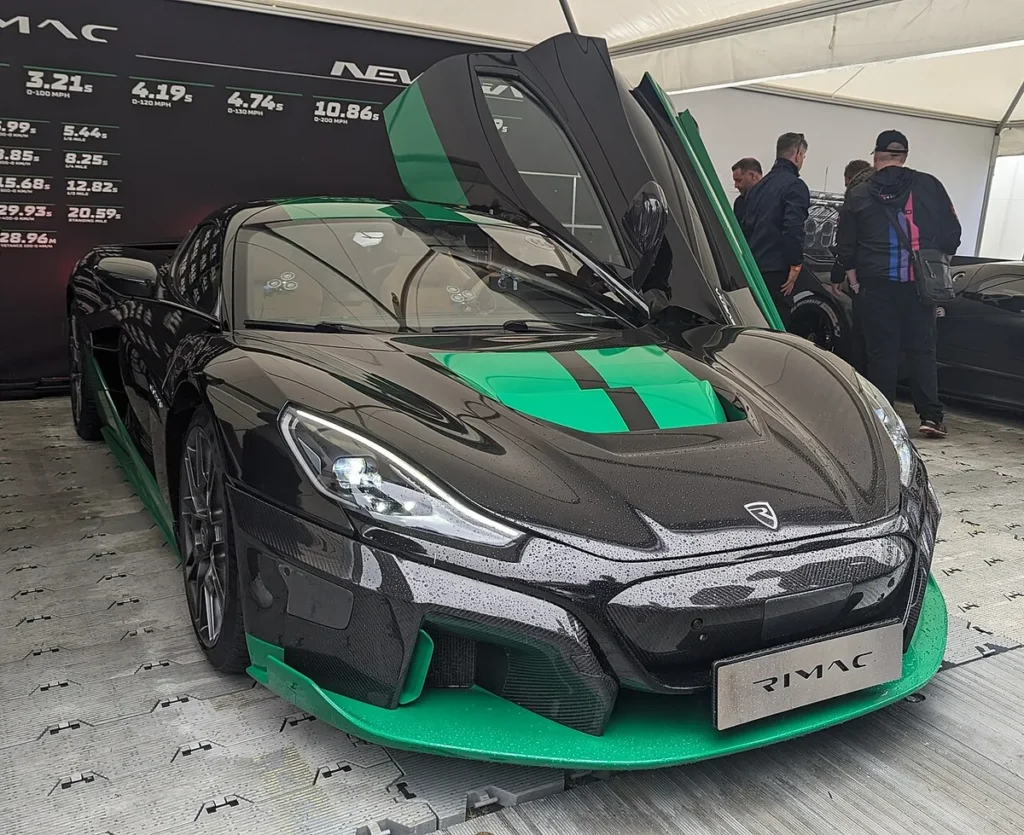
Three years is an eternity in electric hypercars. While the Evija matured in Hethel, Nico Rosberg took delivery of the first production Rimac Nevera in August 2022, and US deliveries of the roughly 1,900-hp Croatian started in June 2023. The Pininfarina Battista, which is a Rimac underneath, was on the road too. The car that was supposed to be king in 2019 showed up in 2024 to a game others had been winning for a while.
At least it showed up
One thing America can’t throw at the Evija: being vapor. The United States has its own promised electric hypercar, and it has become a national punchline. Tesla’s second-generation Roadster was unveiled in November 2017 with a 2020 on-sale date and claims of sub-two-second sprints. On October 15, 2026, Tesla finally put on its reveal at a SpaceX test site in Texas, complete with thrusters and a car hopping over a Cybertruck, and Elon Musk said production would start in 2028. Price: not announced. Deliveries: zero, nine years after the first stage show. Measured against that, Lotus’s three-year slip looks almost disciplined.
The irony runs deeper, because Lotus is the reason the first Tesla Roadster existed at all. The 2008 car rode on an Elise-derived chassis, and Lotus built the rolling gliders in Hethel under a 2,500-unit contract that ran out at the end of 2011. The brand that helped Tesla build its first car, a 1,305-kilogram (2,877-lb) roadster, now sells a flagship that outweighs it by almost 600 kilos.
None of that softens the charge. The Evija got built, and the engineering is superb. The problem sits upstream: a brand poured its genius into the one kind of car that erases what the brand stood for. Delivering it on time wouldn’t have fixed that. Delivering it three years late just gave the rivals more time to make the point for us.
The verdict
Lotus earned its place through a hard kind of discipline: believing less is more while everyone else sold you more, and winning with it on track and road. The Evija sets that discipline down, and not out of incompetence; the thing is brilliantly built and lighter than its Croatian rival. It’s arithmetic. In today’s market a two-million-dollar electric hypercar buys more brand prestige and more headlines than a purist fixation on the gram ever could. Geely runs the numbers, and the numbers in 2026 say power, battery and size.
That’s why the Evija leaves a strange aftertaste even as it dazzles. It could belong to anyone. It’s the first Lotus flagship whose story doesn’t need the name Chapman to stand up; swap the badge for any other maker of 2,000-hp projectiles and the pitch survives intact. For the American who always saw Lotus as the smart alternative to brute force, that’s the gut-punch: Lotus finally built the brute, plugged it in, and called it the future. Nobody doubts the Evija is fast. What’s left of Lotus once its boldest car gives up the one thing that made a Lotus a Lotus is another matter, and the scale already answered it: 1,887 kilos against the Elise’s 725.
Unplug and enjoy.
Images: MrWalkr (CC BY-SA 4.0) · Iain Cameron (CC BY 2.0) · Steve/mrlaugh (CC BY-SA 2.0) · Chelsea Jay (CC BY-SA 4.0) · MrWalkr (CC BY-SA 4.0) · Calreyn88 (CC0), via Wikimedia Commons.