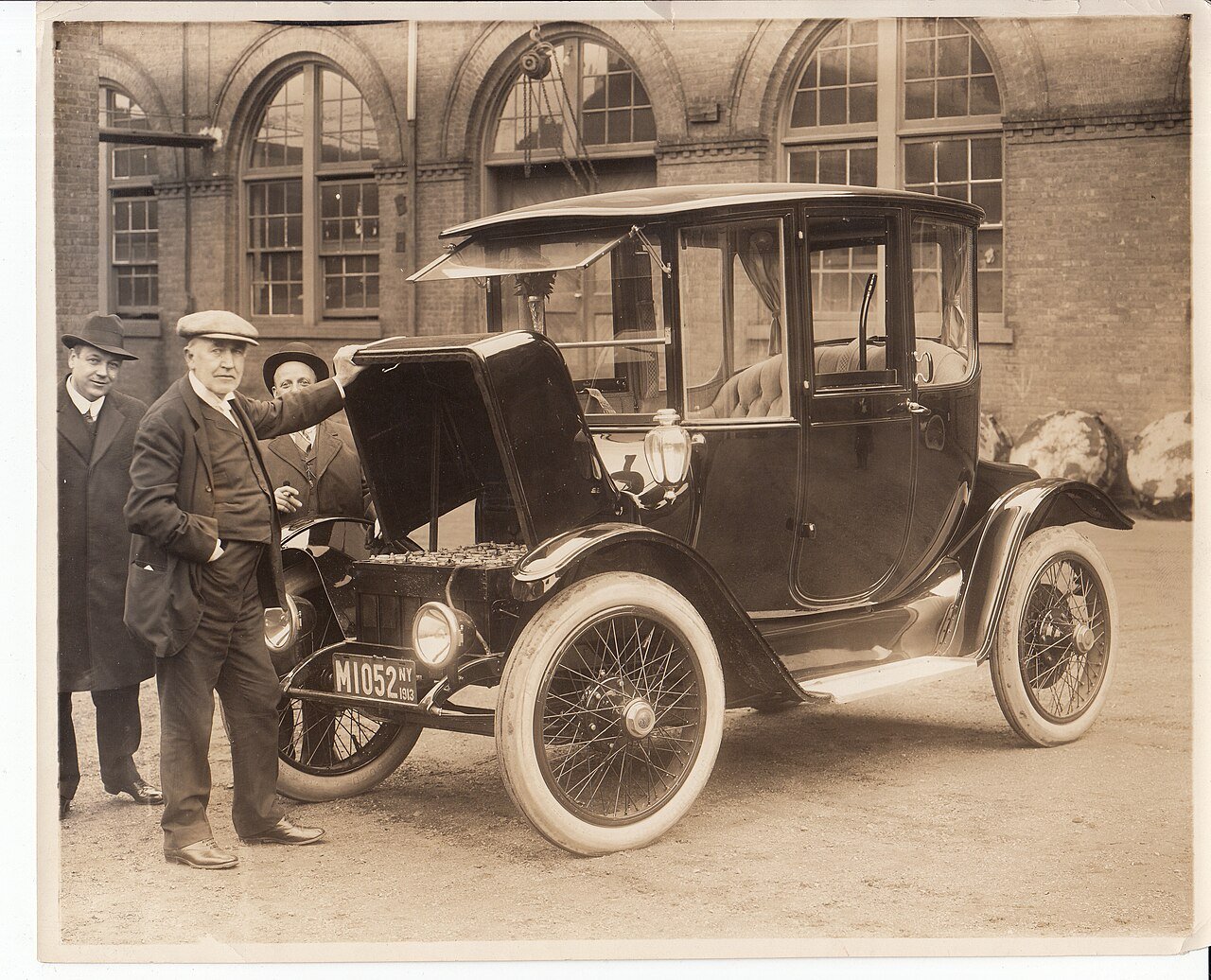
Edison and the Electric Car: The Battery He Had to Pull Off the Market
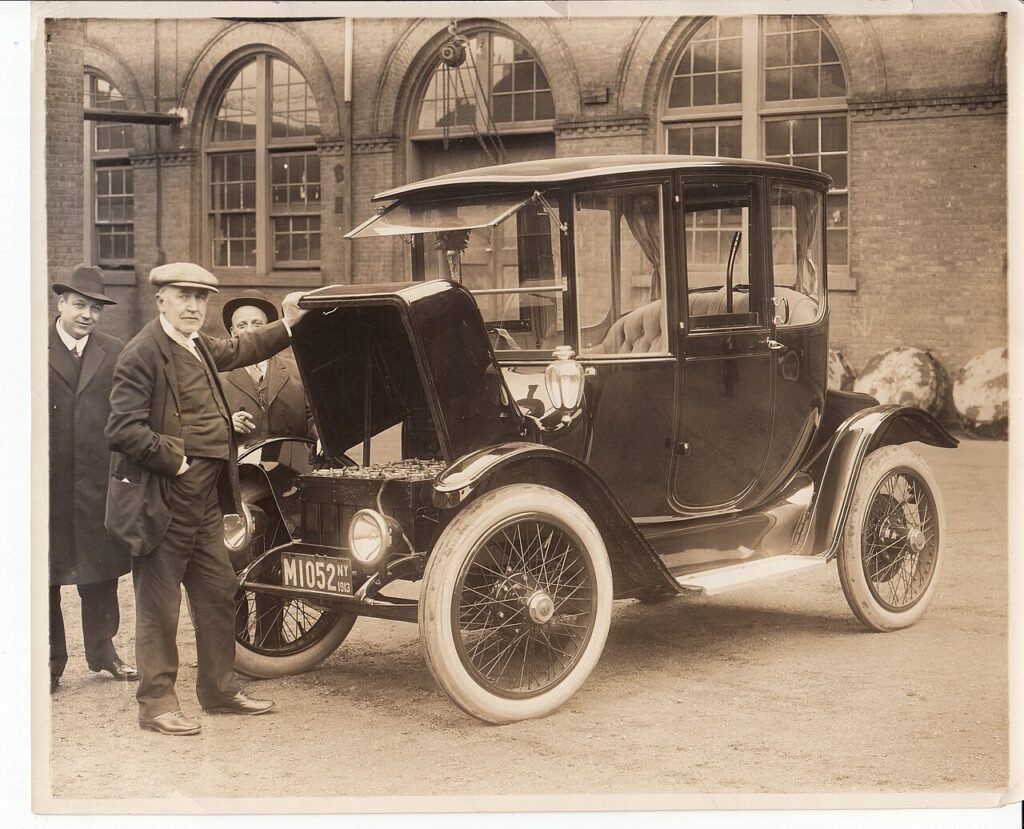
“Within a year, I hope, we shall begin the manufacture of an electric automobile.”
Henry Ford said that to the New York Times, and the paper ran it on January 11, 1914. The battery for that promised car was supposed to come from his friend Thomas Edison. A year later there was no electric Ford. There was a canceled project, a couple of prototypes and an expensive lesson.
Most versions of this story stop at “Ford and Edison almost changed history.” The parts they leave out are better: a recall, a patent fight with a Swede, a Navy submarine and a wife who drove electric while her husband built the Model T.
America already ran on electrics
By the time Ford made his promise, electric cars weren’t a daydream in America. They were a business. The Baker Motor Vehicle Company started in 1899 in Cleveland, Ohio, under Walter C. Baker. Its first car, a two-seater, sold for $850. By 1906 the company built 800 vehicles in a year, which Wikipedia’s entry on the firm calls the largest electric vehicle maker in the world at that time. Its customers included the White House fleet under Helen Taft and, in 1903, King Chulalongkorn of Siam. Prices varied widely: $1,600 for a 1904 Stanhope that could manage 14 mph, $4,000 for a 1906 Landolet, $2,800 for a 1910 model with room for four. These were cars for people with money, and there were enough of them to support seventeen models by 1907.
And Edison was in it. According to the same entry, he bought one of Baker’s first cars as his own first automobile, and nickel-iron batteries he designed went into some Baker electrics.
In 1913 Baker was overtaken in sales by Detroit Electric, which built cars from 1907 to 1939, around 13,000 in all, and 1,000 to 2,000 a year in the 1910s. Its advertising promised 80 miles, about 130 kilometers, between charges. It offered Edison cells as an option, and a 1914 ad claimed that both Ford and Edison had bought Detroit Electrics. Take the ad with a grain of salt, since it’s an ad. What isn’t in doubt is that Edison owned one.
Baker merged with Rauch & Lang in 1914, the same year Ford’s electric prototypes were on the road at Highland Park.
The man who built the promise
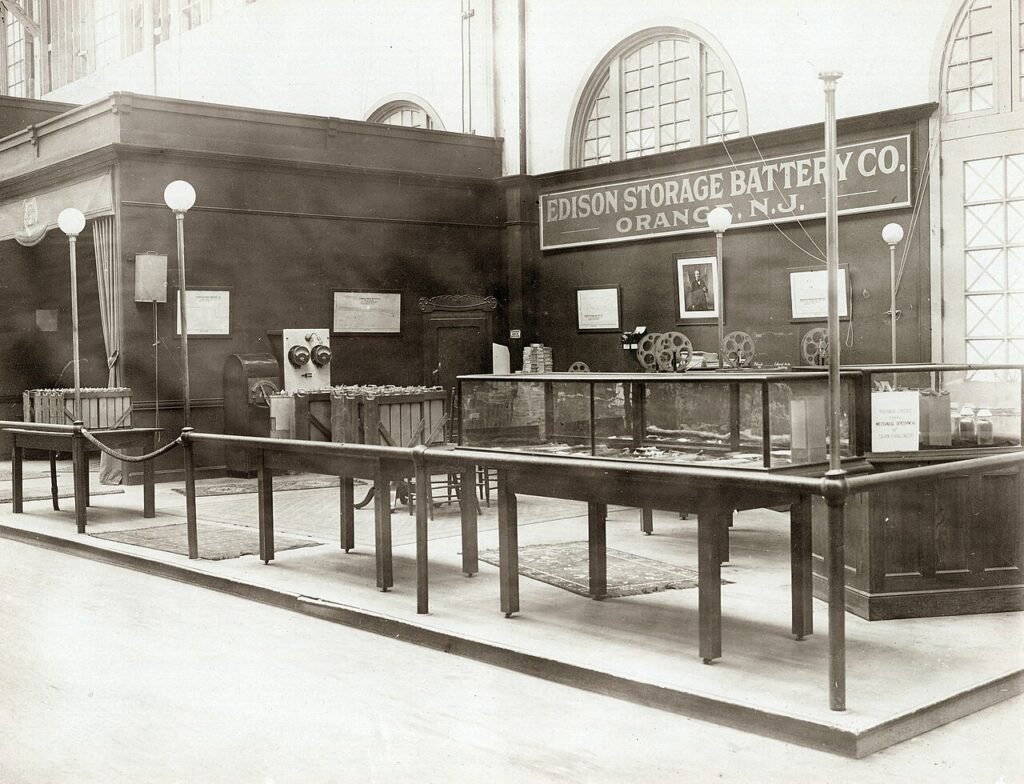
On May 27, 1901, Edison founded the Edison Storage Battery Company in West Orange, New Jersey. The product was a nickel-iron cell for electric vehicles. Seth Fletcher, in his book Bottled Lightning, says the marketing claimed it would last longer than “four or five automobiles.” In 1902 Edison published a piece announcing “the final perfection of the storage battery.” Production began in 1903.
The pitch wasn’t empty. The selling points were a cell about 40 percent lighter than lead-acid for the same stored energy, and a recharge in half the time. The chemistry was a nickel-oxide cathode, an iron anode and a potassium hydroxide electrolyte. Current references give this type of cell a lifespan of 30 to 50 years. One technical write-up says Edison had assistants toss cells from second- and third-floor windows at his lab as a toughness test.
Then the real world got involved. By 1904 the batteries were leaking and, per Fletcher, losing about 30 percent of their capacity. Early Electric Vehicles says sales stopped that November over cell-seam problems. Edison pulled the first batteries and went back to work.
The fix took years. Fletcher puts the leak solution between 1908 and 1909 and dates the second-generation A cell to July 1909. Other sources say late in the year. They disagree on the month and agree on the year, and Fletcher calls the new battery nearly indestructible.
In that window gasoline didn’t stand still. Fletcher notes that Ford launched the Model N in 1906 and Rolls-Royce brought out a six-cylinder gasoline car in 1907.
What the chemistry did
Nickel-iron’s numbers, from current technical references, are not flattering for a car.
Round-trip charge efficiency is under 65 percent. For every 100 units you put in, you get fewer than 65 back. Self-discharge runs 20 to 30 percent a month, so a battery parked in a barn bleeds roughly a fifth to a third of its charge unaided. It did poorly in the cold and cost more than lead-acid.
Against its rivals of the day, it also gave more range: a University of Cincinnati technical paper cites 50 to 75 miles per charge, versus about 25 for early lead-acid cars. That’s two to three times the range, not a footnote. What you paid for it was efficiency, self-discharge and cost. It could outlive its owner. That’s a fine property for a railway signal, a miner’s lamp or a locomotive, which is where Edison’s cell ended up. For a family car charged daily that has to stay light, it’s a harder fit. That last sentence is NEB’s opinion, not a line from a manual, but the numbers are right there.
Ford’s two prototypes
The Ford project was real. The Henry Ford museum has a photograph from around 1914, taken at the Highland Park plant, of motor designer Fred Allison driving an experimental electric car with a low frame, tiller steering and batteries under the seat. The museum says Ford and Edison collaborated on two prototypes built around Edison’s nickel-iron cell. The first was done by late 1913. There was talk of forming a new company to build them. The project was canceled.
The Ford Century, quoted by Jalopnik, puts the cost at about $1.5 million and roughly 100,000 batteries purchased. Why it died depends on who you ask. One account says the nickel-iron cell couldn’t deliver the current the car needed. Another says the electric starter for gasoline engines took away the electric car’s big advantage, no hand cranking. There’s no closed answer. I’m not inventing one.
The same Times piece has the other half of Ford’s quote, and it’s the best summary of the whole thing: the problem, he said, had been to build a light storage battery that would run long distances without recharging.
The wife who drove electric
Here’s the detail that sits badly with “Ford killed the electric car.” His wife, Clara, drove one. Henry bought her a Detroit Electric Model C in 1908, with a special child’s seat. In 1914 she got a Model 47 brougham, which the Henry Ford museum lists at 54 cells, 108 volts and $3,730 as equipped. She kept driving it into the 1930s. The museum doesn’t say which battery chemistry was inside, so I won’t claim one.
Set that price against a 1910 Baker at $2,800. Electric cars weren’t cheap toys. They were what you bought if you could afford the electricity and the garage, and the Ford household could.
Cars with Edison cells also went the distance. In September 1910, two Bailey Electrics, built by S.R. Bailey & Co. of Amesbury, Massachusetts, a firm that sold on Edison’s name and claimed 100 miles on a charge in ideal conditions, made a 1,000-mile endurance run from New York up to Mount Washington, New Hampshire, and back. Both finished, which surprised plenty of onlookers, according to the PreWarCar write-up. Bailey stopped operating by 1915, unable to keep up with increasingly powerful gasoline cars.
That’s the Edison battery’s best year in a car: a thousand miles with no breakdown. And it still wasn’t enough.
The Swede who filed first
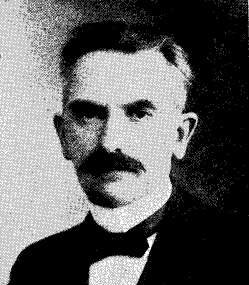
Now for the part the Edison tour skips. Sweden’s national museum of technology, Tekniska museet, says Waldemar Jungner conceived his accumulator in 1890 on a train, patented it in 1899 and founded his company in 1900. The museum says a test in Stockholm that year of his silver-cadmium version ran almost 150 kilometers, about 93 miles, on one charge. Silver and cadmium cost too much, so he moved to nickel and iron.
Edison patented his nickel-iron cell in 1901. A long patent fight followed. Edison won, and the Swedish museum says he had much deeper pockets. Jungner ended up in financial trouble, lost his factory to a fire in 1905 and released his patent to other manufacturers. A successor company ended up inside Saft, the group that still makes nickel-cadmium batteries.
I can’t say Edison copied anyone. The sources I read don’t, and I couldn’t confirm it. I can say who filed first.
Meanwhile in Barcelona
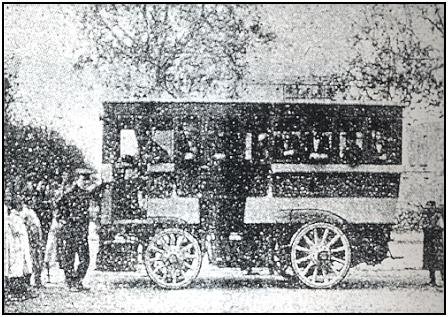
Spain hit Ford’s battery wall more than a decade before Ford did. In 1898 an artillery captain named Emilio de la Cuadra opened the country’s first car factory in Barcelona, and he bet it on electricity: a truck, a bus and a four-wheel car. The car ran flat after about three miles. Compare that with Jungner’s cell in 1900, which went about 93 miles around Stockholm, or the 50 to 75 miles Edison’s cell later gave American electrics.
The batteries came from Carlos Vellino, a partner in the company with his own battery works in town. The company histories say that in August 1900 the press was invited to a demo, and that the bus rolled a few yards out of the factory, died and had to be towed back. That scene does not show up in the digitized press of 1900.
What does show up is the rematch. On the afternoon of December 5, 1900, the bus carried 16 passengers and 400 kilos of luggage twice around Barcelona’s ring roads, with a detour down the Ramblas, at an average of 22 km/h, about 14 mph. The local paper La Dinastía wrote the next day that the trials could not have gone better, and thanked the engineer Vellino and the head of projects, one Mark Birkigt. In January 1901 the magazine Electrón added that it weighed 7,700 kilos and climbed a 12 percent grade without trouble. The story that it was later sold to Valencia and burned along with the ship carrying it comes from later accounts, not from the press of the day.
It worked, and there was still no business. According to de la Cuadra’s military service record, the company stopped production in 1901, and its suspension of payments hit the financial press in December 1902. By then Birkigt, already on staff in 1900, had moved to gasoline. In 1904 the pieces became Hispano-Suiza. Birkigt’s V8 aircraft engine later powered the SPAD XIII, the fighter Eddie Rickenbacker flew to 26 victories in 1918.
Spain’s most famous car name exists because an electric car company ran out of range, then out of money.
The Navy paid for it
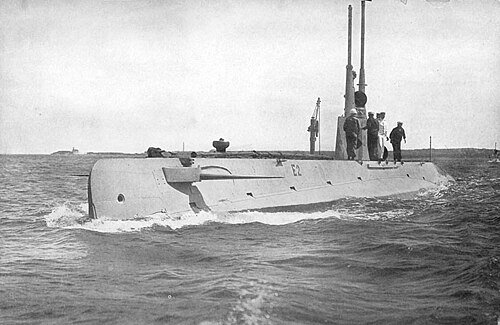
On January 15, 1916, in Dry Dock No. 2 at the New York Navy Yard, the submarine USS E-2 suffered a hydrogen explosion during severe testing of Edison Storage Battery Company batteries. Four people died and seven were injured. Nickel-iron cells were being tested to remove the chlorine gas risk that lead-acid batteries posed in submarines. A Navy investigation led by then-Lieutenant Chester W. Nimitz cleared the boat’s commanding officer.
You don’t hear that on the sentimental version of the Edison story. A battery meant to make submarines safer ended up in an explosion in a dry dock.
What survived
The standard reference on the cell says Edison was disappointed that his battery wasn’t adopted for starting combustion engines, and that electric cars dropped out of production only a few years after it appeared. Detroit Electric lasted until 1939, with its last shipment on February 23 of that year. Edison’s cell carried on in trains, railway signals, forklifts and standby power, and was manufactured in West Orange until 1972.
And now it’s coming back. The chemistry has found fresh interest for off-grid storage. In 2023 the first industrial-scale “battolyser,” a system combining a battery and an electrolyzer, started up at the RWE Magnum power plant in Delfzijl, the Netherlands. A battery that never made it as a car part is now earning its keep at a power station.
Where NEB lands
Edison wasn’t a fool. He picked a chemistry with a long life and middling efficiency for a car that needed the reverse. That doesn’t shrink him. What shrinks him is the legend piled on top, the lone genius with the whole future mapped out. The man was brilliant, he was rich, he had a friend running Ford Motor Company, and the battery still wouldn’t do what the car needed. Money and fame don’t change chemistry.
What he and Ford saw clearly was the problem, and Ford said it in 1914: you need a light battery that goes far without a recharge. More than a century on, the sentence still holds with different numbers. We watched it with La Jamais Contente in 1899, when the batteries weighed nearly half the car, and we’re watching it with the Rimac Nevera, our first hypercar piece. This piece sits next to both, and next to the editorial on the forgotten era of the electric car.
Notice the pattern. A big claim, a deadline, then a walk-back. The “final perfection” of 1902 ended in a recall in 1904. Ford’s “within a year” of January 1914 ended in cancellation. Two famous names, two retreats. The only thing that changes from round to round is whose name is on the claim.
Don’t take it from anyone who says the battery problem is solved this time. Don’t take it from anyone who says it never will be, either.
How many more “final perfections” are we going to sit through?
Unplug and enjoy.
Images: NPS NPGallery / Wikimedia Commons, public domain · Missouri History Museum / Wikimedia Commons, public domain · Svenska Dagbladets årsbok 1924 / Wikimedia Commons, public domain · Unknown author / Wikimedia Commons, public domain · US Naval History and Heritage Command / Wikimedia Commons, public domain.
1 thought on “Edison and the Electric Car: The Battery He Had to Pull Off the Market”