Tama E4S-47: The Electric Car That Beat Its Own Spec Sheet in 1948
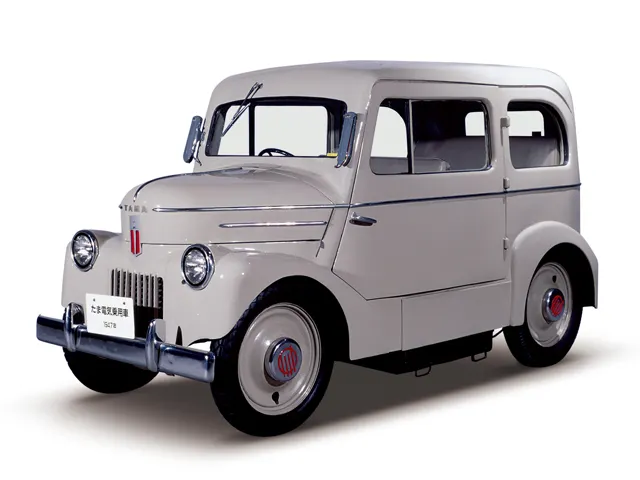
Here’s a quiz for anyone who thinks battery swapping is a 21st-century invention. In 1910 a power company in Hartford, Connecticut, started swapping batteries on electric trucks. In 1947 a Japanese outfit built a swappable pack into a taxi. In 2011 an Israeli startup sitting on about $850 million opened its first swap station. Which one has an old, forgotten, beige sedan in a museum garage?
The Tama E4S-47. And here’s the part that should embarrass every window-sticker range number you’ve ever read: in an official 1948 government test, it went past 96 km, about 60 miles, on one charge. Its maker had promised about 40.
Forty promised, nearly sixty delivered
The number that circulates online is 65 km, or roughly 40 miles, with a top speed of 35 km/h, about 22 mph. That’s the catalog figure.
Then came the first official electric-vehicle performance test run by Japan’s Ministry of Commerce and Industry. Nissan puts it in March 1948. The Tama won it. Result: more than 96 km (about 60 miles) on one charge, with Nissan rounding to 96 and some sources giving 96.3, at 35.2 km/h (21.9 mph) flat out. Against 65 km on the spec sheet, the gap is around 48 percent.
Few retellings mention it, because most of them copy the catalog line. Some of the copies even get the numbers wrong. Nissan, the Japan Society of Mechanical Engineers and the Society of Automotive Engineers of Japan all give 65 km and 35 km/h as the rated figures. I’m using theirs.
Out of work in 1946
Tachikawa Aircraft built airplanes. After the surrender, Japan banned aircraft production, and the company had a plant and a roomful of engineers with nothing on the drawing boards. A new electric car company, Tokyo Electro Automobile, came out of Tachikawa in late 1946 and set up in Fuchu, in the Kita-Tama district west of Tokyo, which is where the name comes from. It is the company that would eventually become Prince Motor. About 200 people from Tachikawa started it.
Two EOT-46 prototypes came first, in 1946. The E4S-47 sedan was done by May 1947. I’m following the Society of Automotive Engineers of Japan for that timeline, because the sources contradict each other on when the company changed its name in those months, and a missing month stays missing.
Why electric? Because gasoline was rationed, industrial resources were controlled by the occupation forces, and Japan kept hydroelectric capacity that made electric mobility attractive, with government support behind it. Nissan’s own page frames it as an acute shortage of oil, goods and food, with electricity available.
What you’d have been looking at
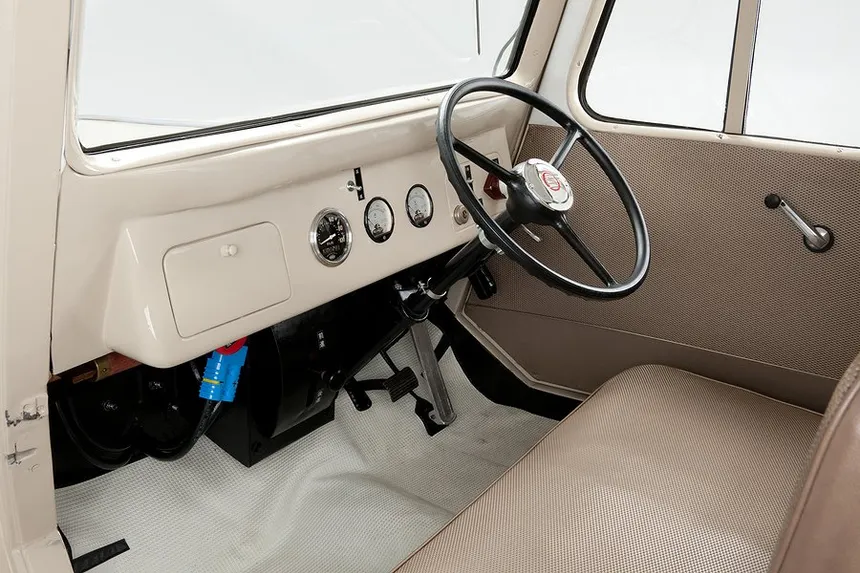
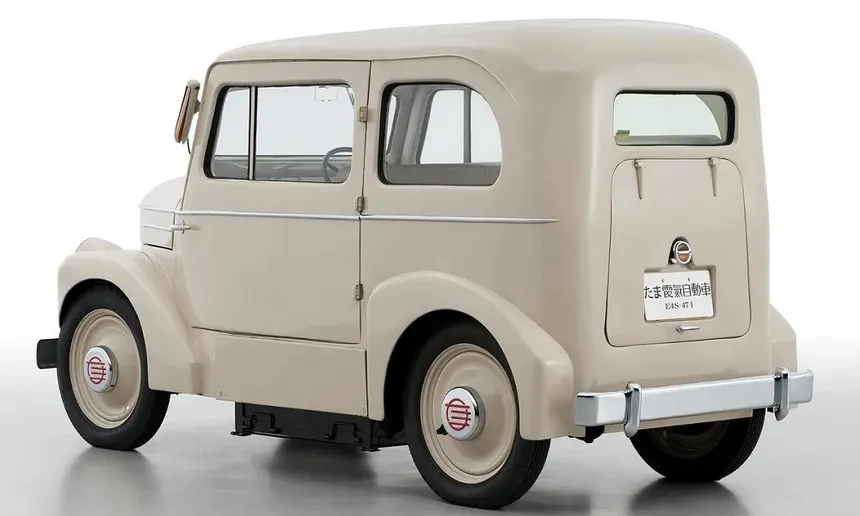
Picture a two-door sedan seating four. Nissan gives the dimensions as 3,035 mm by 1,230 mm by 1,630 mm. That’s a hair under 10 feet long, a little over 4 feet wide and about 5 feet 4 inches tall, on a 79-inch wheelbase, weighing 1,100 kg or about 2,425 pounds. Figures vary between units and documents, so I use the spec sheet of the car Nissan preserves.
The body sits on a wooden frame covered in iron sheet. That’s from the file the Japan Society of Mechanical Engineers wrote when it named the car a mechanical heritage item. The motor is a 36-volt series-wound DC unit rated 3.3 kW, or 4.5 hp, from Hitachi. The battery is lead-acid, 40 volts and 162 amp-hours from Yuasa, split in two blocks under the floor. Multiply it out and you get 6.48 kWh nominal, theoretical energy. Usable energy was lower because of losses and discharge limits. That’s my arithmetic, not an official spec. The 36 V and 40 V are different nominal voltages, one for the motor and one for the pack.
Speed control is done with resistors, so any power you don’t use turns into heat. The Nissan engineers who restored the car say so themselves, and they add that this is nothing like the efficiency of a Leaf. The hood opens in two halves, alligator style. The windshield is flat. The turn signal is a swing-out arm they call “Apollo.” Simple to build, simple to fix.
And the battery packs rode in two compartments fitted with rollers, so a crew could slide the dead ones out and the charged ones in. Nissan presents that system as an engineering achievement that contributed to its result in the ministry tests.
One car, a whole family
The sedan wasn’t alone. The EOT-47 was a two-seat truck rated for 500 kg, about 1,100 pounds, of cargo. In 1948 came the Tama Junior, the E4S-48 and E4S-49, and here’s a detail that quietly kills the wooden-frame story: the Junior had an all-steel body. In 1949 the Senior arrived, a four-door sedan seating five. Nissan’s own heritage material lists the Junior and the Senior as the models that followed the first sedan.
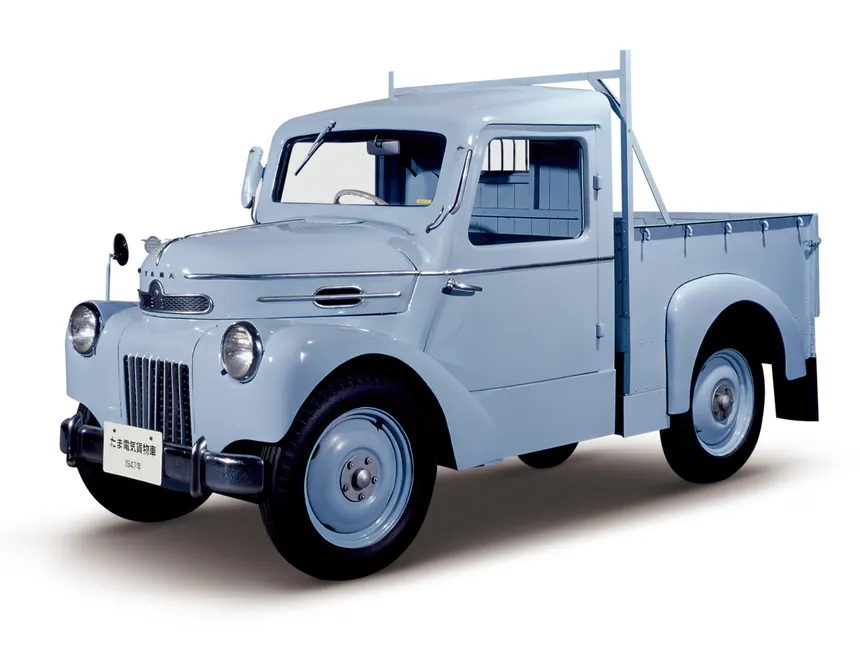
Nissan also keeps a gasoline Tama in its collection, a 1947 pickup, model EOT-47-2, painted blue. The beige electric is number 009 in the collection and the blue gasoline truck is number 010. Even Nissan’s catalog admits the Tama lived in both worlds.
A taxi fleet you’ve never heard about
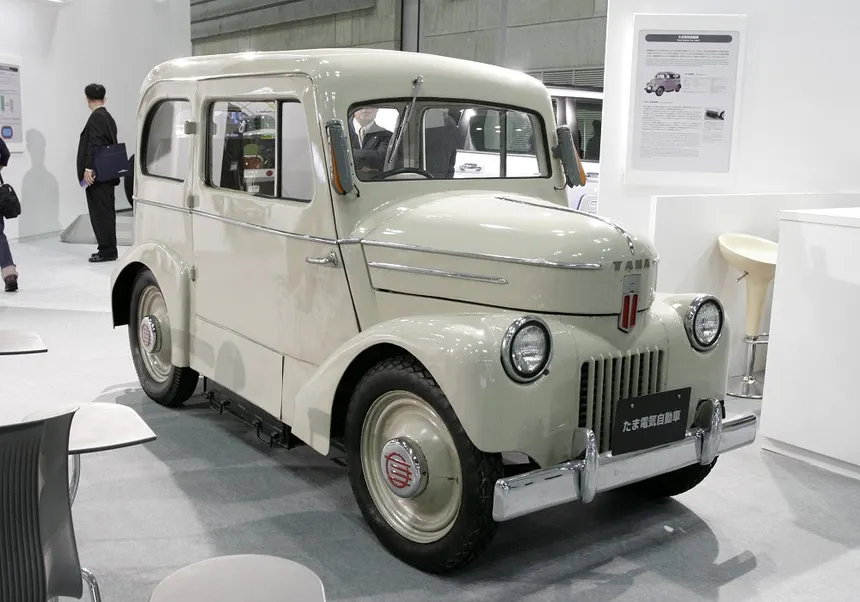
Most of them became taxis. Kazuo Ishikawa, a researcher who wrote a paper on Japan’s forgotten electric car era, quotes a contemporary, Jiro Tanaka, in a 2011 Asahi newspaper piece: the cabs in Tokyo, Osaka, Nagoya and Kyoto were almost all electric. That’s a witness account, not a census, and I found no complete count that turns it into a statistic.
The ministry count cited in that same paper shows: 28 cars in 1947, 270 in 1948, 397 in 1949, 384 in 1950, 20 in 1951. Total 1,099. In 1950 around 1,500 electric cars were running in the whole country, and about 1,100 of those were Tamas, according to the paper, citing Asahi. Treat that as a historical estimate, not an exact census.
For scale, the electric car most Europeans point to from the same decade is the Peugeot VLV. Peugeot says it built 377 between June 1941 and February 1943, with 70 to 80 km (43 to 50 miles) of range and a 35 km/h top speed. So the Tama built about three times as many, over five years instead of almost two, with an almost identical top speed and a somewhat shorter catalog range. That doesn’t say which was the better car, because the tests, batteries and conditions aren’t comparable.
In 1949 came the Tama Senior. The mechanical engineers’ society lists 200 km (124 miles) of claimed range per charge, and other sources say 55 km/h (34 mph). Those are specification numbers, and I found no independent test equivalent to the E4S-47’s. In February of that year Shojiro Ishibashi, who founded Bridgestone, invested in the company and took a leadership role.
Lead, bullets and cheap gas
The Korean War starts in 1950, the one American troops were fighting, and the bullets eat the lead. Every round of ammunition needed it, and so did every lead-acid battery in a Japanese taxi. In Ishikawa’s paper, which cites Tanaka, battery lead cost about 12,000 yen a ton before the war and about 140,000 after. Twelve times as much, a figure that comes from that secondary study and not from an official national series. At the same time gasoline supply got better, and the shift took time rather than happening overnight. The mechanical engineers’ file names those same two reasons for the end of the program: better fuel supply and pricier battery material.
Output went from 384 in 1950 to 20 in 1951.
A Prince in Nissan’s closet
The company lived on. In November 1951 it was Tama Motor. In 1952 it became Prince, after Crown Prince Akihito’s investiture ceremony. In April 1954 it merged with its engine supplier, Fuji Precision Industries, and the Prince name vanished for a while before coming back in February 1961. The first Prince Skyline debuted April 24, 1957, in Tokyo. Prince and Nissan merged in August 1966, and the first Skyline GT-R, the PGC-10 the fans call Hakosuka, arrived in February 1969.
That first GT-R ran the S20 engine, rated at 160 horsepower. Run the clock. In 1947 the company’s product was a 4.5 horsepower electric taxi. Twenty-two years later the same corporate line was selling a car with a 160 horsepower engine. That’s thirty-five times the power, going from one end of the same lineage to the other, in a little over two decades.
So to the Skyline crowd: your car’s family name began on a Prince. Nissan didn’t design or build the Tama. Tokyo Electro Automobile did, that company became Prince, and Prince joined Nissan in 1966, about fifteen years after the Tama stopped. Nissan calls it electric heritage because of the merger chain, which is fair on paper. The Truth About Cars wrote in 2010 that calling it “a Nissan” was probably a stretch. By lineage, the Tama belongs to Prince’s history before it belongs to Nissan’s.
The swap that keeps coming back
Back to Hartford. Per the Wikipedia entry on battery swapping, the Hartford Electric Light Company offered an exchange service for electric trucks between 1910 and 1924. The Tama put the idea in a passenger car in 1947. In 2007 Shai Agassi founded Better Place to scale it up to whole countries. The company raised about $850 million in private capital, sold, according to Wikipedia, fewer than 1,000 cars in Israel, 940 by early 2013, and went bankrupt on May 26, 2013.
Tesla took a swing in 2013. The Wikipedia article reports that a Model S swap took just over 90 seconds in the demonstration, and that Tesla dropped the effort by 2015 for lack of customer demand.
Back on the road in 2010
That was also the year Nissan launched the Leaf. A volunteer group from its development division, the “classic car restoration circle,” revived a 1947 Tama. They had to remake the swing-arm signals, the wipers and the bumper guards, and hunt down headlight lenses that, by their account, fewer than ten survive in all of Japan. The tires, in the original size, can still be sourced in England.
Nissan says the car was restored to its 1947 specification and put back into running order, which is the difference between a museum piece you look at and a car you can start. A 1947 electric taxi that runs is the whole point of the exercise.
The Japan Society of Mechanical Engineers named it Mechanical Engineering Heritage No. 40 that year. The society summed up its value in an idea that is hard to beat: a technology abandoned in the past can become necessary again, and a product can end as a passing success if no system of social acceptance supports it. That’s my paraphrase of its Japanese text.
My verdict
The 1947 electric car worked. What finished it wasn’t the motor. It was a metal that got twelve times more expensive over a war, and gasoline coming back. Battery swapping has been showing up and disappearing for more than a century, and every time an executive pitches it as new, someone should wheel a Tama into the meeting.
Hartford’s service ended in 1924, the Tama in 1951, Better Place in 2013. I know why the Tama went down, and it wasn’t the car. For Better Place, Wikipedia points to heavy infrastructure spending and sales far under forecast. In all three cases the car was one piece of a bigger system, and when the energy, the infrastructure or the business model failed, the vehicle couldn’t save the project. That’s what pisses me off. How many times do we bury the same idea before we understand that a car is only one piece of the system?
Unplug and enjoy.