
Bentley Torcal: $55,000 More Than the Porsche It’s Built On
Bentley will sell you its first electric car for $218,000. Porsche will sell you the Cayenne Turbo Electric for $163,000. They share a platform, a battery, a wheelbase and a rear motor. The Porsche makes more power. Do the subtraction and you get $55,000 for a winged badge, a wool-lined cabin, a suspension that actually earns its keep and a soundtrack recorded by a drummer.
That’s the Torcal. Bentley revealed it in London on September 23, 2026, and it lands in American showrooms in 2027 as a 2028 model. It’s the most powerful car Crewe has ever built. It’s also the cheapest model in the lineup. And according to its own CEO, it’s the only electric Bentley you should expect this decade.
Those three facts don’t sit comfortably together. Let’s pull them apart.
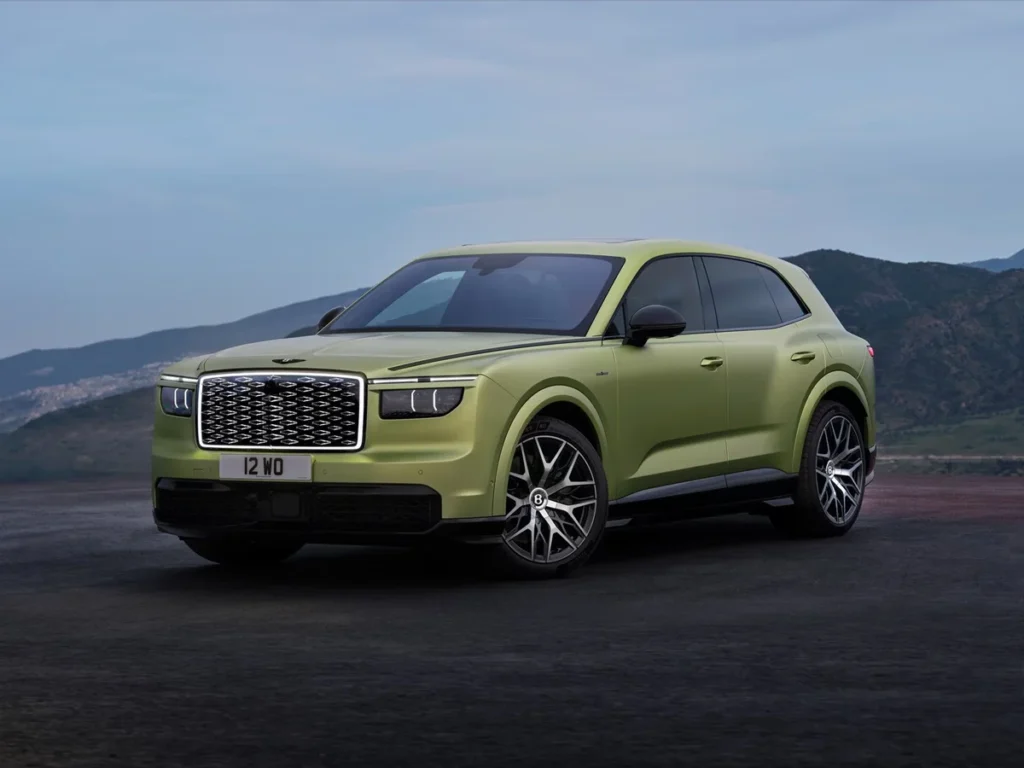
Same bones, different badge
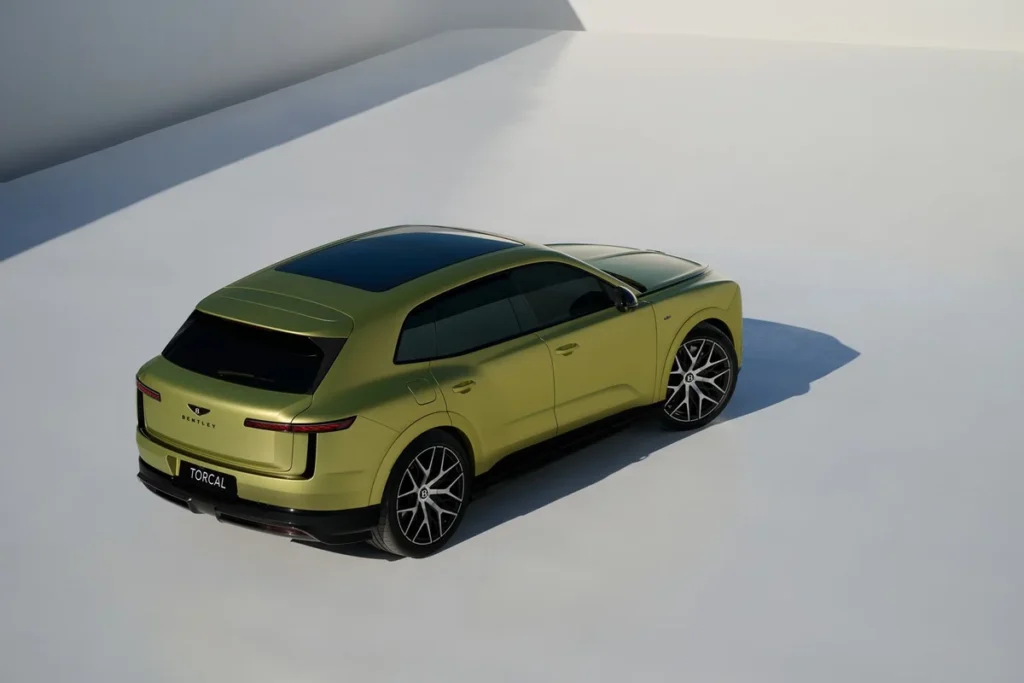
Bentley doesn’t hide what’s underneath, so neither will we. The Torcal rides on PPE, the Premium Platform Electric that Porsche and Audi developed inside the Volkswagen Group. It’s an 800-volt architecture that debuted under the electric Macan in early 2024. From the Cayenne Electric, the Torcal takes the 113 kWh battery (108 kWh usable, which is the figure quoted for US-spec cars), DC fast charging at up to 400 kW, a 10-to-80 percent top-up in about 16 minutes, and the same 119-inch wheelbase.
The motors are where it gets interesting. Martin Page, Bentley’s product line director for the Torcal, told Autocar that the rear axle uses the Cayenne Electric’s motor, while the front axle borrows the unit from Audi’s Q6 e-tron. So the first electric Bentley has its heart split between Zuffenhausen and Ingolstadt, with Crewe doing the tailoring.
Here’s what the tailoring produces:
| Torcal | Torcal S | |
|---|---|---|
| US base price | $218,000 | $258,000 |
| Power | 810 hp | 876 hp |
| Torque | no consistent figure (*) | 996 lb-ft (launch control) |
| 0-60 mph | not confirmed for the US | 2.8 sec |
| Top speed | 155 mph | 162 mph |
| Range | no EPA rating yet | about 375 miles (WLTP) |
(*) Bentley’s launch materials and its current spec sheet disagree on the base car’s torque. Until the company settles on one number, we won’t print either.
The US prices come from Mike Sayer, Bentley’s head of product communications, in an email to WardsAuto. American cars get a NACS port. As for range, the WLTP number is Europe’s test cycle, which runs generous. CarPro points out that no EPA estimate exists yet and that Americans should expect a lower number when it does. The Torcal measures just over 197 inches long, so it’s shorter than a Bentayga, and it weighs around 6,000 pounds.
Shared platforms aren’t a scandal at Bentley. The Bentayga has ridden on the MLB Evo architecture since 2015, alongside the Audi Q7, the gas Porsche Cayenne and the Lamborghini Urus. Bentley is a Volkswagen Group brand, and that’s how it pays the bills. The difference is that, in a gas car, the W12 or the V8 supplied the personality. An electric motor supplies nothing of the kind. Whatever makes the Torcal a Bentley has to come from everything else.
The math nobody puts in the press release
Bentley calls the Torcal S its most powerful production car ever, and that’s accurate. The previous record belonged to the 2024 Continental GT Speed, the plug-in hybrid that retired the W12, with 771 hp. The Torcal S beats it by more than a hundred horses.
Now hold it up against its own cousin. The 2027 Cayenne Turbo Electric, with the same battery on the same architecture, makes up to 1,139 hp and 1,106 lb-ft with launch control, and runs 0-60 mph in 2.4 seconds. Electrive put it plainly: the Torcal slots above the Cayenne S Electric and below the Turbo.
So the money goes like this:
- Torcal ($218,000) vs. Cayenne Turbo Electric ($163,000): $55,000 more, and 329 hp less.
- Torcal S ($258,000) vs. Cayenne Turbo Electric: $95,000 more, 263 hp less, and four-tenths slower to 60.
WIRED widened the comparison to Land Rover. The Range Rover Electric starts at around $138,000 in the US with similar range, and the closest price match is the Range Rover Electric Autobiography at roughly $208,000. The Torcal costs more than both.
What the extra $55,000 actually buys
To be fair, the money doesn’t vanish. It buys Somerset merino wool and walnut veneers built from up to a thousand hand-selected layers. It buys interior lighting based on a cut crystal Bentley commissioned, physical switches, powered doors and a curved screen of its own. And it buys some restraint. Page told Edmunds the Torcal has no passenger display because it “doesn’t add value.” In 2026, that alone deserves a round of applause.

It also buys standard hardware the Cayenne Electric charges extra for: fully active suspension and rear-wheel steering.
The chassis is where Crewe clearly did the work. The Torcal is the first Bentley with fully active suspension, a hydraulic system that controls each corner independently. The result is that the car does without conventional anti-roll bars, because the system itself manages body roll. The rear wheels steer up to five degrees, and the turning circle is 36.4 feet.
What Bentley did with that hardware is the clever part. Its engineers told evo they started from a dead-flat, race-car setup and then dialed roll back in on purpose, so the Torcal would move like a Bentley rather than a Porsche. Page describes the target as Continental GT dynamics with Flying Spur comfort. Bentley also says prototypes and pre-production cars covered more than 620,000 miles of testing, from minus 36 degrees Fahrenheit in Sweden to more than 13,700 feet up Pikes Peak.
That’s the Torcal’s best argument, and it’s a real one. The Cayenne Turbo Electric brags about lap times. The Torcal wants the person in the back seat to miss the pothole entirely. If that comes through on the road, Bentley earned some of that premium. Just be clear about what you’re paying for: tuning, trim and a badge. Somebody else already paid for the hardware.
A drummer where the V8 used to be
Then there’s the noise. Before the launch, CEO Frank-Steffen Walliser made a promise: “Every Bentley will have sound.” The Torcal included.
On July 16, 2026, Bentley unveiled what it calls the Bentley Dynamic Symphony. The team recorded and analyzed a Bentley V8, the bloodline of the famous 6¾-liter engine, and decided that what hooks people is the rhythm. To test the theory, they set up two parabolic speakers. One played the V8. In front of the other, a live drummer played. People walked between the two and, according to Bentley, noticed an obvious similarity in energy and cadence.
From there, “world-class” musicians recorded a throttle-responsive soundtrack with real instruments: mostly drums, viola and bass guitar. Bentley insists it doesn’t imitate the V8. It’s meant to make you feel what the V8 made you feel.
It’s classier than the fake V8 most brands pump through the speakers. Give them that. But the problem underneath doesn’t go away. An 876-hp electric car that needs a band to make its owner feel something is admitting that, without the band, the owner wouldn’t feel enough. On Bentley’s own sound film, plenty of commenters asked for the same thing: just keep the real engine.
Named after a place full of holes

Americans won’t know the name. Spaniards will. Bentley announced it in July 2026, about two and a half months before the reveal. It comes from El Torcal de Antequera, a limestone landscape in the province of Málaga, in southern Spain. Picture rock stacked like pancakes, maze-like corridors and formations worn into shape by rain and wind. It became a protected natural area in 1989, and since July 2016 it has been part of the Antequera Dolmens Site on UNESCO’s World Heritage list.
Bentley added a second reason. “Torcal,” it says, echoes the Latin torquere, “to twist,” the same root that gave English the word torque. For an electric car with all its torque available from a standstill, that works nicely in a press release.
In Spanish, though, the word carries a different meaning. The Royal Spanish Academy defines a torcal as “terrain where there are torcas,” and a torca is “a circular depression with steep edges.” Geologists call it a doline. A sinkhole. Crewe sold the world torque. The Spanish dictionary describes ground full of holes.
It isn’t the first time Bentley has gone shopping for names in Spain, either. When the brand announced its first SUV at the Detroit Auto Show in January 2015, then-chairman Wolfgang Dürheimer called it the Bentayga. Bentley pointed to two sources: the taiga, the great northern forest, and the Roque Bentayga, a volcanic rock formation in Tejeda, on Gran Canaria. So both turning points in Bentley’s modern history, the move into SUVs and the move to electric, carry the names of Spanish rocks. One from the Canary Islands, one from Andalusia.
It was supposed to have 1,400 hp
The Torcal arrives late and with less than promised. In November 2020, Bentley launched its Beyond100 plan: the first electric model in 2025, and an all-electric lineup by 2030. It had already shown its first electric concept, the EXP 12 Speed 6e convertible, at the 2017 Geneva show, and in 2019, for its centenary, the EXP 100 GT, a vision of the grand tourer in 2035.
Then, in May 2022, then-CEO Adrian Hallmark got carried away in an interview with Automotive News Europe. The first electric Bentley, he said, would make up to 1,400 hp and hit 60 mph in 1.5 seconds. He even mentioned a gentler 2.7-second mode, because past a certain point, acceleration “just becomes nauseous.”
What actually arrived is 876 hp and 2.8 seconds in the S. A year late, too, because the first EV slipped from 2025 to 2026.
A lot changed in between. Walliser, who used to run Porsche’s motorsport program, took over at Bentley in July 2024. That November, the strategy became Beyond100+ and the all-electric deadline moved to 2035. The stated reason was weaker-than-expected demand for luxury EVs. By 2025, Walliser was saying there wasn’t even a firm date to stop selling combustion cars.
The first, and the last for a while

At the London reveal, Walliser finished the job. According to several outlets, no other electric Bentley is expected before 2030. The era of the ten-year roadmap is over in Crewe, he said, and he blamed regulators who change the rules so often that long-range planning has become impossible.
The factory reflects that. Bentley has wrapped up a £350 million (about $460 million) investment in Crewe, and the Torcal is built in the historic “A1” building on a new line. The factory strategy aims to build EVs and plug-in hybrids on the same line and shift output to whatever customers actually order. Walliser summed it up: “Choice is the strategy. No one who today prefers a Bentayga with a V8 is forced into a new car.”
As a business call, that’s defensible. Lamborghini shelved the Lanzador, Audi dropped the Q8 e-tron, and Ferrari pushed its second EV back to 2028 at the earliest over weak demand, a delay reported months before it even revealed its first one. The luxury EV market is cold, and Bentley is hedging. The Torcal also has a clear job to do: Walliser says about half the early interest comes from people who have never owned a Bentley. It’s the “more affordable Bentley,” the one that opens the door.
But read it straight. Bentley built its first EV the way you hand in a mandatory assignment: with parts the group already had on the shelf, a pretty name and a soundtrack to cover the silence. And on reveal day, it made clear it doesn’t expect to do it again until next decade.
Insurance with a Spanish name
The Torcal is probably a terrific car. Bentley builds interiors like almost no one else, and it knows how to make three tons float over a broken road. If you want a luxury electric SUV and can’t stand the thought of a Porsche crest on the steering wheel, this is your car.
Just don’t buy the new-era speech. The first electric Bentley uses the Cayenne Electric’s platform, battery and rear motor. Add an Audi motor up front and a band in the speakers, charge $55,000 more than the Cayenne Turbo Electric, and you get a car that makes less power. Its own boss doesn’t expect another electric Bentley this decade. Bentley didn’t bet on electric. It bought insurance in case electric wins, and gave the policy a Spanish name so it would sound nice.
The name is the best joke in the whole package. Bentley picked Torcal for torque. Back in Antequera, a torcal is ground full of holes. You decide which one fits the first electric car from a brand that, on the day it unveiled it, was already talking up the gas engines it plans to keep selling.
The question for whoever signs the order is simple: what’s a winged B worth when there’s a quicker, cheaper Porsche underneath?
Unplug and enjoy.
Images: Bentley Motors (Bentley Media).