Tesla Roadster: Tesla didn’t invent it, but it knew how to sell it
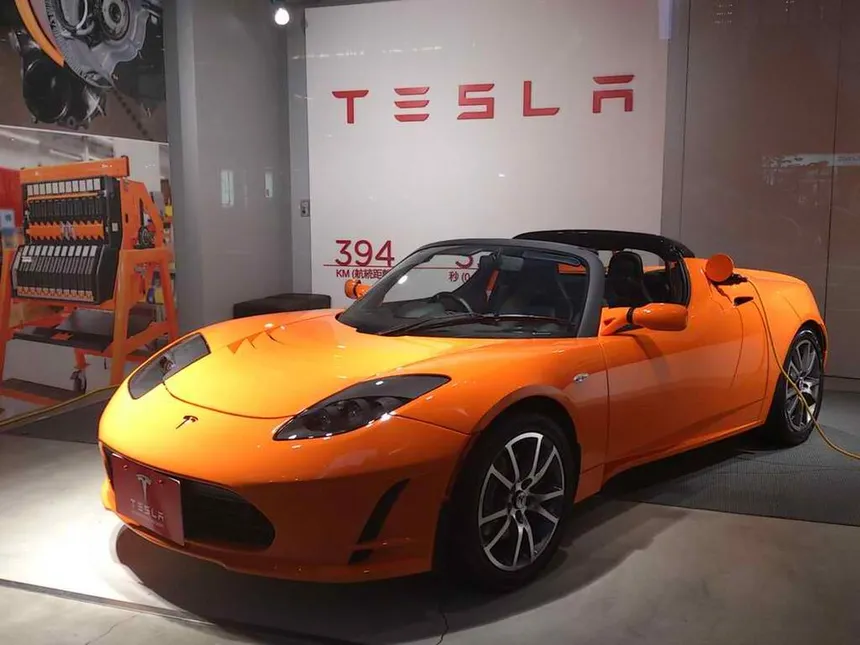
Tesla didn’t invent the Roadster from scratch. It took the idea from someone else’s prototype that nobody wanted to build, licensed its electric technology, and turned it into a production car on a Lotus base — then sold it as the Big Bang of the electric car. The vehicle every American remembers as the spark that lit the revolution drew straight from a California prototype, and its technical DNA links back to the same world that produced the electric car General Motors had ordered crushed a few years earlier.
None of this takes anything away from the Roadster. It puts it in its place. Because the real story, the one the company’s mythology would rather skip, is far better than the official fairy tale. Here it is.
The father nobody names: the AC Propulsion tzero
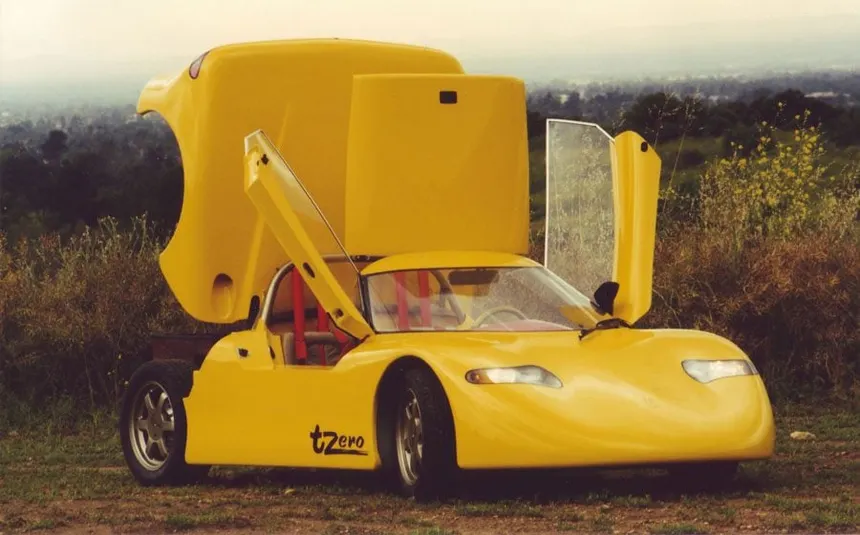
In the mid-1990s, a tiny company in San Dimas, California, called AC Propulsion, hand-built an electric sports car called the tzero. It was designed by Alan Cocconi, who had worked on the power electronics of the GM Impact — the prototype that became the EV1 — before founding AC Propulsion. Tie that thread, because it’s the one that stitches this whole story together: the knowledge GM let die with the EV1 walked out with Cocconi to San Dimas.
The original tzero ran lead-acid batteries, did 0–60 mph in about 3.6 seconds, and beat combustion sports cars in informal acceleration runs. AC Propulsion built only a handful; the most-cited figure is three hand-built vehicles. In 2003, an entrepreneur named Martin Eberhard — fresh off selling his e-book company and fluent in lithium batteries — funded AC Propulsion to convert a tzero to lithium-ion laptop cells, about 6,800 of them. The result was staggering: it slashed the weight and pushed the quoted range past 300 miles in favorable conditions.
Eberhard saw the future in that car and tried to convince AC Propulsion to build it in volume. They said no. Separately, another investor drove the tzero and also tried to get AC Propulsion to produce it: his name was Elon Musk. They said no to him too. It was Tom Gage, AC Propulsion’s president, who suggested the two camps join forces if they wanted this to go anywhere. That’s where everything started.
Cocconi is worth pausing on, because he’s the link connecting the electric car’s three deaths and its rebirth. He had worked on the electronics of the GM Impact, the prototype that became the EV1 — the car GM built, leased, forcibly repurchased and crushed. When GM buried its electric car, the knowledge didn’t die with it: it lived on in San Dimas, in the tzero, and from there it jumped into the Roadster. The car that gets all the credit for resurrecting the EV draws, at bottom, on a technical bloodline that started in the program the industry had buried a decade earlier. The Roadster’s father was a hand-built oddity from San Dimas; the son ended up going to space. History doesn’t hand out credit fairly.
The founding, and the myth machine
The facts, unretouched. Tesla Motors was incorporated in Delaware on July 1, 2003, founded by Martin Eberhard and Marc Tarpenning. Ian Wright was the third employee. Elon Musk came in during 2004 as lead investor of the Series A round — he led the round and put in most of it, around 6.5 of the 7.5 million dollars raised — and became chairman of the board that April. JB Straubel joined later and became one of the central technical figures. After the 2009 legal settlement, all five were publicly recognized as co-founders, following years of fighting over who founded what.
And there’s the strategy that would define the brand. Tesla took a staged approach: start at the top, with an eye-wateringly expensive sports car to seduce wealthy opinion-makers and prove the technology, then use that money to fund higher-volume cars later. The famous “master plan” Musk published in 2006 put that logic in writing, and Musk was decisive in imposing and popularizing it. In August 2007, the board removed Eberhard from the CEO job. Michael Marks and Ze’ev Drori then passed through the top office; Musk finally took the role in October 2008. Eberhard and Tarpenning ended up outside the day-to-day running of the company, while the dispute over who could call themselves founder ran on until the 2009 settlement. The company built to democratize the electric car began, in its first chapter, with a 100,000-dollar toy.
The car: a tzero in a Lotus suit (not the way you’ve heard it)
Two myths need dismantling at once.
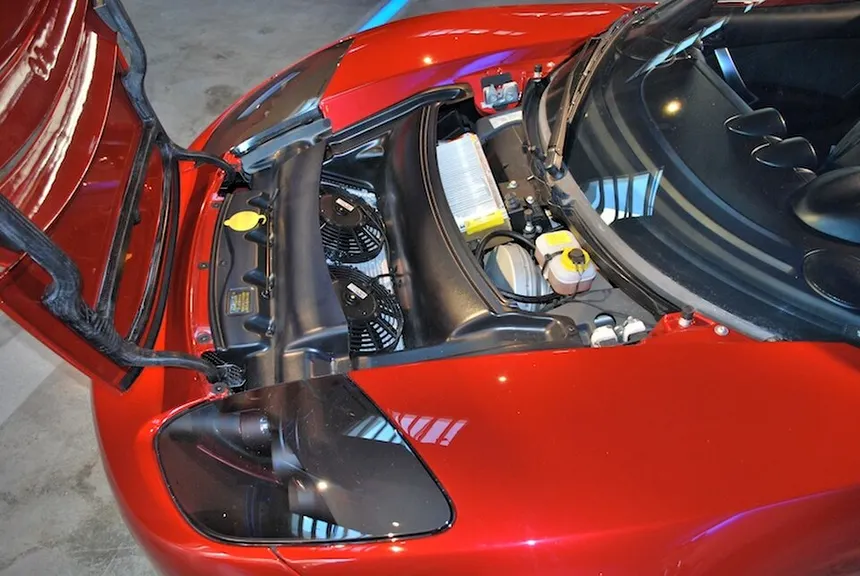
Myth one: “the Roadster is a Lotus Elise with batteries.” False, or at least wildly overstated. The Roadster came out of an agreement with Lotus signed in July 2005, and it was assembled at Lotus‘s factory in Hethel, England. But Tesla said only about 6% of the components were directly interchangeable with the Elise. It had a longer wheelbase, a stiffened chassis, and carbon-fiber body panels. The battery pack, on top of that, added several hundred kilos over an equivalent Elise, despite the lightweight materials. It wasn’t a disguised Elise; it was a different car that shared a cousin.
Myth two: the Roadster came out clean. Also false. The first two-speed transmission couldn’t reliably handle the motor’s torque and revs: some units failed after a few thousand miles. Tesla even announced deliveries with second gear locked (0–60 mph in 5.7 s) before replacing the system with a single-speed unit built by BorgWarner. That final transmission and the Roadster 2.0 stabilized the product, but the company kept depending on outside financing and industrial deals to survive.
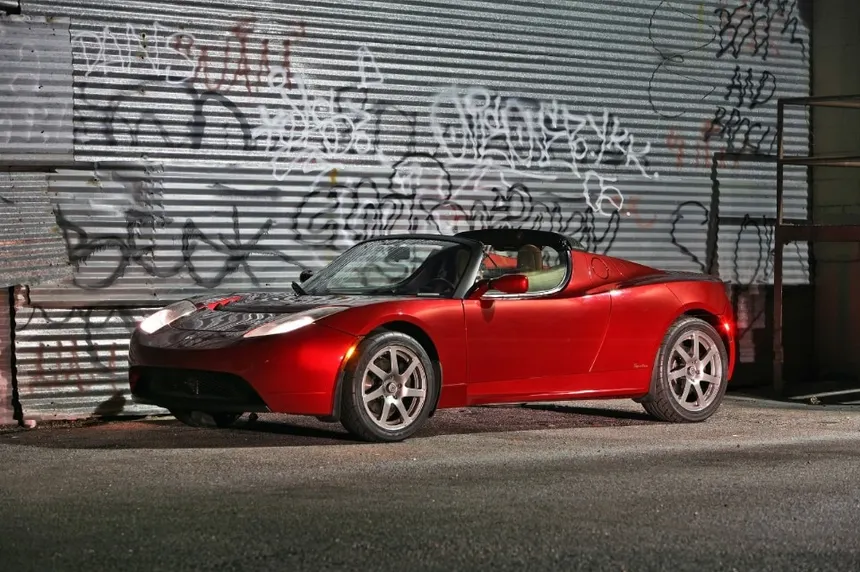
The mature car’s numbers were genuinely impressive for the era. A 53 kWh pack made of 6,831 commodity laptop cells, a three-phase AC induction motor of around 248 hp, and, above all, 244 EPA miles of range with the final transmission. The Roadster 2.0 ran about 3.9 seconds 0–60 mph; the 2010 Sport rose to 288 hp and dropped to roughly 3.7. Top speed capped around 125 mph. It was the first production EV to break that barrier. To measure what that meant in 2008, look at what surrounded it: nothing. The Nissan Leaf wouldn’t arrive until 2010, nor the Chevy Volt, and the surviving EVs were neighborhood boxes. The Roadster did 0–60 like a contemporary Porsche 911 and went nearly 250 miles. In a world where “electric” meant slow and ugly, here was one that was fast and gorgeous. That was the bomb. Tesla ended production in January 2012, with roughly 2,450 units delivered to customers in more than 30 countries, shortly after the Lotus contract — and with it the chassis supply — ran out.
A signature epilogue: on February 6, 2018, the first production Roadster, owned by Musk himself, was launched into space aboard SpaceX’s Falcon Heavy rocket, a spacesuited mannequin at the wheel and a nod to Bowie’s “Space Oddity.” It became the first production automobile launched into deep space and placed in a heliocentric orbit. Nobody has ever understood the marketing of a myth better than this man.
What the Roadster actually sold wasn’t the car
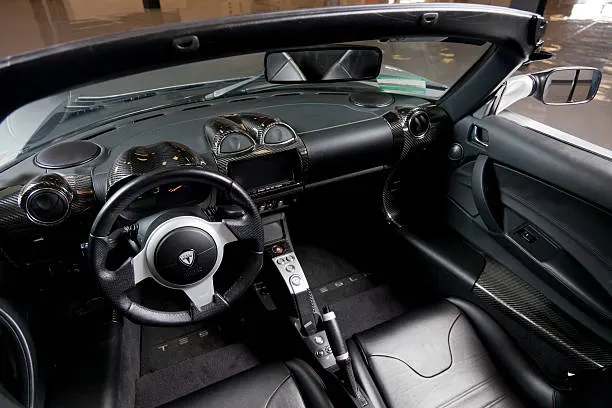
Here’s the spine almost nobody puts at the center. The Roadster’s real product was never those 2,450 units with their temperamental transmissions. It was credibility. The Roadster proved an electric car could be desirable, fast and sexy, and that proof was worth infinitely more than the cars themselves.
With that proof in hand, Tesla sold confidence to the very giants that had sneered at the EV. Daimler bought a stake in 2009. Toyota came in during 2010 with 50 million dollars, after its president, Akio Toyoda, drove a Roadster and said he’d felt “the wind of the future.” That same deal handed Tesla the Fremont factory where the Model S would be born. The Roadster didn’t win by selling cars: it won the future by selling an idea, and used that capital and those factories to build everything that followed.
The myth-building was relentless and, credit where due, brilliant. In 2010 the Roadster showed up in “Iron Man 2,” with Tony Stark parking one in his workshop and Musk himself making a cameo — a Hollywood coronation that fused the car, the man and the future into a single American origin story. For a generation of buyers, that was the moment Tesla stopped being a car company and became a belief. The Roadster didn’t just sell electric performance; it sold the idea that one Silicon Valley outsider could out-engineer Detroit, Stuttgart and Tokyo at once. Everything Tesla has done since, including the parts that don’t work, trades on the credibility banked in those years.
The myth outlives the car: the Roadster that never comes
If the first Roadster was proof that Tesla could turn an idea into reality, the second is proof that Tesla learned to sell the idea without the reality.
In November 2017, Tesla unveiled a new Roadster with science-fiction numbers: 0–60 in under 1.9 seconds, a top speed above 250 mph, 620 miles of range. It opened reservations at 50,000 dollars for the standard car and 250,000 for the Founders Series, with production promised for 2020. It never came: the car has slipped at least eight times and hasn’t delivered a single unit. In September 2026, Tesla reopened reservations — 50,000 dollars, structured as 5,000 on a card and another 45,000 by wire within ten days — and announced an unveiling for October 1, 2026, near Waco, Texas, still with no firm production date or final price. The people who put money down in 2017 are still waiting, nearly a decade on. The company that grew up proving the EV was real has spent years charging, in part, for an EV that still doesn’t arrive.
The verdict
Here’s NEB’s read, with credit and knife where each belongs.
The Roadster earns its place in history, and a big one. It was the car that resurrected the EV after the industry killed it twice, the one that proved a battery could move something exciting and not just a city cart, and the one that funded the entire revolution that followed. None of that is a lie. Denying it would be as foolish as swallowing the whole tale. It was, no argument, one of the most important cars of the century.
But the whole tale is exactly the problem. Tesla has spent twenty years claiming it conjured the Roadster from nothing, when it actually picked up the baton from a tzero that in turn drank from the EV1 GM buried. And it has spent twenty years selling the myth of the Roadster harder than it ever sold the car: 2,450 units with transmissions that fell apart, wrapped in a flawless PR campaign. The new Roadster — deposits taken in 2017, still undelivered in 2026, and reservations reopened in September 2026 before the car was even shown — is the pure distillation of that formula: the product is no longer the car, it’s the promise of the car.
The Roadster was the rebirth of the electric car, yes. But it was also the moment the industry learned you can sell more future than you deliver. The first Roadster proved the desirable EV was possible; the second proves the myth can keep drawing attention and deposits even when the car has gone years without reaching production. And that lesson, for better and worse, is still rolling.
Unplug and enjoy.