Electric cars aren’t the future — America had them 125 years ago and killed them
Here’s a fact that should rearrange how you think about your driveway: in 1900, more American cars ran on electricity than on gasoline. The electric car isn’t a brave leap into the unknown. It’s a comeback. America built it, loved it, made it the default in its cities — and then killed it, on purpose, through a mix of cheap oil, cheap steel and one of the great ironies in industrial history.
Every time a carmaker sells you the EV today as “the future,” they’re selling a very profitable case of amnesia. The real story is older, stranger and a lot less flattering to the country that now imports most of its batteries. Let’s tell it straight.
1899: an electric car breaks 60 mph first
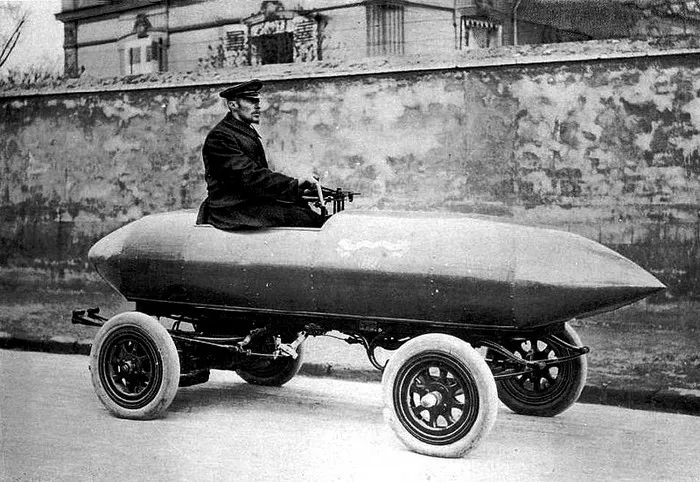
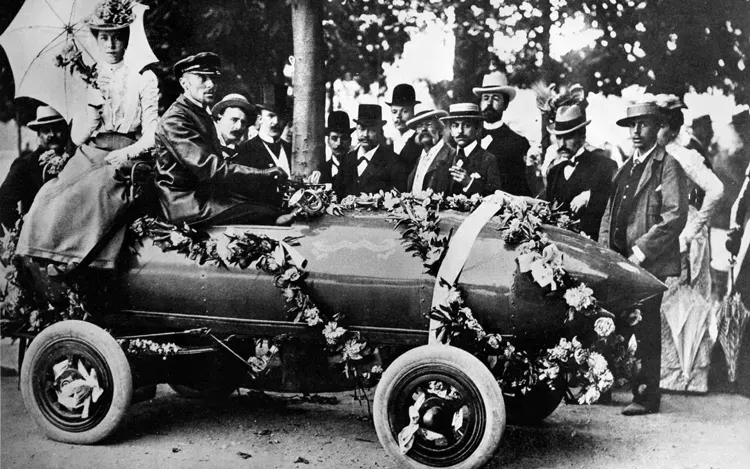
Put a date on it. On April 29, 1899, on a stretch of road at Achères near Paris, a Belgian engineer and racer named Camille Jenatzy climbed into a torpedo-shaped projectile and became the first human to pass 100 km/h — roughly 66 mph — on land. The exact mark: 105.88 km/h.
The car was called La Jamais Contente — “the never satisfied” — and it was electric. The first vehicle to break that barrier ran on batteries, not gasoline.
The details are wild for the era. The body was partinium, a light alloy of aluminum, tungsten and magnesium. Two Postel-Vinay electric motors made about 68 horsepower. And here’s the line that ties 1899 to your neighbor’s garage in 2026: the heavy lead-acid batteries made up nearly half the car’s total weight. A hundred and twenty-six years later we’re still fighting the exact same problem — battery weight. Only the chemistry changed.
Jenatzy didn’t beat just anybody. He took the record from another electric car, Count Gaston de Chasseloup-Laubat’s, which had hit 92.78 km/h that March. The duel for world’s fastest car in 1899 was a duel between two EVs. Gasoline wasn’t even invited.
The peak: a third of American cars plugged in
This wasn’t a fluke. For years, the electric car was the sensible default for people with money.
The numbers are hard to argue with. Of the roughly 33,842 cars on American roads in 1900, 38% were electric, 40% steam and just 22% gasoline. The U.S. Department of Energy says it plainly: around 1900 the electric car was at its peak and made up about a third of all vehicles on the road. Historical archives push further, calling 1899 and 1900 the high-water mark, with electrics outselling gas cars ten to one.
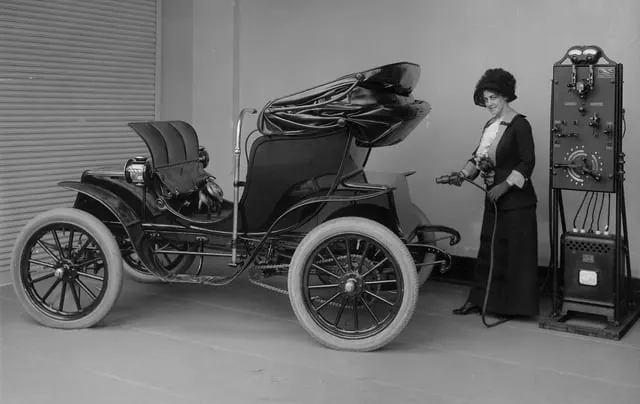
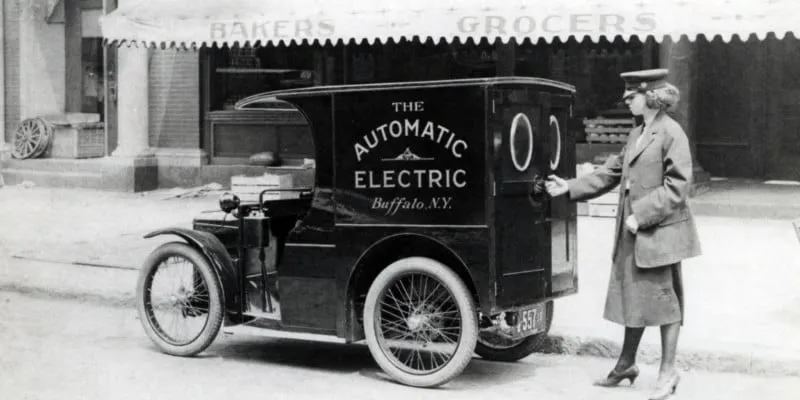
Why did they win? Because for the actual life of 1900, they were simply better. They didn’t shake, didn’t stink, didn’t roar. And crucially, you didn’t have to shift gears or wrestle a crank to start them. The gasoline car of 1900 was a hostile, filthy, physically dangerous machine to fire up. The electric was civilized. New York ran a fleet of more than 60 electric taxis, and names we now file elsewhere — Oldsmobile, Studebaker — literally started out building EVs. New York even had a commercial charging station running by 1910. The idea that public charging is a 21st-century invention is one more thing the amnesia quietly deletes.
Measure it against its time. In 1900 there were no highways. Most people never drove out of their city. Trips were urban and short. In that world, the electric’s short range wasn’t a flaw — it was irrelevant. The EV wasn’t a niche for eco-conscious hobbyists. It was the mainstream of the American city. And here’s where the official story gets lazy and shrugs, “then Ford came along.” It was more than that. It was colder.
The man who killed the electric car was married to one
Here’s the detail that turns this from history into something sharper. Henry Ford, whose Model T and assembly line did more than anything to bury the electric car under cheap gasoline, was married to a woman who refused to drive one.
Clara Ford drove a Detroit Electric — a 1914 Model 47 Brougham — and kept driving it into the 1930s, long after her husband’s gas cars had conquered the country. She wasn’t alone in that company. Thomas Edison, Henry Ford’s close friend, drove a Detroit Electric too. So did John D. Rockefeller Jr. The best-known American EV maker, Detroit Electric, built cars from 1907 to 1939, roughly 13,000 of them, most before the 1929 crash. They were quiet, clean and started at the flick of a control, which is why they were marketed hard to physicians — who needed to leave instantly for an emergency — and to wealthy women who had no interest in wrestling a crank.
The Detroit Electric got about 80 miles per charge and topped out around 20 mph, which in a city was plenty. Edison, who believed in the electric car enough to develop his own nickel-iron batteries for it, understood exactly where the technology’s weakness lived. He joked that the battery business “brings out [a man’s] latent capacity for lying” — a line that would land just as well in a 2026 EV press conference as it did a century ago. The battery was the ceiling then, and the battery is the ceiling now.
So picture it: the founder of the company that made gasoline king, coming home to a wife who wouldn’t touch his Model T because her silent electric was simply nicer to live with. The American EV didn’t die because Americans hated it. It died because gasoline got cheaper, roads got longer and the people making the decisions weren’t the ones enjoying the electric car.
1900: Porsche was already doing it — and already suffering what you suffer
The name Porsche, which you now attach to the howl of a flat-six, got famous on an electric car.
On April 14, 1900, at the Palace of Electricity at the Paris World’s Fair, a 24-year-old named Ferdinand Porsche unveiled the Lohner-Porsche Electromobile, with the motors built into the hubs of the front wheels. No transmission, no driveshaft, no belts — the motor placed exactly where the power was needed. Two 2.5-hp motors, a top speed around 35 km/h, and four-wheel braking, which in 1900 was close to witchcraft. The racing version, with a motor in each wheel, was the first all-wheel-drive passenger car in history.
Lohner’s reason for going electric reads like a headline from this week: the city air, he said, was being ruthlessly spoiled by all the gasoline engines running around. Urban pollution as a sales pitch. In 1900.
Then the jewel. That same year Porsche built the Semper Vivus — “always alive” — the first functional hybrid in history, precisely because the batteries kept failing and there was virtually no charging infrastructure. Weak batteries and nowhere to plug in: the two exact problems today’s EV driver still fights, solved by Porsche 125 years ago by adding a gas engine that ran a generator. That’s a plug-in hybrid under another name. And a detail for the record: the Semper Vivus generator could be reversed to act as a starter motor, sparing the driver the dangerous crank. Porsche invented the electric-starter trick a decade before Kettering, and nobody remembers.
The murder: four stab wounds and one perfect irony
The electric car didn’t lose a clean technological race. A storm of blows brought it down, and the deadliest is one of the great industrial ironies.
Stab one: Ford and price. The Model T and the assembly line made gasoline cheap for anyone. By 1912 a Ford cost 650 dollars while an electric roadster ran 1,750. Three years later Ford dropped his to 390. The electric became a rich man’s ornament right as gasoline went democratic.
Stab two: Texas oil. The Spindletop gusher of 1901 flooded the country with dirt-cheap fuel. Gas stations sprouted everywhere — a refueling network the electric, with its 30-to-40-mile range, couldn’t match the moment you left town.
Stab three: the roads. As America laid highways between cities, people wanted to roam. The urban range that used to be fine became a cage. The electric was perfect for a world that was ending.
Stab four, the fatal one: electricity killed the electric car.
In 1912, Charles Kettering introduced the electric starter on the Cadillac, killing the crank and sending gasoline sales through the roof. The electric’s one great usability edge — starting at the flick of a switch, no dangerous crank — was erased. And it was erased by a little electric motor bolted inside a gasoline car.
The origin of that invention seals it. Cadillac got into it because a friend of the company’s founder, Byron Carter, died after a crank kicked back and struck him in the face while he was helping a woman whose car had stalled. That death produced the electric starter. And that starter produced gasoline’s total dominance for the next century. The electric car didn’t fall to something better. It fell to its own genius, installed in the enemy. By 1935 it had all but vanished from the road.
The verdict
Here’s NEB’s take, no anesthetic, and no flattery for the green side either.
When a brand frames the EV as a brave step into the unknown, it’s lying by omission. The electric car isn’t an experiment into the void. It’s the return of a rightful champion stripped of his title for economic reasons, not technical ones. Gasoline didn’t win because it was the better car. It won because it was cheaper to build, because there was an ocean of oil under Texas, and because someone stole the electric’s best trick and bolted it onto the rival.
Now the blade turns the other way, because there’s a lesson here the plug-in faithful won’t like. The 1900 electric lost for three reasons still alive in 2026: cost, range and charging infrastructure. Swap “lead-acid” for “lithium.” Swap “Texas gas stations” for “fast-charging network.” The skeleton is identical. The industry has spent 125 years trying to solve the exact same three things, and only now, maybe, has them half in hand. Anyone telling you the EV already won hasn’t looked at the power bill or the charger map on a Sunday afternoon with the family in the car.
So no, the electric car isn’t the future. It’s the past, getting back up. America had it, preferred it in its cities, and let it die for reasons that had nothing to do with which car was better and everything to do with which car was cheaper to feed. That’s not a knock on the EV. It’s a warning about how these decisions actually get made — in boardrooms and oil fields, not in driveways. And the only question that matters isn’t whether it wins this time. It’s whether we’ll be smart enough not to kill it again with our own hands.
Unplug and enjoy.