Lohner-Porsche: America Was Winning the Electric Race, Then the Battery Won
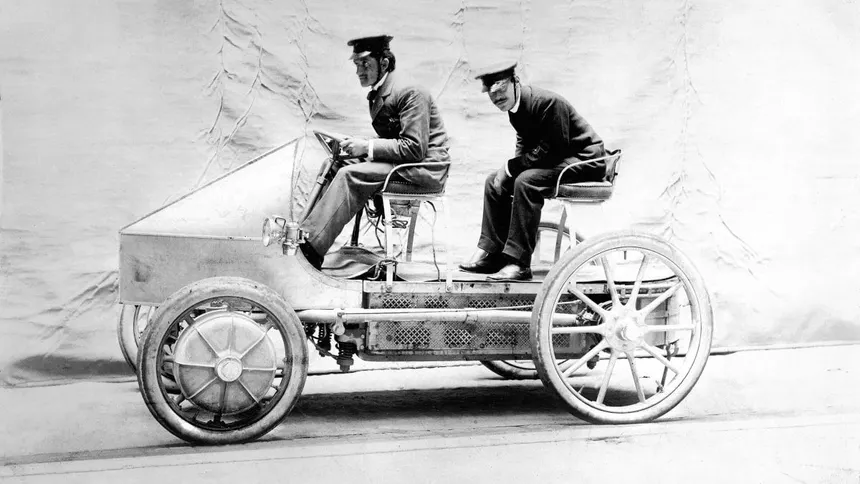
Here is a number that ruins a lot of dinner-party history. The 1899 US census counted 1,575 electric vehicles built, 1,681 steam vehicles, and 936 gasoline cars.
Gasoline came third. In America.
New York’s first motorized cab fleet was electric, and the company running it had worked out the business model everybody thinks is new: the Electric Vehicle Company leased its cars instead of selling them and built service stations where a drained battery pack was swapped out for a fresh one. Battery swapping, Manhattan, 1897.
So while America was solving the business problem, a twenty-five-year-old in Vienna was solving the physics one. He solved it beautifully. And then he ran into exactly the same wall the Americans did, which is the actual story of the Lohner-Porsche and the reason the world’s first hybrid exists at all.
It was not built to pollute less. It was built because the battery weighed 1,800 kilos.
Before the hub motor, the octagon
The machine to look at first is not the Paris car. It is the one before it.
A Viennese coachbuilder named Jakob Lohner, who built carriages for Emperor Franz Joseph and half the royalty of Europe, worked out that the horse business was finished. His son Ludwig partnered with an electrical firm and put together a phaeton with electric drive. The electrical half was signed off by Ferdinand Porsche, then twenty-two.
The motor was called the “octagon” after its eight-sided housing. It weighed 130 kilos, made 3 horsepower and up to 5 in short overload bursts, ran on shock absorbers and oscillated around the rear axle. Speed came from a lever called the controller with twelve positions: six forward, two reverse, four braking levels. Lohner built four different bodies on that platform.
The Egger-Lohner C.2 Phaeton first ran through Vienna on 26 June 1898. Wooden, around 1,350 kilos with batteries aboard, 35 km/h flat out, roughly 80 kilometres of range. Compare that with the Columbia runabout Americans were buying a couple of years later, good for about 40 miles between charges, and you see these machines were all in the same narrow box.
And it raced. At the International Motor Vehicle Exhibition in Berlin on 28 September 1899, a 40-kilometre race for electrics was run, with serious gradients and a rule requiring three passengers aboard. Porsche crossed the line first, 18 minutes ahead of second. More than half the field never finished. He took the efficiency prize too, having used less energy than anyone.
Then the car vanished. It sat untouched in an Austrian warehouse from 1902 and did not resurface until 2014, motor still turning, batteries and seats long gone. It is the oldest surviving Ferdinand Porsche construction and it lives in the Stuttgart museum now. A hundred and twelve years in a shed.
The real idea: delete the transmission
What made Porsche famous at the 1900 Paris World’s Fair was not an electric car. America alone had thousands of those. What nobody had was a car with no transmission.
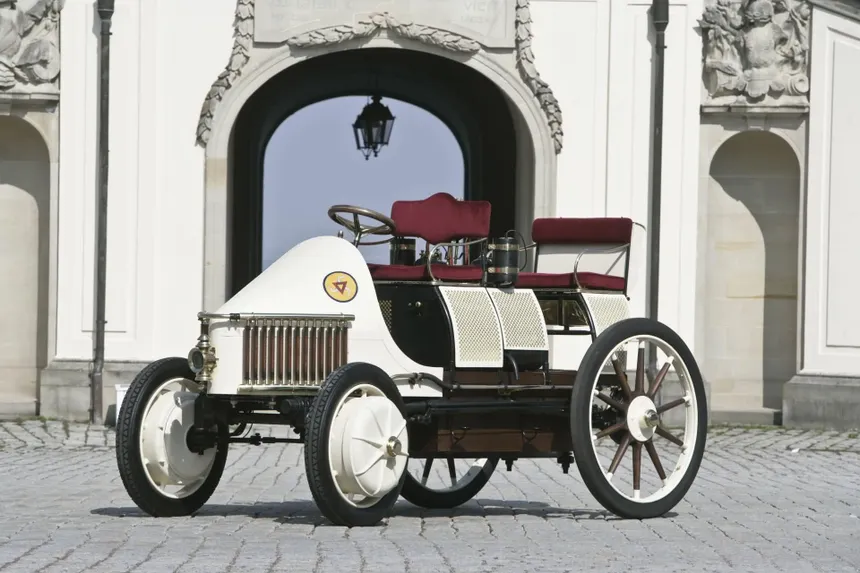
He put the motor inside the wheel hub. Austrian patent AT19645B. The wheel is the rotor, turning around a stator fixed to the suspension. No gearbox, no clutch, no driveshaft, no chains, no belts. In an era when half of all breakdowns were stripped gear teeth and thrown chains, that is not solving the problem, it is deleting it.
Efficiency of the drive ran around 83 per cent. A combustion engine of that era, or of this one, is nowhere close.
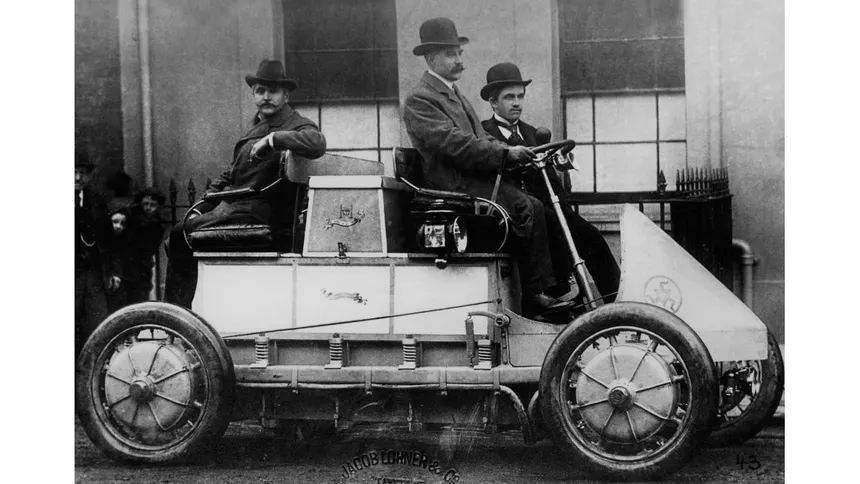
A British coachbuilder named E. W. Hart ordered the version with no mental handbrake: four motors, one per wheel, four seats, running on both electricity and gasoline. Out came the world’s first car with four-wheel drive and four-wheel brakes. Out also came a monster. Eighteen hundred kilos of batteries, a 44-cell 80-volt pack in a spring-suspended container so the fragile cells would survive the road, 580 kilos of motors alone, and over four tonnes total on Continental pneumatic tyres.
Four tonnes. A Benz Velo of 1894, a complete gasoline car, weighed 280 kilos.
Why the hybrid exists
There is the knot. Porsche’s electric worked beautifully except for one thing: to move the weight of the batteries it needed more batteries.
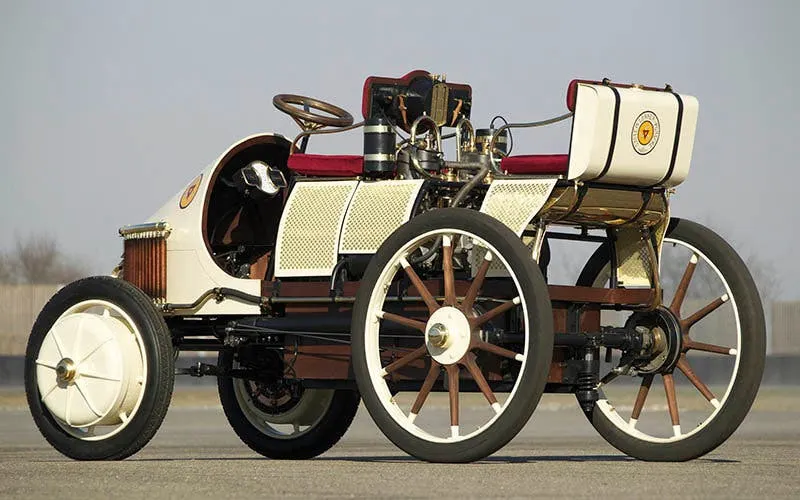
The way out was the Semper Vivus. He cut the pack to 44 cells, freeing weight and space, and mounted two water-cooled De Dion-Bouton single-cylinder engines of 700 cc and 3.5 hp in the middle of the chassis. Those engines never touched the wheels. They spun two generators of about 2.5 hp each at 120 rpm, and the current fed the hub motors and the battery.
Combustion, generator, electric. No mechanical connection to the ground whatsoever. That is precisely the layout General Motors sold America as the Chevrolet Volt a hundred and ten years later, drawn in 1900 by a man with no engineering degree.
Fully loaded the package weighed around 1,200 kilos, only 70 more than the pure electric. The trouble lay elsewhere. With no bodywork, gasoline engines in the open and an unsprung rear axle, it looked exactly like what it was, a rolling test bench. It impressed the experts at the 1901 Paris Motor Show and sold nothing.
There was also an enemy that sounds like a joke now and was not one then: dust. Roads in 1900 were unpaved, and the dirt the car threw up got into the accumulators and killed them. Porsche spent years fighting two fronts at once, shrinking the battery to save weight while trying to seal it against dust. Neither front was ever won. And 1,200 kilos badly distributed over the soft rubber compounds of the day was a third problem, because period tyres were not built for it.
One technical detail says more than any brochure about how far this was from a modern car. Under braking the driver moved the controller to the retarding position, the hub motors were cut from the supply and short-circuited through an eight-ohm resistor. The energy of the moving car was turned into heat and thrown away. Putting it back into the battery was not possible with 1900 technology. The world’s first hybrid could not recover energy, which is the one thing that makes a hybrid worth owning today.
If the band brakes on the rear wheels were not enough, you stood on the pedal and prayed.
The Mixte, or how you sell a hybrid in 1901
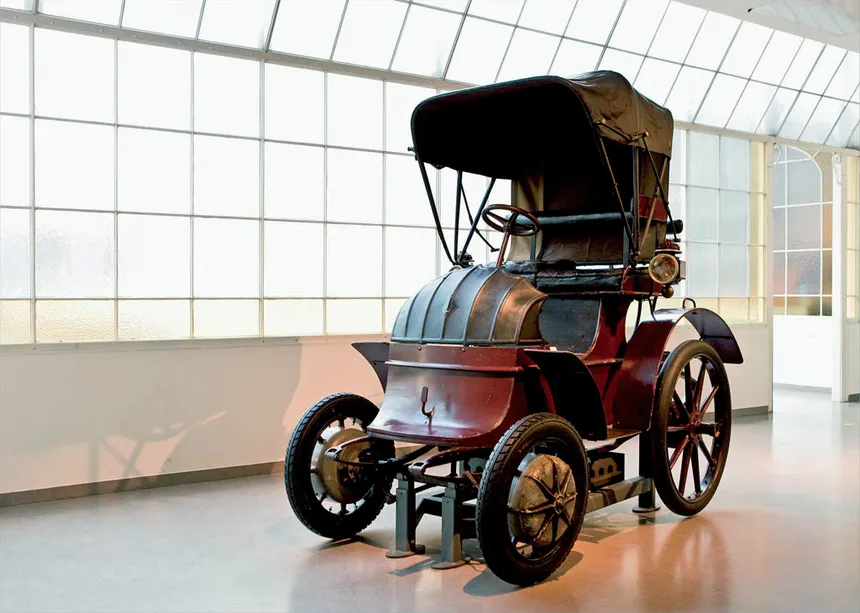
Out of that prototype came the version you could build: the Lohner-Porsche Mixte, from the French voiture mixte.
Bodied as a four-seat tourer it still weighed around 1,200 kilos. In normal running the gasoline engine and generator turned at constant speed, feeding wheels and battery at constant voltage, the same principle a range extender uses now. And it had a lovely trick: reverse the polarity and the generator became an electric starter. In 1901, when hand-cranking a car was an extreme sport with wrist fractures included.
On battery alone, the reduced pack was good for a few kilometres and little more.
The market? Ludwig Lohner and Ferdinand Porsche closed 1901 with five Mixtes sold. Five. Depending on body and equipment it cost between 14,400 and 34,028 crowns, close to double a comparable conventional car, and you had to maintain a fiendish drivetrain while ordinary gasoline cars got more reliable every year.
The pure electrics did better. Across the first five years of series production, to the end of 1905, around 65 electric Lohner-Porsches were sold. Sixty-five cars in five years.
And there is the paradox that organizes the whole story: the hub motor won, the car carrying it did not. Paris made Porsche famous overnight, and that fame opened the industry’s doors and let him keep selling the same principle for forty years. The component prevailed. The complete automobile stopped at 65 units.
What Americans were actually buying
It is worth being concrete about the machine a well-off American had in the garage, because it frames how narrow the window really was.
The Columbia electric runabout was the benchmark, and Columbia knew exactly who it was selling to. The cars were pitched as high-end goods at a time when any automobile was expensive, with the showroom sitting across the street from the Metropolitan Opera House in Manhattan. They worked best in cities, where the pavement was smooth enough to flatter a silent electric motor and where a plug was never far away, which mattered because the runabout was good for about 40 miles between charges.
Columbia did prove the technology could stretch when it wanted to. One of them was driven the 250 miles from Boston to New York in 1903, in 23 hours.
Read that twice. Two hundred and fifty miles took a full day and a night, and it was impressive enough to make the papers. That is the ceiling the whole industry was pushing against, on both sides of the Atlantic, while Porsche in Vienna was bolting a generator to his chassis to get around the same ceiling.
America lost the same fight, for the same two reasons
This is the part worth putting side by side, because the American ending is not a different story, it is the same one with more capital behind it.
The Electric Vehicle Company had the fleet, the swap stations, the financing from a New York financier who had already electrified the city’s streetcars, and expansion into Philadelphia, Chicago and Boston. At one point it was the largest automobile manufacturer in the country. It also had batteries that could not keep up, cabs that fell years behind, a fire that destroyed a chunk of the fleet and the Panic of 1907. The company was gone by 1907.
That same year a local operator put 65 gasoline cabs on the streets of New York, imported from France. Inside twelve months he had 700 of them. The Model T arrived in 1908.
Not one of those blows was about ideology. Two things killed it: what the battery could store, and what the whole thing cost.
Where the idea actually went
Here the story leaves the usual script, the one that ends with “a hundred years ahead of his time” and a photo of a Taycan.
The layout did not sit around waiting patiently. Porsche took it into the Mercedes Electrique from 1906 and, above all, to Austro-Daimler, where he found the one customer willing to pay for it: the army. He used electric transmission to move artillery trains weighing tens of tonnes, and forty years later that same architecture was still inside his tanks.
It did not survive because it was clean. It survived because when you must move an enormous mass at constant speed and no gearbox will take the torque, it is still the best answer available. It makes no difference whether the mass is a 1,200-kilo tourer or a siege mortar.
The resurrection
In November 2007 the museum began one of the strangest projects in its history: rebuilding the Semper Vivus from nothing, because nothing of the original survives. It was done with Porsche Engineering’s people and the Drescher coachbuilding shop in Hinterzarten, working from sketches and archive research. The fully functional replica was finished in 2011.
They added an external band parking brake the original probably never had. Telling detail: to show the thing moving in the twenty-first century, they had to give it one more brake.
The verdict
That Ferdinand Porsche signed off the world’s first hybrid in 1900 is a magnificent fact and needs no decoration. The problem is how it gets told.
There was no environmental vision. There was a twenty-five-year-old with a brilliant hub motor and a lead problem with no solution, who fixed it by carrying a portable power station on board. He sold five. The electric sold 65 in five years at twice the price of a gasoline car. And the idea only truly prospered once it found customers who cared about neither price nor consumption, which is to say the people buying artillery.
Americans did not abandon the electric car because they were sold a story. They abandoned it because 1,575 electric vehicles a year could not scale against a machine that refueled in two minutes and got cheaper every season. Run down the list of reasons an EV does not work for somebody in your driveway today and tell me how many have merely changed names, and how many are still exactly those same two.
Unplug and enjoy.
2 thoughts on “LOHNER-PORSCHE”