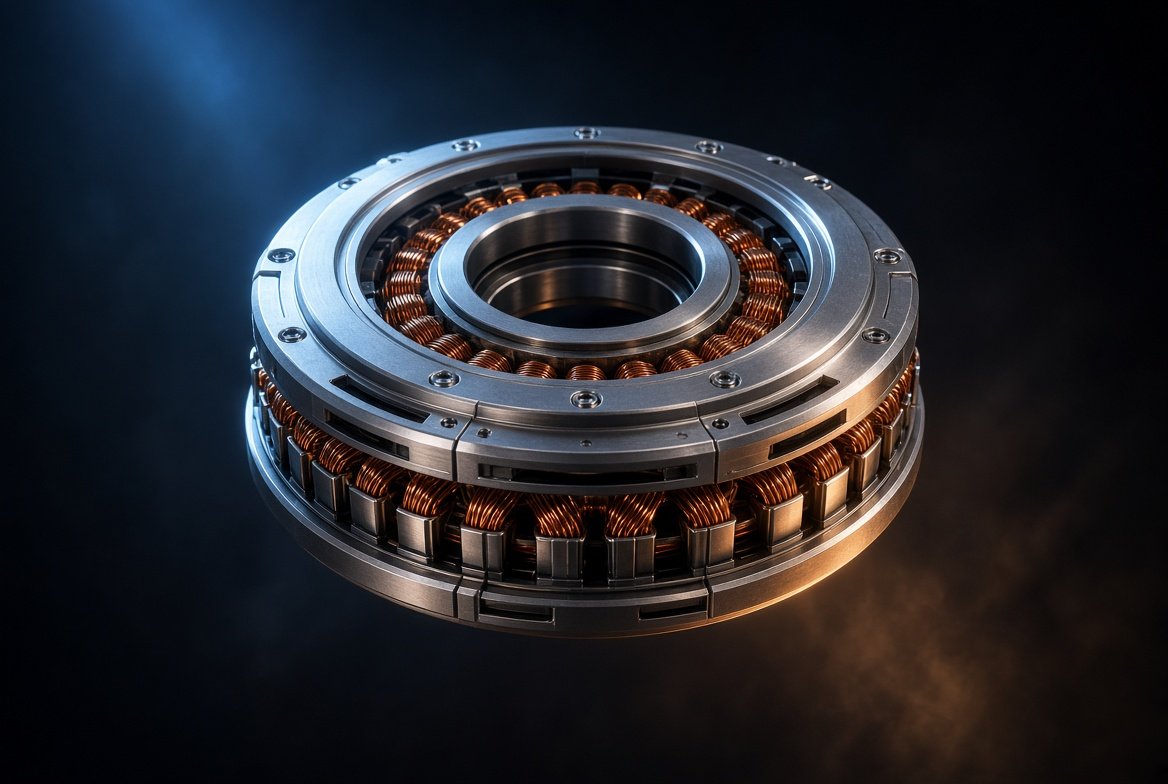
Axial Flux Motor: The Pancake That Made Mercedes Buy a Whole Company
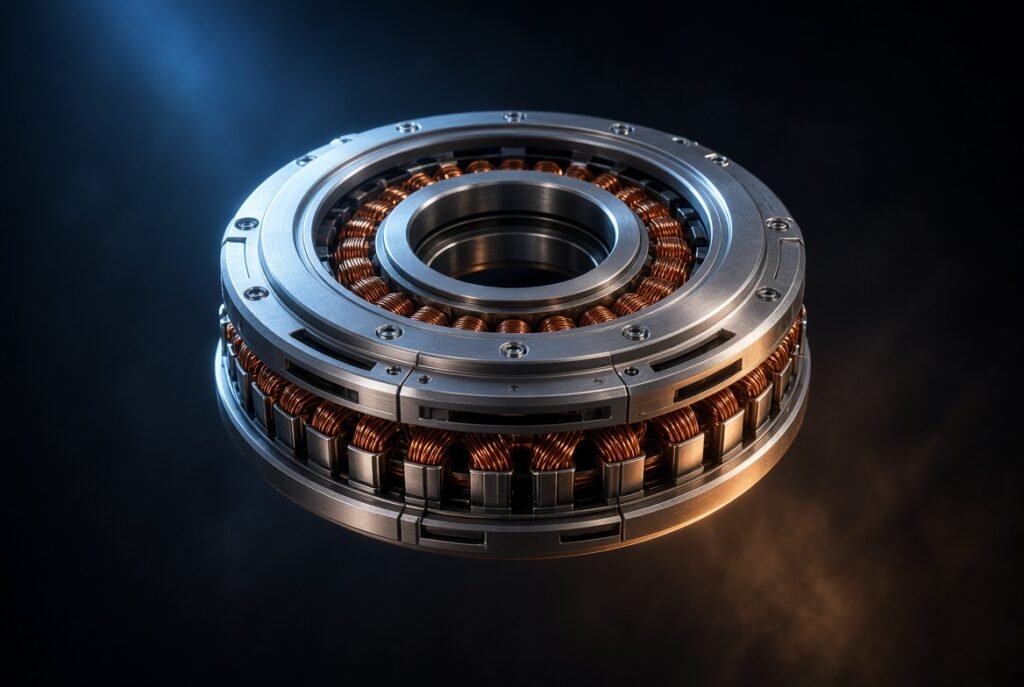
Here is a name most American gearheads have never heard: YASA. It should be on your radar, because the motor this little Oxford outfit builds is quietly showing up in the wildest hybrids money can buy, and Mercedes-Benz thought enough of it to swallow the entire company in July 2021.
The whole story fits in the palm of your hand. Picture the electric motor in your Tesla or your neighbor’s Lucid Air: shaped like a soda can. Now picture a pancake instead. That is the difference between the radial flux motor in almost every EV on the road and the axial flux motor that has hypercar engineers losing sleep. We are not going to hand you the press release. We are going to tell you what this thing actually is, where it came from, and why you will probably never own one.
The name is the trick
Nobody bothers to explain this, so we will. YASA is not a slick brand invented by a marketing agency. It stands for Yokeless And Segmented Armature. In other words, the company’s name is the exact technical description of why the motor hits so hard. Strip out the stator yoke, the chunk of iron that closes the magnetic circuit in a normal motor, and you drop up to 80 percent of the iron mass. Less iron, less weight, more power density. The entire invention lives in those three words.
Radial versus axial, no engineering degree required
Every electric motor does the same job: a stationary stator makes a magnetic field, a rotor reacts to it and spins. The difference between the two families is where that magnetic flux travels.
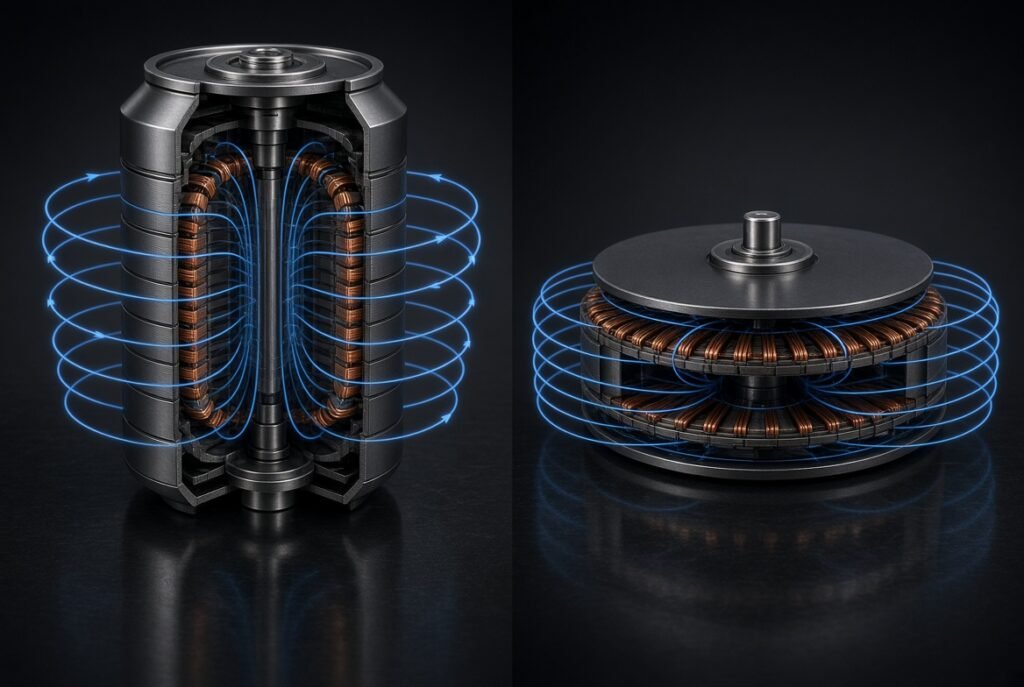
The old-school radial motor is a cylinder, shaped like a soda can. Flux runs perpendicular to the shaft, from the center outward, like the spokes of a wheel. That is what powers roughly 95 percent of EVs and virtually every hybrid on sale, from a Model 3 to a Taycan. It is rugged, cheap, easy to build and decades into refinement. Nothing wrong with it.
The axial motor is a flat pancake. Flux runs parallel to the shaft, along the length of the motor. In YASA’s layout the trick doubles up: two rotors, one on each side of the stator, all three at roughly the same diameter. Here is the part that changes everything, and it is high-school physics. Torque is proportional to rotor diameter, squared. Spin the rotor at a bigger diameter and the same force makes far more torque. Double the diameter, quadruple the torque for the same material. A YASA axial unit puts out up to four times the torque of a comparable radial motor at about half the size and weight. Not magic. Just geometry, used well.
From a broken algorithm to the world’s first hydrogen sports car
The origin story beats any Silicon Valley garage myth. Back in 2005, Oxford University ran an algorithm that assigned tough final-year projects to engineering students. For Tim Woolmer, the algorithm broke. It could not find him a project, so the university told him to write his own brief. He thought hard about what actually interested him, and out of that self-assigned project the motor was born.
The first YASA was not built for a supercar. It was built for the 2008 Morgan LIFECar, an attempt at the world’s first hydrogen sports car. Woolmer and his supervisor, Dr. Malcolm McCulloch, needed a small, powerful, light motor that simply did not exist. So they invented one. In 2009 it spun out of Oxford as a company with 1.45 million pounds and a bet that sounded crazy at the time: go axial while the entire industry sprinted toward radial because radial was the easy road onto the EV bandwagon.
Here is the fact that shuts down anyone who thinks this is brand-new tech: Nikola Tesla patented the axial flux motor in 1889. It took 126 years for the idea to reach a production car, the 2015 Koenigsegg Regera. The geometry is ancient. What was missing were strong permanent magnets and the manufacturing to exploit it. Woolmer did not invent axial flux. He invented a way to make it light and mass-producible.
Where it is already running
This is where it gets serious for the horsepower crowd. YASA is not a lab curiosity. It has been inside some of the planet’s most violent cars for years.
Ferrari was the first volume OEM customer, in 2019, with the SF90 Stradale, followed by the 296 GTB and 296 Speciale. Lamborghini runs axial flux in the V12 Revuelto and the Temerario, which stacks three axial motors behind a twin-turbo V8. McLaren uses one in the Artura. And Koenigsegg was an early adopter with the Regera: two YASA 750s driving the rear wheels directly, plus a YASA 400 up front.
The pattern is obvious: hypercars and ultra-high-performance hybrids. Which is exactly the only place it currently makes sense to pay for this tech. It rattled the competition enough that Koenigsegg engineered its own answer, the Quark motor, with a topology it named Raxial Flux, a blend of axial and radial to grab the best of both. When a hypercar maker starts coining words to beat you, you have touched something big.
The run that stunned the industry
In 2025 YASA spent the year breaking its own records within months. Order matters here, because it is easy to garble.
In the summer of 2025 it showed a 13.1 kg prototype making 550 kW (738 hp) for a power density of 42 kW/kg, an unofficial world record and nearly double what the rest of the industry called state of the art. In October 2025 came the lighter, refined version at 12.7 kg, and it shattered that mark: 750 kW, over 1,000 hp peak, for 59 kW/kg. A 40 percent jump over its own record in a handful of months. Per YASA CEO Joerg Miska, that triples the density of the best radial motors on the market. These are not two versions of one car; they are two milestones back to back. And it is not simulation. It is hardware on the dyno, with estimated continuous output between 350 and 400 kW.
The bombshell landed in December 2025. YASA put that 750 kW motor inside the wheel. An in-wheel system delivering over 1,000 hp per wheel, paired with a 15 kg, 1,500 kW inverter. The company calls it the world’s first mass-neutral in-wheel motor, meaning it does not add the unsprung weight that killed every earlier attempt to stuff a motor in a wheel. Founder Tim Woolmer puts it flatly: until now, in-wheel tech was too heavy, low on torque, not powerful enough.
Now the honest caveat, because plenty of outlets oversell this: that in-wheel unit is a lab prototype. It runs on the dyno, not in production, and there is no production date. If it lands, it rewrites what an EV can be. For now it is a very promising promise, not a car you can buy.
Why it is so hard to cool
There is a reason axial flux did not bury radial twenty years ago, and cost is only half of it. The other half is heat. Pack that much power into a thin disc and dumping the heat becomes a brutal engineering problem. The industry has climbed a ladder of cooling tricks: a water-glycol jacket around the stator, simple but limited; direct oil spray onto the end windings, as in a Tesla Plaid or Porsche Taycan; and at the top, direct conductor cooling, where coolant flows inside hollow copper conductors, a technique that until recently lived only in Formula 1 KERS hardware. YASA leans on slot cooling and advanced thermal management for a simple reason: solve the heat or the whole power-density advantage stays on paper. A motor that makes 750 kW for three seconds and then chokes is useless. The magic is in those 350 to 400 kW it can hold.
To put the numbers in American terms: McLaren’s Artura runs a 15.4 kg axial unit making 70 kW peak in its torque-fill role next to the V6. A Lucid Air drive unit, motor, inverter, transmission and differential together, delivers roughly 485 kW peak from 74 kg, with the motor spinning to 20,000 rpm. YASA’s 12.7 kg demonstrator making 750 kW peak is playing a different sport entirely. That is the gap between a very good production EV motor and a laboratory record chasing aerospace territory.
The spin-off that flew away
Few people connect this dot. In 2021, the same year Mercedes bought in, YASA spun off a sister company, Evolito, to take the tech into the air. It makes total sense. If there is anywhere every gram matters more than in a car, it is an electric aircraft. Woolmer’s target for aviation motors is 50 kW/kg, the number that makes real electric flight viable. That the 2025 car prototype already peaks near 59 kW/kg tells you where this is heading. The motor that started in a hydrogen car almost nobody remembers could end up moving airplanes. Not bad for a project that exists because a university algorithm crashed.
The barrier the brochure skips
Now the fine print, and it is truck-sized: cost. The axial motor demands far more precise manufacturing than the radial. YASA had to build its own robotic machines to make these motors, in its own words, it had to “develop the machines that develop the machine.” Add materials with a less mature supply chain. Radial has been built for decades on assembly lines amortized to the last cent. Axial has not. That is why it stays penned inside the high-performance world.
Translated: no axial flux motor in your next commuter EV. For now it is technology for cars that cost more than a house. YASA is scaling, from roughly 1,000 motors a year five years ago to a new 60,000-square-foot Oxford plant with capacity for 25,000 units, with its 2018 factory already sized for up to 100,000, but scaling production is not the same as making it cheap enough for a Corolla.
Radial, meanwhile, is not going anywhere. Reliable, cheap, simple to service. For the vast majority of street EVs it remains the right answer. Axial is the precision scalpel. Radial is the pocketknife that does almost everything.
The NEB verdict
YASA’s axial flux motor is the most interesting evolution in electric propulsion in a decade, and it is not marketing. These are cars that exist, run and break records. But do not let anyone sell you on it landing in your garage tomorrow. For the next several years this lives in six-figure territory, reserved for whoever can afford a hypercar. The real revolution will not be a 59 kW/kg record on an Oxford dyno. It will be the day, if it comes, when this pancake costs the same as the soda can under your hood right now. Until then, it is the most expensive, most brilliant toy in the business.
Unplug and enjoy.