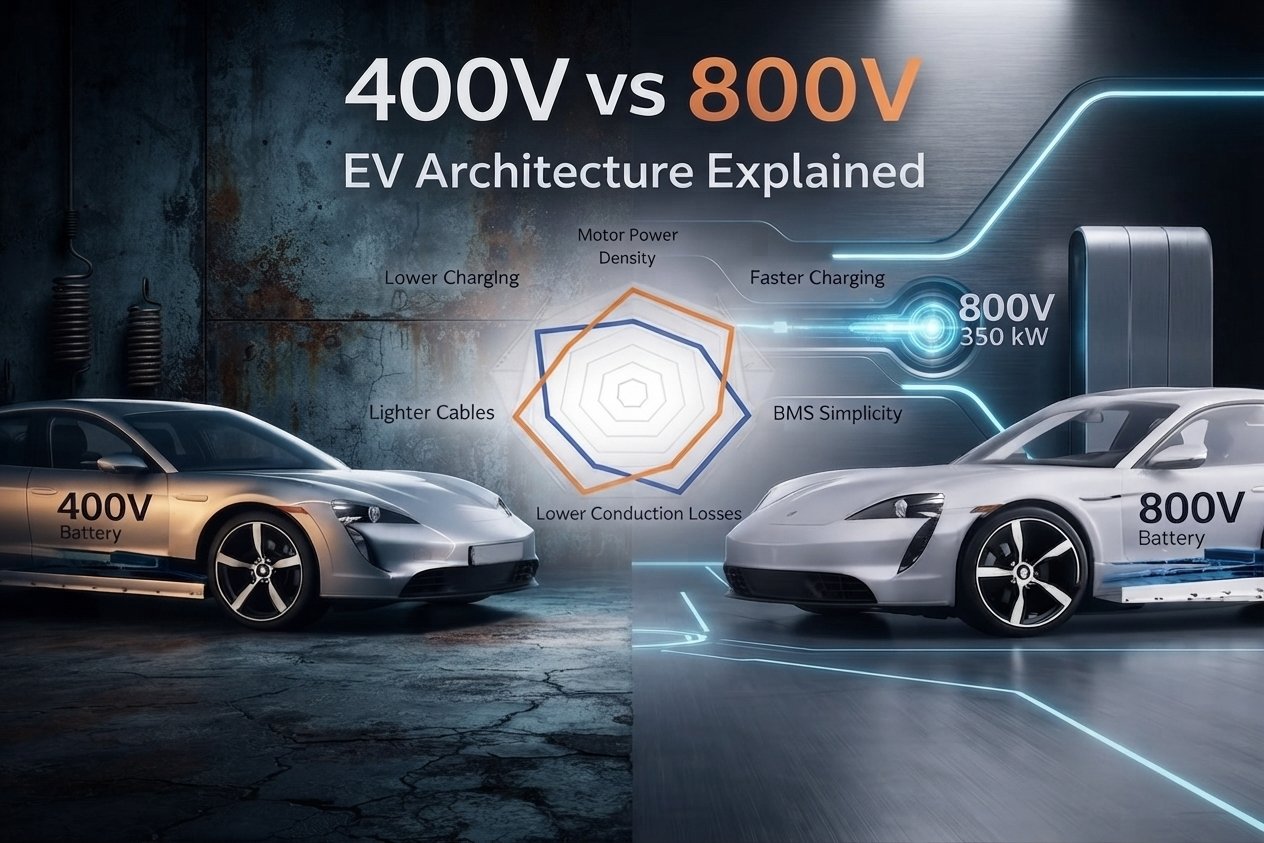
400V vs 800V in EVs: What Actually Changes, and Why It Doesn’t Always Charge Faster
The “800 volts” they sell you as ultra-fast charging guarantees absolutely nothing. And there’s a Tesla that proves it.
It’s become the new spec-sheet medal. “800-volt architecture!” they announce, as if those three figures were automatic shorthand for charging in a flash. And yes, the architecture’s voltage matters, a lot, but not for the reason most people think, and not in the magic way the ad implies. A badly executed 800-volt car can charge worse than a well-built 400-volt one, and I’ll prove it with names attached, including one from Tesla’s own lineup. Let’s pop the hood on voltage.
The physics, in one line that explains everything
The whole 400-versus-800-volt story fits in a high-school formula: power equals voltage times current. Power equals volts times amps. If you want to push a lot of power into the battery to charge fast, you have only two roads: raise the voltage, or raise the current, the amps.
And here’s the trick, because those two roads aren’t equal. Current has a brutal enemy called heat. Energy losses in a cable grow with the square of the current, the famous I²R law. Translation: double the amps and the heat losses multiply by four. That’s why cranking up amperage to charge fast is a dead end: you need monstrously thick cables, heavy cooling, and you still waste a pile of energy as heat.
The 800-volt play is elegant. For the same power, if you double the voltage, you need half the current. And because losses scale with the square of the current, cutting amperage in half slashes heat by 75%. With half the amps you can use thinner, lighter, cheaper cables, smaller components, and above all sustain very high power for longer without everything cooking itself. Cutting conductor size can trim total cable volume by up to a third, which is weight the car no longer has to haul around. There’s a catch buried in that win, though: higher voltage demands thicker insulation and tighter safety engineering, because 800 volts is a lot less forgiving to work on than 400. Mechanics need extra training, and the components carry a premium. That’s the real prize of 800 volts, and it’s not free.
Before going on, a detail almost nobody clears up: a “400-volt” system isn’t exactly 400, and an “800” isn’t exactly 800. The label is a range. A 400-volt system actually swings between roughly 300 and 500 volts depending on state of charge, temperature, and battery age; an 800-volt one runs around 700 to 900. The voltage rises and falls constantly as you drive and charge. When someone says “400 volts,” they mean a family of architecture, not a fixed number.
What an 800-volt car really wins (beyond charging)
Before dismantling the charging myth, let’s be fair to the tech, because it has real advantages almost nobody spells out.
The lower current doesn’t just help when charging. It benefits the car’s entire electrical system: the inverter, the motor controller, the internal wiring. They all work with less current and therefore fewer resistive losses. Some manufacturers put the efficiency gain from the voltage architecture alone at 2-3%, and that translates straight into real range, especially at highway speeds where power demand is highest. Less copper, less weight, more compact components, and a hair more range. On paper, 800-volt architecture is simply better engineering. The problem is what happens when that paper meets the road.
The myth: “800 volts = charges twice as fast”
Here’s where we pop the balloon. The popular belief is that an 800-volt car charges twice as fast as a 400-volt one because it has double the voltage. False. It’s not a linear relationship, and it’s not magic.
The real reason an 800-volt car usually charges faster is subtler and more down-to-earth: most public chargers are limited by current, not voltage. Many stations top out around 500 amps. At 400 volts, those 500 amps give you at most around 200 kW. But at 800 volts, those same 500 amps give you double the power. The 800-volt car doesn’t charge faster because it’s magic, but because it dodges the charger’s amperage bottleneck. Put it this way: plug a 400-volt car and an 800-volt car into the same station capped at 250 amps, and the 800-volt car can pull double the power from that identical pillar without the cable suffering more. It’s not that the charger “wants” to give the 800-volt car more; it’s that the physics of amperage lets it. The 400-volt car hits its ceiling far sooner. That nuance changes everything, because it means the advantage depends entirely on the charger in front of you.
The proof that voltage isn’t everything: names attached
Now the data that dismantles the marketing, because facts are stubborn.
Start with the most common misunderstanding. Some cars are marketed as “800 volts” and, in practice, charge in most places like a plain old 400-volt car. The Tesla Cybertruck illustrates it well: its pack is 800 volts, but it splits electronically into two 400-volt halves so it can charge on the old V3 Superchargers, which only deliver 400 volts. It only unleashes its full 800-volt potential on the next-gen V4 stations. It’s a smart engineering trick, the same one Chinese phones use for ultra-fast charging, but it makes one thing clear: the “800 volts” label doesn’t describe how your car will charge at the electric pump in your town, only how it charges in the best possible case. And that best case, as we’ll see, is rarely the one you actually meet.
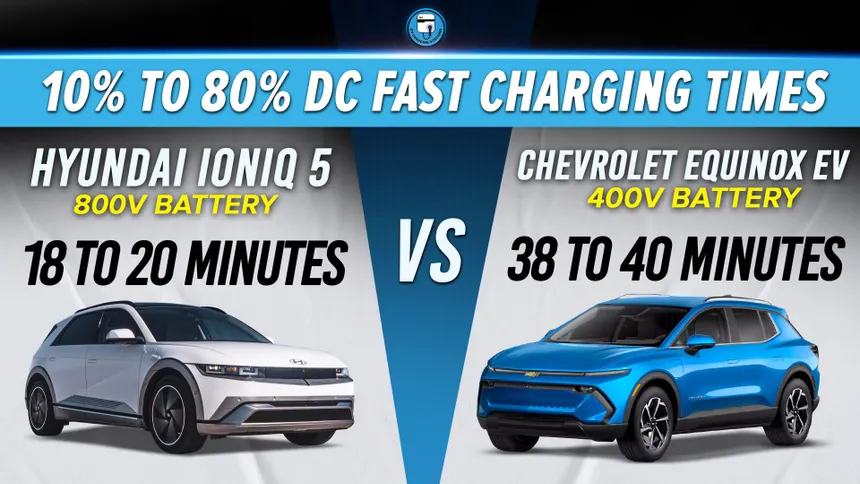
Now the flip side. In a real charging-speed ranking of EVs sold in the U.S., the top spots are an absolute lockout by the 800-volt cars from Hyundai, Kia, and Porsche. The first Tesla, a 400-volt Model 3 Long Range, shows up in tenth place, because its architecture won’t let it sustain more than about 136 kW average, while the Koreans consistently hold 200 kW or more. That gap is real: the Ioniq 6 sustained around 210 kW average through the session while the Model 3 peaked higher at 251 kW and then sagged to that 136 kW average. The 800-volt car’s whole trick is holding power, not spiking. Point to 800 volts so far. But look at the detail almost nobody flags: that same 400-volt Model 3 is more efficient in energy use per mile than the Ioniq 6 that wins the ranking. The Korean wins the charge on its architecture, but the Tesla spends less energy to move. Careful with the takeaway, because it’s easy to draw the wrong one: the Tesla’s efficiency doesn’t come from running 400 volts, it comes from other levers (aerodynamics, weight, thermal management, tightly tuned power electronics) where Tesla pushes harder. Voltage alone makes you neither more nor less efficient. The real lesson is that charging and consumption are separate fights: 800 volts helps the first, and whoever wants to win the second has to grind on everything else. Voltage is one piece of the puzzle, not the whole puzzle. There’s a deeper irony for American buyers here: Tesla built the most expansive 250 kW fast-charging network on the continent while sticking to 400 volts in its cars for years, so it has the best plugs and, until the Cybertruck, not the architecture to fully exploit ultra-high-power sites. The Koreans had the architecture and, for a while, nowhere near enough places to use it. Hardware and network rarely arrive in the same hands at the same time.
The bottleneck nobody mentions when you sign: infrastructure
Here’s the biggest fine print of all, the one that can turn your shiny 800-volt car into a 400-volt car in disguise.
Four hundred volts wasn’t a whim or a historical error: it was the standard that let manufacturers develop cells and components fast and at scale in the early EVs, from the Nissan Leaf onward, back when nobody was asking to charge in fifteen minutes. The entire public charging network was built around those 400 volts. When you plug an 800-volt car into an old 400-volt charger, the car has to use an onboard DC-DC converter to step up the voltage, and speed is capped by whatever that station delivers. That boost hardware costs money and adds weight, a tax the 800-volt car pays precisely so it isn’t crippled on the older network it will meet most often. Meaning: your 800-volt car only unleashes its superpower on modern high-power chargers, the 200-to-350 kW ones that are still a minority.
Coverage of those next-gen chargers (networks like Electrify America and Tesla’s V4 Superchargers) is growing fast but stays concentrated on major corridors and big cities. And the number that puts it all in perspective: in 2025, cars with 800-volt architecture were only about 12% of the market, up from 2% shortly before. Growing like crazy, yes, but the overwhelming majority of the fleet, Tesla included, is still 400 volts. Buying an 800-volt car to always charge in a town with no ultra-fast charger for 60 miles is paying for a superpower you’ll never use.
What’s coming: the thousand-volt war
In case 800 volts felt like the ceiling, China is already in another league. BYD unveiled its Super e platform in March 2025 with a 1,000-volt architecture, a 1,000-amp charging current, and a 10C charge rate, and its first cars, the Han L and Tang L, are already on sale. And this isn’t brochure theory: real tests filmed in China have shown peaks brushing a full megawatt and 10-to-70% charges in around six minutes, with 400 km of range (Chinese cycle) recovered in five. A motor spinning past 30,000 rpm rounds out the show.
But here’s the catch that confirms everything this article has said: that megawatt only exists on BYD’s own chargers, the Megawatt Flash Charging stations the brand is rolling out across China by the thousand. Plug that same Han L into a conventional charger and it charges around 270 kW, like any other powerful car. The record-setting architecture is worth nothing without the record-setting pillar behind it. Other Chinese makers like XPeng and NIO have long been pushing 500 kW chargers and curves that drop 10-to-80% to twelve minutes. The voltage frontier is moving, and moving fast, and neither Europe nor the U.S. is setting the pace: whoever’s leading today sits in Shenzhen, not Stuttgart or Detroit. For an American industry already behind on cheap batteries, it’s one more front opening up.
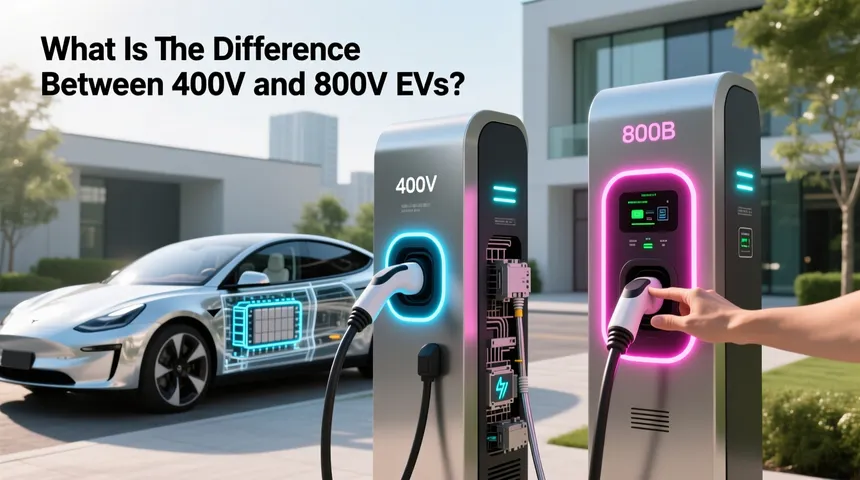
So do you care whether it’s 400 or 800 volts?
Depends on how you live with the car, and this time the answer is clearer than the marketing wants.
If you charge at home most nights and use the car day to day, the architecture’s voltage barely matters to you: the real-life difference is minimal, and a 400-volt car with a good home charger will feel flawless. What rules there is real range, comfort, and price, not volts.
If instead you take a lot of long trips and live off public fast charging, then yes, 800 volts can meaningfully cut your stop time, but only if you have 200-to-350 kW chargers on your routes. Without that infrastructure, the superpower stays asleep, and you’ve paid extra for boost hardware and thicker cabling to charge at the same speed as the 400-volt car in the next stall.
Here’s the closing shot, and I won’t soften it: “800 volts” has become a prestige sticker plenty of people buy without understanding what they’re buying. It’s not a magic number that guarantees anything on its own. It’s a good engineering decision whose real benefit depends on the car’s battery curve and the chargers you actually visit. Next time a salesman waves “800 volts” at you like gold, ask the two questions that deflate the trick: fine, and how long does it really take from 10 to 80%, and on which charger? Because voltage doesn’t charge your car. The whole system does, and the plug in front of you.
Unplug and enjoy.